


A groundbreaking technology has been unveiled that improves the efficiency of thermoelectric materials, which are key in converting waste heat into electricity, by altering their geometry to resemble an hourglass. Unlike previous research that solely depended on the material properties of thermoelectric substances, this new approach is expected to have widespread applications in thermoelectric power generation.

Credit: POSTECH
A groundbreaking technology has been unveiled that improves the efficiency of thermoelectric materials, which are key in converting waste heat into electricity, by altering their geometry to resemble an hourglass. Unlike previous research that solely depended on the material properties of thermoelectric substances, this new approach is expected to have widespread applications in thermoelectric power generation.
The National Research Foundation of Korea (Chairman Lee Kwang-bok) announced that a joint research team, led by Professor Jae Sung Son of POSTECH and Saniya LeBlanc of George Washington University, has successfully developed a new geometry for thermoelectric materials—previously confined to cuboid shapes—through geometric design and 3D printing processes. This new design significantly enhances power generation efficiency.
Thermoelectric technology, as the name suggests, is a technology that converts heat into electricity. It is gaining attention as a sustainable renewable energy source because it can convert heat generated by factories, car engines, or even human body heat into electricity. Thermoelectric materials, which are central to thermoelectric technology, are typically made from solid thermoelectric semiconductor materials. Up until now, research on thermoelectric generators has focused on improving the inherent thermoelectric material properties (ZT). However, despite improvements in ZT, the efficiency of thermoelectric generators has not reached a level practical for everyday use, necessitating a new approach beyond just enhancing material properties.
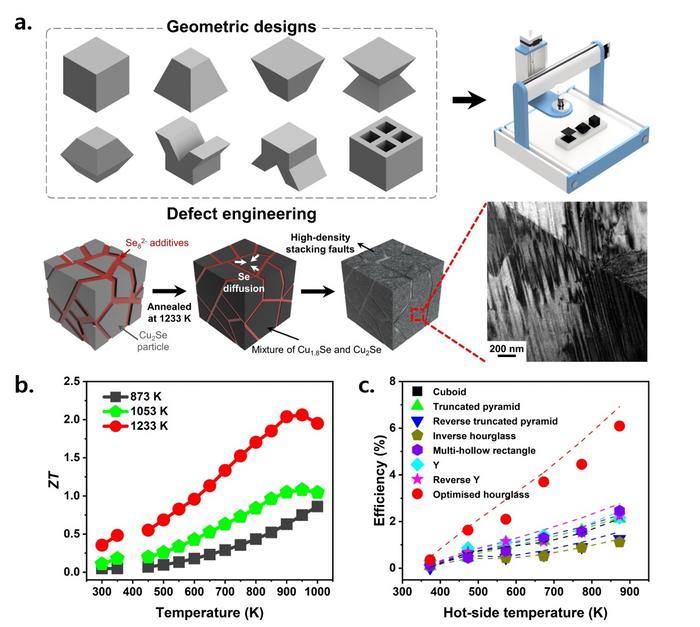
The joint research team has demonstrated through this study that simply changing the geometry and composition of thermoelectric materials can maximize power generation efficiency. By simulating eight different geometric structures, including the traditional cuboid shape and the hourglass shape, and measuring the power generation efficiency of each, the team confirmed that the hourglass consistently outperformed others under all power generation conditions. The research team further advanced 3D printing processes capable of producing complex-shaped thermoelectric materials, creating high-density micro-layered defects within the material to minimize thermal conductivity and increase the thermoelectric performance index (ZT) to 2.0. This is the highest value achieved for thermoelectric materials produced via 3D printing.
Based on these experiments, the team fabricated thermoelectric generators using the eight different structures and measured their efficiency, finding that the hourglass-shaped generator was approximately 3.6 times more efficient than the traditional rectangular-based generator.
Professor Jae Sung Son stated, “This research is the first instance where efficiency has been improved by three-dimensional geometry of the material that controlled thermal and electrical transport, instead of conventional microstructure-focused research on thermoelectric materials. It is expected that this approach can be universally applied to all thermoelectric materials and can also be utilized in thermoelectric cooling technologies.”
This achievement, supported by the Mid-Career Researcher Program and Nano and Materials Technology Development Program under the Ministry of Science and ICT and the National Research Foundation of Korea, was published online in the international journal Nature Energy on July 19.
Journal
Nature Energy
Article Title
Geometric design of Cu2Se-based thermoelectric materials for enhancing power generation
Article Publication Date
19-Jul-2024
Cite Scienmag News
Reid Dalton. (August 16, 2024). Revolutionizing thermoelectric technology: Hourglass-shaped materials achieve a 360% efficiency boost. Scienmag. https://scienmag.com/revolutionizing-thermoelectric-technology-hourglass-shaped-materials-achieve-a-360-efficiency-boost/
Reid Dalton. "Revolutionizing thermoelectric technology: Hourglass-shaped materials achieve a 360% efficiency boost." Scienmag, 16 August 2024, https://scienmag.com/revolutionizing-thermoelectric-technology-hourglass-shaped-materials-achieve-a-360-efficiency-boost/. Accessed 4 September 2026.
Reid Dalton. "Revolutionizing thermoelectric technology: Hourglass-shaped materials achieve a 360% efficiency boost." Scienmag. August 16, 2024. https://scienmag.com/revolutionizing-thermoelectric-technology-hourglass-shaped-materials-achieve-a-360-efficiency-boost/

