


Polyurethane (PUR) is an indispensable plastic material used in mattresses, insulation in refrigerators and buildings, shoes, cars, airplanes, wind turbine blades, cables, and much more. It could be called a wonder material if it weren’t also an environmental and climate burden. Most of the PUR products discarded worldwide end up being incinerated or dumped in landfills.

Credit: Thomas Balle Bech, Aarhus University
Researchers discover smarter way to recycle polyurethane
Researchers at Aarhus University have found a better method to recycle polyurethane foam from items like mattresses. This is great news for the budding industry that aims to chemically recover the original components of the material – making their products cheaper and better.
Polyurethane (PUR) is an indispensable plastic material used in mattresses, insulation in refrigerators and buildings, shoes, cars, airplanes, wind turbine blades, cables, and much more. It could be called a wonder material if it weren’t also an environmental and climate burden. Most of the PUR products discarded worldwide end up being incinerated or dumped in landfills.
This is problematic because the main components of the material are primarily extracted from fossil oil. And we’re talking about significant quantities. In 2022, the global market for PUR reached almost 26 million tons, and a forecast for 2030 predicts nearly 31.3 million tons, with about 60% being foam in various forms.
However, there is a small but growing industry that chemically breaks down (depolymerizes) PUR into its original main components, polyol and isocyanate, with the aim of reusing them as raw materials in new PUR products.
Still, there is a long way to go before their output can actually compete with “virgin” materials. It is expensive to separate and purify the desired elements.
Breaking down and separating in one go
This is where a research team from Aarhus University comes in with a smart idea. They base their method on what the companies in question already use, namely breaking down PUR foam with acid (acidolysis).
But the companies do not separate the broken-down PUR into polyol and isocyanate. This results in a mixture that cannot be directly recycled but requires their customers to use new recipes.
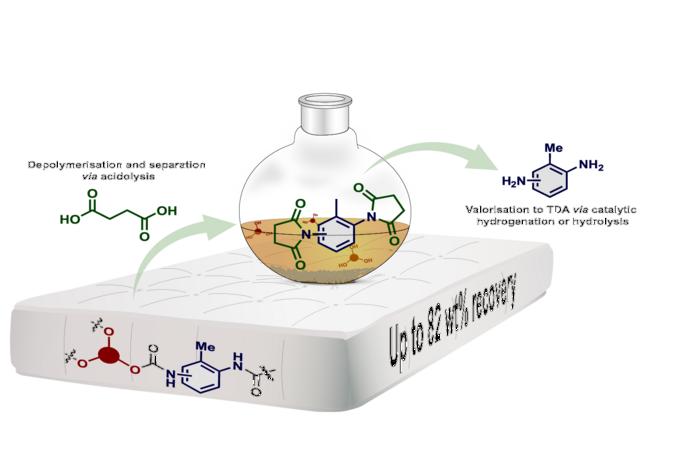
The AU researchers are not only able to break down PUR and separate the two main components – they can do it in one go. They heat flexible PUR foam to 220°C in a reactor with a bit of succinic acid (see fact box). Afterwards, they use a filter that catches one material and lets the other pass through.
It is the polyols that pass through, and they do so in a quality comparable to virgin polyol, making it possible to use them in new production of polyurethane. The solid part of the product mixture that is filtered out is transformed into a so-called diamine in a simple hydrolysis process, which is used in the production of isocyanates and thus PUR.
In this way, the researchers are able to recover up to 82 weight percent of the original material from flexible PUR foam – used in mattresses – as two separate fractions of diamines and polyols. The researchers have recently published their findings in the scientific journal Green Chemistry.
Enormous potential in the industry
“The method is easy to scale up,” points out one of the study’s authors, Steffan Kvist Kristensen, assistant professor at the Interdisciplinary Nanoscience Center (iNANO) at Aarhus University.
He sees enormous potential for recycling the PUR foam waste at the factories that use it as raw material (slabstock) in their production.
“But the prospect of also handling PUR waste from consumers requires further development,” he adds.
… but still a long way to go to a circular economy
Manufacturers in the PUR industry each use unique formulae to achieve specific material properties for their products.
Therefore, a number of challenges need to be solved before a real economy in recycling polyurethane can be achieved:
– Waste sorting
– Logistics
– Sorting PUR into types
Depolymerization is thus only a small part of the solution.
Not just soft foam
AU researchers have also tested the combination of acidolysis and hydrolysis on regenerated PUR foam and rigid PUR foam. And it works.
But the paths to a circular economy are even longer here.
Rigid PUR foam is primarily used as insulation materials, but the endeavour to transform it into valuable raw materials is still in its infancy.
Right now, the researchers are testing the new technology on other polyurethane materials to see how these can be recycled. They are also investigating how the dicarboxylic acid, which is part of the process, can be reused. Additionally, they will test the recycled materials to create new products to show that the technology can truly create a circular economy.
FACTS:
Polyurethane is typically created in a chemical reaction between the main components polyol and isocyanate, which are mostly derived from fossil oil. Polyurethane is a polymer (a long chain of molecules), so when talking about chemically breaking down polyurethane, it is called depolymerization.
Succinic acid is a natural acid, an antioxidant that plays an important role in the body’s energy production. It is used both as a food additive and as a starting material for several types of plastics. In this case, succinic acid can break down polyurethane (PUR) without the use of other chemicals.
Journal
Green Chemistry
Method of Research
Experimental study
Subject of Research
Not applicable
Article Title
Chemical separation of polyurethane via acidolysis – combining acidolysis with hydrolysis for valorisation of aromatic amines
Article Publication Date
27-Jun-2024
COI Statement
There are no conflicts to declare.
Cite Scienmag News
Denise Maddox. (August 16, 2024). Researchers discover smarter way to recycle polyurethane. Scienmag. https://scienmag.com/researchers-discover-smarter-way-to-recycle-polyurethane/
Denise Maddox. "Researchers discover smarter way to recycle polyurethane." Scienmag, 16 August 2024, https://scienmag.com/researchers-discover-smarter-way-to-recycle-polyurethane/. Accessed 4 September 2026.
Denise Maddox. "Researchers discover smarter way to recycle polyurethane." Scienmag. August 16, 2024. https://scienmag.com/researchers-discover-smarter-way-to-recycle-polyurethane/

