


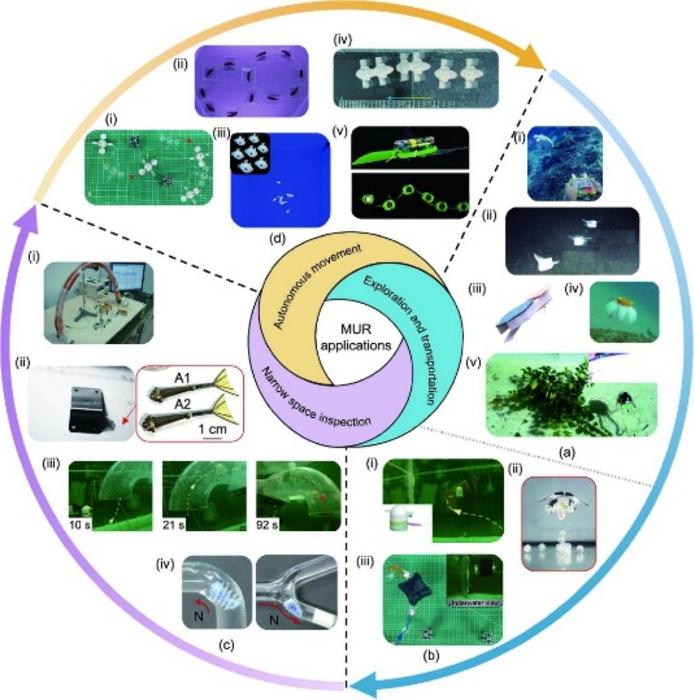
Miniature Underwater Robots (MURs) are at the forefront of a technological revolution, redefining our understanding and exploration of aquatic environments. As the demand for underwater exploration intensifies, researchers are rigorously investigating the actuation and locomotion mechanisms that enable these robots to navigate the challenges posed by underwater conditions. One of the foremost hurdles that engineers face is the efficiency of propulsion in highly resistive water. Unlike their aerial and terrestrial counterparts, MURs confront substantial drag forces that not only complicate movement but also necessitate innovative solutions aimed at optimizing energy consumption and enhancing maneuverability.
Traditional propulsion methods, such as propellers and jet propulsion, have established themselves as the backbone of underwater vehicle designs over the decades. However, these conventional systems often struggle with critical engravings of miniaturization and energy efficiency when applied in the context of miniature robots. Researchers have thus turned to nature for inspiration, developing bio-inspired propulsion systems that mimic the swimming patterns of marine organisms. These designs promise not only to enhance the agility of underwater robots but also to provide stealth and energy efficiency attributes that are indispensable for long-duration missions.
The development of soft-bodied actuators is a key progress in this field. By integrating flexible and adaptive components into the design of MURs, robots can respond dynamically to their surroundings. This adaptability is crucial in environments that are not only constrained but also unpredictable. Recent innovations in soft robotics have showcased the potential of these compliant materials, allowing robots to operate effectively amidst various underwater pressures while maintaining energy efficiency, a crucial aspect of extended exploration missions.
Despite these promising advancements, a range of challenges presents potential pitfalls in miniature underwater robotics. A significant obstacle lies in the effort to miniaturize actuation systems whilst ensuring power output remains viable. Smaller robots are particularly disadvantaged when it comes to onboard energy storage; the limited battery capacities often impede effective operation across extended periods, particularly in remote underwater explorations where recharging or refueling presents a daunting task. This critical issue encourages ongoing research into ultra-low-power actuators and pioneering energy-harvesting technologies that could augment the capabilities of underwater robots.
Navigating the unpredictable currents and fluctuating water conditions adds another layer of complexity to MUR functionality. The ability to achieve precise movement and stable locomotion is paramount, as erratic currents can disrupt navigational accuracy and efficacy. Cutting-edge research is currently gravitating towards advanced control strategies that leverage reinforcement learning-based adaptive techniques and distributed swarm intelligence. These methodologies could empower MURs to exhibit autonomous navigation capabilities, adapting fluidly to the dynamic underwater environment, thus enhancing their operational utility.
As researchers delve deeper into the complexities of MURs, various promising trajectories for future investigations are emerging. The anticipated integration of artificial intelligence into these robotic systems is seen as a game-changer, significantly enhancing the levels of autonomy achievable by MURs. Innovations in AI-driven motion planning algorithms could result in robots being able to optimize their travel paths while simultaneously minimizing energy consumption. This level of advanced computation and decision-making is expected to take MUR capabilities to new heights, enabling them to operate independently in various underwater ecosystems.
Additionally, the confluence of soft robotics with biohybrid actuation technologies holds the promise of creating robots capable of adapting seamlessly to varying environmental conditions. By harnessing the biomimetic qualities of aquatic organisms, such robots could replicate movements with greater fluidity and responsiveness, further simplifying operation within constricted or challenging marine contexts. The expansion of these technologies could also foster the advancement of swarm robotics, where multiple MURs can coordinate efforts for collective tasks like environmental monitoring, exploration, or data collection.
Beyond their immediate applications in exploration and marine research, MURs present vast potential in various sectors, including environmental monitoring, infrastructure inspection, and even biomedical applications. Their compact design and superior maneuverability render them ideally suited for tasks such as pipeline inspections, ship maintenance, and deep-sea ecological surveys. As the global demand for efficient and intelligent underwater robots escalates, breakthroughs in actuation mechanics and control strategies will undoubtedly be pivotal in propelling the field of underwater robotics toward new milestones.
This ongoing research encapsulates a thorough review of diverse actuation methods, categorizing and evaluating various propulsion techniques utilized in miniature underwater robotics. Each method is analyzed concerning its distinct advantages and limitations, thereby providing a comprehensive appraisal of systems currently in use. By recognizing the potential for future development in soft-bodied actuators and biohybrid swimming mechanisms, the research lays a foundational understanding that could significantly enhance the efficiency and adaptability of underwater robots.
As advancements in miniature underwater robot technology continue to burgeon, they are set to redefine applications across multiple domains, from marine science to healthcare and industrial monitoring. By synergizing soft robotics, cutting-edge AI control systems, and energy-efficient propulsion techniques, the next generation of MURs will likely be capable of achieving autonomous operations in intricately complex underwater realms. This evolution has significant implications, including safeguarding marine ecosystems and improving the efficacy of search-and-rescue missions, while also enhancing the maintenance of underwater infrastructure—a paradigm shift in how humanity explores and interacts with our planet’s aquatic domains.
In summary, the ongoing research encapsulated in the paper titled “Actuation and Locomotion of Miniature Underwater Robots: A Survey” sheds light on the transformative potential of MURs. Researchers Panbing Wang, Xinyu Liu, and Aiguo Song have provided a valuable resource that illustrates the critical challenges and promising advancements in this exciting field of robotics. As we stand at the brink of a new era in underwater exploration, the insights from this research could serve as a beacon guiding future innovations and applications.
Cite Scienmag News
Denise Maddox. (March 26, 2025). Revolutionizing Miniature Underwater Robotics: Breakthroughs in Actuation and Locomotion Technologies. Scienmag. https://scienmag.com/revolutionizing-miniature-underwater-robotics-breakthroughs-in-actuation-and-locomotion-technologies/
Denise Maddox. "Revolutionizing Miniature Underwater Robotics: Breakthroughs in Actuation and Locomotion Technologies." Scienmag, 26 March 2025, https://scienmag.com/revolutionizing-miniature-underwater-robotics-breakthroughs-in-actuation-and-locomotion-technologies/. Accessed 3 September 2026.
Denise Maddox. "Revolutionizing Miniature Underwater Robotics: Breakthroughs in Actuation and Locomotion Technologies." Scienmag. March 26, 2025. https://scienmag.com/revolutionizing-miniature-underwater-robotics-breakthroughs-in-actuation-and-locomotion-technologies/


