


Traditional memory devices are volatile and the current non-volatile ones rely on either ferromagnetic or ferroelectric materials for data storage. In ferromagnetic devices, data is written or stored by aligning magnetic moments, while in ferroelectric devices, data storage relies on the alignment of electric dipoles. However, generating and manipulating magnetic fields is energy-intensive, and in ferroelectric memory devices, reading data destroys the polarized state, requiring the memory cell to be re-writing.

Credit: Tokyo Tech
Traditional memory devices are volatile and the current non-volatile ones rely on either ferromagnetic or ferroelectric materials for data storage. In ferromagnetic devices, data is written or stored by aligning magnetic moments, while in ferroelectric devices, data storage relies on the alignment of electric dipoles. However, generating and manipulating magnetic fields is energy-intensive, and in ferroelectric memory devices, reading data destroys the polarized state, requiring the memory cell to be re-writing.
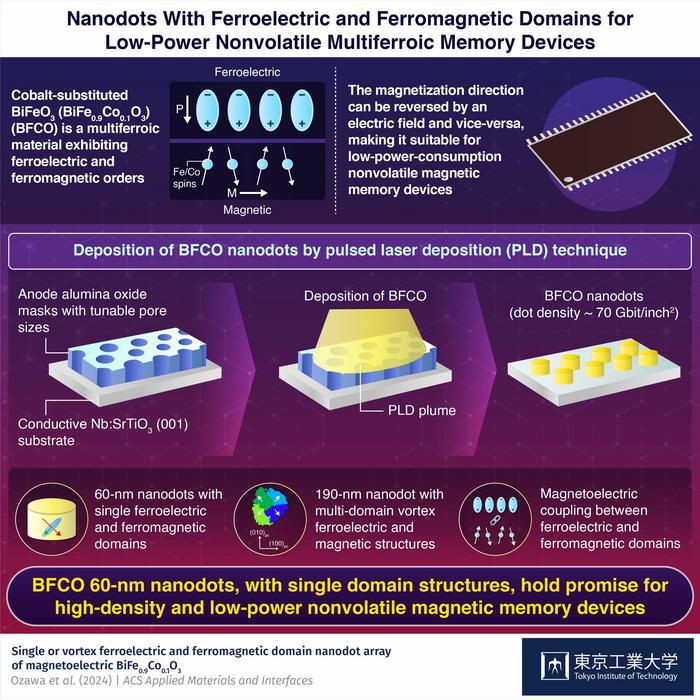
Multiferroic materials, which contain both ferroelectric and ferromagnetic orders, offer a promising solution for more efficient and versatile memory technology. Cobalt-substituted BiFeO3 (BiFe0.9Co0.1O3, BFCO) is a multiferroic material which exhibits strong magnetoelectric coupling, meaning changes in electric polarization affect magnetization. As a result, data can be written using electric fields, which is more energy-efficient than generating magnetic fields, and read using magnetic fields, which avoids the destructive read-out process.
In a significant milestone for multiferroic memory devices, a team of researchers led by Professor Masaki Azuma and Assistant Professor Kei Shigematsu from Tokyo Institute of Technology in Japan has successfully developed nanodots with single ferroelectric and ferromagnetic domains.
“At “Sumitomo Chemical Next-Generation Eco-Friendly Devices Collaborative Research Cluster” within the Institute for Innovative Research at Tokyo Institute of Technology, there is a focus on multiferroic materials that exhibit cross-correlation responses between magnetic and electrical properties based on the principles of strongly correlated electron systems. The center aims to develop materials and processes for next-generation low-power non-volatile magnetic memory devices, as well as to conduct reliability assessments and social implementation,” says Azuma.
In their study published in the journal ACS Applied Materials and Interfaces on April 9, 2024, researchers utilized pulsed laser deposition to deposit multiferroic BFCO onto a conductive Nb:SrTiO3 (001) substrate. They controlled the deposition process by using anodized aluminum oxide (AAO) masks with adjustable pore sizes, resulting in nanodots with diameters of 60 nm and 190 nm.
BFCO is a promising option for low-power, nonvolatile magnetic memory devices as its magnetization direction can be reversed with an electric field. On observing the polarization and magnetization directions using piezoresponse force microscopy and magnetic force microscopy, respectively, the researchers found that the nanodots exhibit correlated ferroelectric and ferromagnetic domain structures.
Interestingly, when comparing nanodots of different sizes, they noticed significant differences. The smaller 60-nm nanodot, made using an oxalic acid AAO mask, showed single ferroelectric and ferromagnetic domains, where the polarization and magnetization directions are uniform throughout. However, the larger 190-nm nanodot, formed using a malonic acid AAO mask, had multi-domain vortex ferroelectric and magnetic structures indicating strong magnetoelectric coupling.
“Such a single-domain structure of ferroelectricity and ferromagnetism would be an ideal platform for investigating BFCO as an electric-field writing magnetic read-out memory device, and multi-domain structures offer a playground for fundamental research,” remarks Shigematsu.
Nonvolatile magnetic memory devices are crucial for various electronic applications as they retain stored information even when power is turned off. With their unique composition of single ferromagnetic and ferroelectric domains, BFCO 60-nm nanodots show great potential for creating magnetic memory devices that require minimal electrical power for writing and reading operations.
Journal
ACS Applied Materials & Interfaces
Method of Research
Experimental study
Subject of Research
Not applicable
Article Title
Single or vortex ferroelectric and ferromagnetic domain nanodot array of magnetoelectric BiFe0.9Co0.1O3
Article Publication Date
9-Apr-2024
Cite Scienmag News
Denise Maddox. (April 26, 2024). Revolutionizing memory technology: multiferroic nanodots for low-power magnetic storage. Scienmag. https://scienmag.com/revolutionizing-memory-technology-multiferroic-nanodots-for-low-power-magnetic-storage/
Denise Maddox. "Revolutionizing memory technology: multiferroic nanodots for low-power magnetic storage." Scienmag, 26 April 2024, https://scienmag.com/revolutionizing-memory-technology-multiferroic-nanodots-for-low-power-magnetic-storage/. Accessed 3 September 2026.
Denise Maddox. "Revolutionizing memory technology: multiferroic nanodots for low-power magnetic storage." Scienmag. April 26, 2024. https://scienmag.com/revolutionizing-memory-technology-multiferroic-nanodots-for-low-power-magnetic-storage/

