


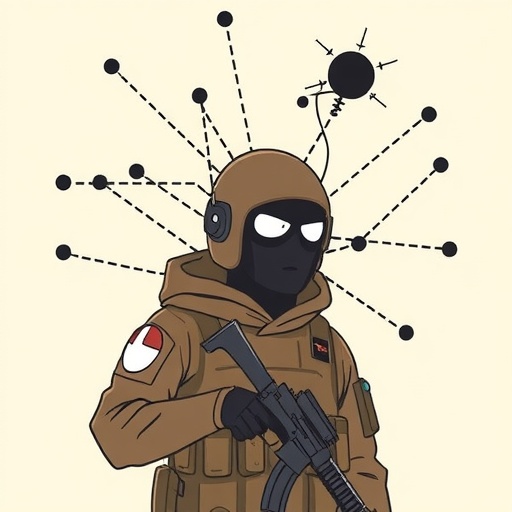
In an era marked by increasingly sophisticated terrorist networks, the imperative to develop advanced disruption methods has never been more urgent. A groundbreaking study titled “Explainable Multi-Agent Learning for Adaptive Terrorist Network Disruption,” published in Scientific Reports in 2026 by Dogan, Prestwich, and O’Sullivan, promises to revolutionize how intelligence agencies and counterterrorism units tackle these hidden threats. This innovative research leverages cutting-edge machine learning techniques to not only predict but adaptively disrupt terror networks with unprecedented precision, all while maintaining transparency and interpretability—features essential for real-world deployment in sensitive and high-stakes environments.
At the heart of this study lies the concept of multi-agent learning, a subset of machine learning where multiple agents operate within an environment, learning both independently and cooperatively to achieve complex goals. The authors incorporate explainability into this framework, addressing one of the most significant hurdles in deploying artificial intelligence in security domains: the black-box nature of many machine learning models. By designing algorithms that reveal their decision-making processes, the research ensures actionable intelligence can be trusted and validated by human operators. Such transparency is pivotal in counterterrorism contexts, where decisions must be justifiable and ethically sound.
The terrorist networks targeted by the system are inherently dynamic, characterized by constantly evolving structures and communication pathways. Traditional static analysis methods often fail to capture these rapid changes, leading to ineffective or outdated disruption strategies. The multi-agent learning system developed here adapts in real-time, continuously updating its understanding of network configurations and communication patterns based on new intelligence inputs. This adaptability mirrors the fluid nature of terrorist organizations, which exploit network flexibility to evade detection and intervention efforts.
In technical detail, the system deploys a set of autonomous agents that simulate various intervention strategies simultaneously. Each agent employs reinforcement learning techniques to evaluate the effectiveness of actions such as isolating key nodes, disrupting communication channels, or targeting influential operatives for surveillance. These agents share insights within a cooperative framework, learning from both successes and failures to optimize overall disruption performance. Such coordination among agents ensures a holistic approach that balances targeted interventions with broader network considerations.
One of the study’s most pioneering aspects is its embedding of explainability within these multi-agent interactions. The algorithms generate interpretable behavioral policies, allowing analysts to trace how specific network disruptions emerge from the agents’ decisions. This interpretability facilitates not only trust but also improved collaboration between human decision-makers and automated systems. For instance, analysts can interrogate the rationale behind targeting particular nodes, assess potential impacts, and refine operational protocols based on AI-generated recommendations.
The dataset underpinning this research is a synthetic yet realistically modeled representation of terrorist networks, incorporating diverse communication modalities, hierarchical structures, and operational tactics drawn from open-source intelligence. This complexity ensures the model’s robustness and generalizability, equipping it to handle multiple threat scenarios. Furthermore, the design anticipates real-world constraints such as incomplete data, noisy signals, and adversarial deception tactics, which are prevalent in intelligence gathering environments.
Central to the success of this approach is the feedback loop created between agents and their operational environment. The agents receive continuous monitoring data, which includes intercepted communications, movement patterns, and social media activity. By applying sophisticated natural language processing and anomaly detection methods, the system flags emergent threats and refines its intervention strategies accordingly. This real-time iterative learning mechanism enables rapid adaptation to the ever-shifting tactics of terrorist organizations.
The implications of deploying such an explainable multi-agent framework extend beyond counterterrorism. Similar adaptive disruption strategies could be utilized to combat organized crime syndicates, cyberterrorism cells, and even pandemic misinformation networks. The universality of the underlying methodology—coupling learning agents with interpretable outputs—opens avenues for broad applications in scenarios where networked adversaries challenge public security.
However, the authors also acknowledge the ethical and privacy considerations inherent in this technology. While multi-agent learning offers potent tools for disruption, it necessitates careful governance to prevent misuse or unjust targeting of individuals. Transparency features play a crucial role in safeguarding rights by enabling oversight and accountability. The study calls for multidisciplinary cooperation, integrating insights from ethics, law enforcement, and computer science to ensure balanced and effective deployment.
Moreover, this research delineates future directions for enhancing the sophistication and reliability of multi-agent disruption systems. These include expanding agent diversity to encompass a wider range of tactics, improving the fidelity of network simulations through deeper integration of human intelligence, and refining explainability mechanisms to cater to different operational roles. By fostering ongoing innovation, the study lays the groundwork for a resilient security apparatus capable of confronting ever-evolving extremist threats.
The potential societal impact of this technology is enormous. By disrupting terrorist networks adaptively and transparently, it promises to reduce the frequency and severity of attacks while preserving civil liberties. Security agencies equipped with these tools could preempt attacks before they materialize, saving lives and stabilizing communities. Additionally, as the system learns from diverse operational theaters, its effectiveness is expected to increase continually, outpacing adversarial adaptations.
Technically, the framework integrates state-of-the-art deep reinforcement learning architectures with graph neural networks that explicitly model relational data inherent in terrorist networks. This combination allows the agents to effectively process complex connectivity patterns and leverage spatial-temporal dependencies—a significant advancement over previous approaches relying solely on static graph analytics or shallow learning models. The seamless orchestration of these technologies ensures comprehensive situational awareness and targeted responsiveness.
In conclusion, Dogan, Prestwich, and O’Sullivan’s research represents a quantum leap in adaptive counterterrorism technology, merging explainability with multi-agent learning to create a powerful, transparent, and responsive disruption toolkit. Its capacity for real-time adaptation, deep interpretability, and robust network modeling sets new standards for protecting societies against clandestine threats. As this methodology matures, it will not only transform counterterrorism but also inspire analogous solutions in diverse security challenges worldwide.
This pioneering work underscores the transformative power of artificial intelligence when harnessed responsibly and with careful attention to ethical imperatives. By advancing tools that enable human-machine symbiosis in the fight against terrorism, this study heralds a new frontier where technology empowers policy and operational decisions—making the world safer, smarter, and more just.
Cite Scienmag News
Blake Davidson. (May 17, 2026). Explainable Multi-Agent Learning Disrupts Terrorist Networks. Scienmag. https://scienmag.com/explainable-multi-agent-learning-disrupts-terrorist-networks/
Blake Davidson. "Explainable Multi-Agent Learning Disrupts Terrorist Networks." Scienmag, 17 May 2026, https://scienmag.com/explainable-multi-agent-learning-disrupts-terrorist-networks/. Accessed 5 September 2026.
Blake Davidson. "Explainable Multi-Agent Learning Disrupts Terrorist Networks." Scienmag. May 17, 2026. https://scienmag.com/explainable-multi-agent-learning-disrupts-terrorist-networks/


