


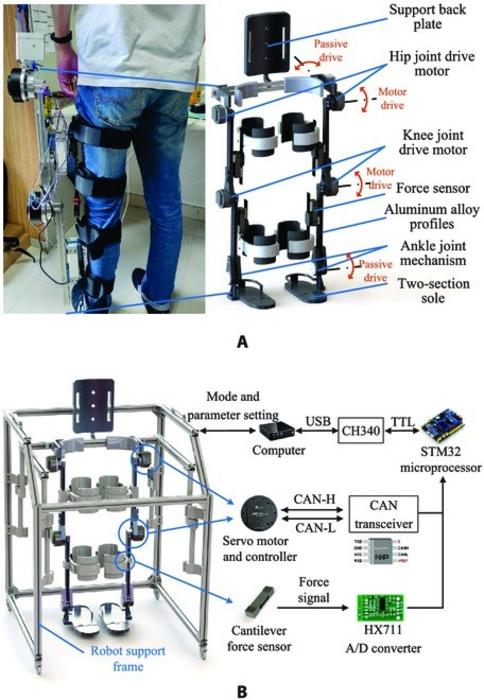
In an era where technology increasingly merges with healthcare to enhance patient outcomes, a groundbreaking study conducted by Fuyang Yu and his colleagues introduces an innovative approach to lower limb rehabilitation. Their research, published in Cyborg Bionic Systems, outlines the development of a lower limb rehabilitation robot designed to significantly improve the safety and effectiveness of gait training through a novel method based on human-robot interaction force measurement.

Credit: Fuyang Yu, School of Artificial Intelligence, University of Chinese Academy of Sciences.
In an era where technology increasingly merges with healthcare to enhance patient outcomes, a groundbreaking study conducted by Fuyang Yu and his colleagues introduces an innovative approach to lower limb rehabilitation. Their research, published in Cyborg Bionic Systems, outlines the development of a lower limb rehabilitation robot designed to significantly improve the safety and effectiveness of gait training through a novel method based on human-robot interaction force measurement.
Rehabilitation robots are not new, but the technology behind them continues to evolve. Traditional models often rely on predetermined gait patterns, which may not suit every patient’s needs, particularly those with some residual muscle strength. Yu and his team’s new robot addresses this by dynamically adjusting its gait in real-time to match the user’s intent and capabilities, a significant shift from the more common, passive training approaches.
This robot, developed through collaborative efforts from institutions including the University of Chinese Academy of Sciences and the Institute of Automation at the Chinese Academy of Sciences, features an array of sensors and a sophisticated control system. These components work together to measure the forces exerted by a patient’s movements and adjust accordingly, ensuring that the robot’s support is neither too little nor too excessive.
The core innovation lies in its adaptive gait training capability. By using face-to-face mounted cantilever beam force sensors, the robot can accurately detect and interpret the subtle forces exerted by the patient during a training session. This data informs a dynamic model that predicts and adapts the robot’s movements in real-time, significantly enhancing the training’s responsiveness and effectiveness.
The research team conducted extensive testing to validate their design. Results from interactive experiments demonstrated that the robot could significantly improve the training experience by responding to the patient’s muscle inputs. This adaptability not only maximizes engagement but also helps to prevent muscle atrophy and improves overall recovery outcomes.
Moreover, this robot represents a promising solution for remote or underserved areas where professional medical and rehabilitation support may be scarce. Its ability to offer personalized training remotely could democratize access to high-quality rehabilitation services, making it a valuable tool in global health contexts.
As healthcare continues to embrace technological advancements, the work of Yu and his team showcases the potential of robotics in enhancing patient care. Their development not only offers new hope for individuals with lower limb impairments but also sets a new standard for the integration of intelligent technology in therapeutic practices. This adaptive approach could well become a cornerstone in the future of physical rehabilitation, paving the way for more responsive and effective treatments.
The paper, “Adaptive Gait Training of a Lower Limb Rehabilitation Robot Based on Human-Robot Interaction Force Measurement ”was published in the journal Cyborg and Bionic Systems on Jun 21, 2024, at DOI:
Journal
Cyborg and Bionic Systems
Cite Scienmag News
Denise Maddox. (August 21, 2024). Revolutionary rehab robotics: A new leap in adaptive gait training. Scienmag. https://scienmag.com/revolutionary-rehab-robotics-a-new-leap-in-adaptive-gait-training/
Denise Maddox. "Revolutionary rehab robotics: A new leap in adaptive gait training." Scienmag, 21 August 2024, https://scienmag.com/revolutionary-rehab-robotics-a-new-leap-in-adaptive-gait-training/. Accessed 3 September 2026.
Denise Maddox. "Revolutionary rehab robotics: A new leap in adaptive gait training." Scienmag. August 21, 2024. https://scienmag.com/revolutionary-rehab-robotics-a-new-leap-in-adaptive-gait-training/

