


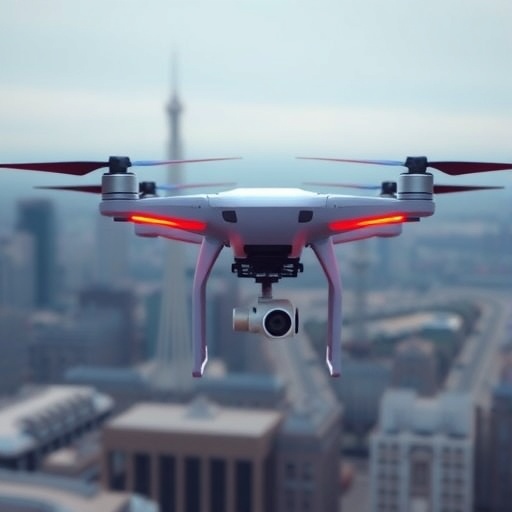
In the current landscape of aerial surveillance and environmental monitoring, the rise of drone technology has opened new frontiers in the field of remote sensing. Among the various capabilities that drones are equipped with, 3D object detection stands out as a crucial feature that enhances the application spectrum across industries. The integration of depth-sensing mechanisms into drones paves the way for more accurate spatial analysis and detection of objects, providing valuable insights into real-time operations. In a groundbreaking study, researchers have introduced the DPETR model, which stands for Depth-aware Position Embedding Transformation for drones, marking a significant step in enhancing drone technology.
The DPETR model emerges as a promising solution to the challenges posed by traditional 3D object detection techniques. Conventional models often struggle with accurately understanding the spatial arrangements of objects, particularly in complex and dynamic environments. The introduction of depth-aware embedding techniques provides a refreshing approach to mitigating these limitations, suggesting that depth perception is integral to effective object detection. By leveraging depth information, DPETR not only improves the accuracy of detection but also enhances the model’s ability to perceive the environment more realistically, a crucial aspect for applications such as disaster response and wildlife monitoring.
At the core of the DPETR model is an innovative image-based depth-aware position embedding transformation mechanism. This method integrates visual data captured by drone-mounted cameras with depth information obtained through advanced sensors. By training the model on a comprehensive dataset, the researchers have been able to optimize its performance, allowing it to differentiate between objects based on their positions relative to the observer—an important factor in real-world scenarios where traditional models might falter.
One of the standout features of the DPETR model is its adaptability to various environmental conditions. This adaptability is critical, as drones often operate in diverse settings ranging from urban landscapes to dense forests. The model’s ability to generate accurate depth maps in these varying conditions enhances its robustness and reliability. In their experiments, the authors demonstrated the model’s capability to maintain high performance across different tasks, showcasing its versatility as a state-of-the-art solution for unmanned aerial vehicle (UAV) object detection.
The incorporation of depth information within the DPETR framework significantly reduces false positives—misidentified objects that can lead to erroneous interpretations of the data. This reduction in false positives is critical for applications where decision-making relies heavily on accurate data interpretation, such as during rescue operations or when monitoring endangered species. The researchers have noted that this improvement stems from a finely-tuned balance between depth estimation and position embedding, a relationship that has often been overlooked in past models.
Furthermore, the research outlines the potential impact of the DPETR model on various industries. For instance, in agriculture, farmers can utilize this advanced detection capability to monitor crop health and detect potential threats such as pests or diseases more effectively. In urban planning, city officials could deploy drones equipped with this technology to gather data on urban development, infrastructure integrity, and population density. The implications extend even further, as industries that rely on logistic efficiencies could significantly enhance their operational processes through improved aerial surveillance.
As the capabilities of drone technology continue to grow, the DPETR model’s introduction marks a new era of depth-aware computing that transcends previous limitations. The importance of embedding depth perception within machine learning models cannot be overstated; as AI systems become increasingly integrated into complex decision-making processes, the sophistication of these systems will depend largely on their understanding of spatial relationships. DPETR symbolizes a crucial advancement in this domain, encouraging future research into depth-aware object detection techniques.
Notably, the model’s creators highlight the importance of ongoing collaborations between technical experts and industry practitioners. By bridging the gap between theoretical advancements and practical applications, the potential for transformative change in how we utilize drone technology becomes greater. The authors advocate for further empirical studies to test the DPETR model in real-world scenarios, which would help refine its algorithms and ensure its effectiveness across various applications.
The journey of the DPETR model from conception to realization illustrates the critical pace of innovation in the field of UAV technology. As drone applications expand and become more sophisticated, the necessity for enhanced detection models like DPETR will also grow. The ongoing evolution in machine learning and AI offers unparalleled opportunities for advancements in object detection, challenging researchers to push the boundaries of what is currently possible.
As a closing reflection, the researchers encourage the community to envision the possibilities that models like DPETR present. They invite collaborations that could explore joint ventures to harness these new technologies further. This inclusion could stimulate more advancements, pushing the industry toward a future where drones play an even more significant role in solving complex challenges across myriad sectors.
In summary, the introduction of the DPETR model represents a pivotal moment in the realm of 3D object detection for UAVs. With its depth-aware capabilities, it not only enhances accuracy but also broadens the scope of potential applications, paving the way for smarter, more efficient drone technology. With ongoing support and research, the full potentials of this model remain to be discovered, signaling exciting opportunities in the evolution of aerial technologies.
Zhou, H., Tuo, H., Jing, Z. et al. DPETR: a new image-based depth-aware position embedding transformation model for UAV 3D object detection.
AS (2025). https://doi.org/10.1007/s42401-025-00415-4
Cite Scienmag News
Denise Maddox. (January 17, 2026). Revolutionary Depth-Aware Model Enhances UAV 3D Detection. Scienmag. https://scienmag.com/revolutionary-depth-aware-model-enhances-uav-3d-detection/
Denise Maddox. "Revolutionary Depth-Aware Model Enhances UAV 3D Detection." Scienmag, 17 January 2026, https://scienmag.com/revolutionary-depth-aware-model-enhances-uav-3d-detection/. Accessed 4 September 2026.
Denise Maddox. "Revolutionary Depth-Aware Model Enhances UAV 3D Detection." Scienmag. January 17, 2026. https://scienmag.com/revolutionary-depth-aware-model-enhances-uav-3d-detection/


