


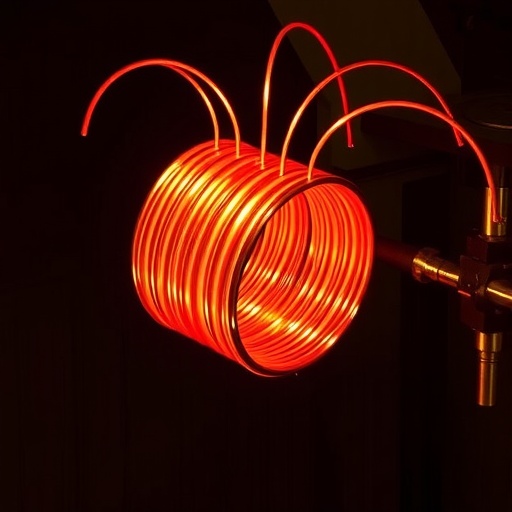
In a groundbreaking advance at the intersection of materials science and environmental sustainability, researchers have unveiled a novel method that significantly enhances the pyrolysis process of waste polyurethane enamelled copper wire. This pioneering work, led by Zhang, W., Zhang, X., Geng, Y., and collaborators, introduces the concept of reversible copper coordination to selectively redirect pyrolysis products, potentially revolutionizing how complex waste streams are valorized and managed.
Pyrolysis, the thermal decomposition of materials in an oxygen-deficient environment, traditionally converts polyurethane-coated copper wires into a heterogeneous mix of gases, liquids, and solids. While recovery of copper is straightforward in some processes, the thermal breakdown products of polyurethane coatings have until now remained a complex, poorly controlled mixture, limiting both the efficiency and environmental safety of waste treatment. The new study’s insight into copper’s ability to reversibly bind during pyrolysis offers nuanced control over these reaction pathways, steering product distributions toward more valuable and environmentally benign outcomes.
At the core of this breakthrough is the observation that copper ions coordinate dynamically with degradation intermediates formed as polyurethane decomposes. This reversible coordination alters the chemical environment and effectively acts as a molecular switch, steering pyrolysis away from producing hazardous byproducts and toward compounds that are easier to capture or reuse. The researchers meticulously characterized these interactions using advanced spectroscopic techniques and molecular modeling, elucidating the complex interplay that governs product selectivity at elevated temperatures.
Such copper coordination phenomena were previously underappreciated in thermal waste conversion paradigms, especially given copper’s prominent role as both a metal substrate and a catalytic center in various chemical reactions. In the context of enamelled copper wires coated with polyurethane—a ubiquitous component in electrical waste streams—the manipulation of these coordination states allows for an unprecedented degree of control over the kinetic and thermodynamic pathways accessible during pyrolysis.
Detailed experimental investigations demonstrated that by modulating conditions such as temperature ramps, atmosphere composition, and reaction time, it was possible to toggle copper coordination states reversibly. This tunability influenced the breakdown routes of polymer chains, steering the formation of gaseous compounds like CO2, H2, and light hydrocarbons, as well as the condensation products in the liquid phase. The precise redirection improved the yield of recyclable copper and enabled the recovery of pyrolytic oils with compositions suitable for further chemical upgrading.
Moreover, this mechanistic understanding opens the door to designing tailored pyrolysis processes that not only mitigate environmental hazards commonly associated with polyurethane combustion—such as toxic amines and persistent organic pollutants—but also enhance resource recovery. By leveraging reversible copper coordination, the process can be fine-tuned to suppress formation of noxious species and favor the production of higher-grade byproducts, aligning with circular economy goals.
The significance of this discovery extends beyond the immediate scope of polyurethane enamelled copper wires. It presents a conceptual advancement that can be generalized to other composite materials where metal-organic interfaces dictate degradation pathways. This approach therefore paves the way for new strategies in waste management technologies, potentially influencing sectors from electronics recycling to polymer-based composite disposal.
On a microscopic level, the copper-polyurethane interface exhibits a dynamic chemical equilibrium during pyrolysis, where ligands from the degrading polymer transiently bind and unbind the copper centers. This equilibrium mediates the energy landscape of polymer bond cleavage events, effectively acting as a catalyst within the breakdown matrix rather than a passive participant. Such dual catalytic and coordination behavior marks a paradigm shift in understanding thermochemical waste treatment reactions.
In addition to experimental work, the team employed computational simulations that validated the reversible binding interactions and mapped energy barriers of competing reaction channels. These insights guided process optimization, emphasizing conditions that maximize desirable product formation and copper recovery while minimizing energy input and deleterious emissions.
The environmental implications are profound. Electrical waste is a growing global concern, with millions of tons generated annually containing valuable metals encased in polymer matrices. Traditional disposal methods either release pollutants or waste valuable resources. By integrating chemical principles of reversible coordination into pyrolysis design, this method offers a scalable and sustainable pathway to recover critical metals and convert polymers into feedstocks or fuels, dramatically reducing landfill volumes and toxic emissions.
Economically, this technology could substantially reduce costs associated with raw material shortages and hazardous waste management. Recovering copper at high purity while simultaneously producing useful chemical fractions generates multiple revenue streams, making recycling financially attractive and environmentally responsible.
This blend of fundamental chemistry and practical innovation echoes the broader scientific quest to harmonize industrial processes with ecological stewardship. It exemplifies how intricate molecular-level interactions, once deciphered and harnessed, translate into tangible advances for sustainability in a resource-constrained world.
Future research is poised to explore wider applications of reversible metal coordination in pyrolysis systems involving other metals such as nickel, iron, or cobalt, and diverse polymer matrices. Scaling up from laboratory reactors to industrial operations will require addressing engineering challenges related to process integration, control, and safety, but the foundational insights offered by the Zhang et al. study lay a robust groundwork.
Additionally, coupling this technique with emerging analytical and real-time monitoring tools could enable adaptive process control, further optimizing product yields and environmental performance. Advances in machine learning might also be leveraged to predict optimal pyrolysis parameters tailored to mixed waste streams.
In essence, the discovery that copper coordination can be reversibly switched to guide pyrolysis product distribution represents a powerful tool to meet the intertwined challenges of waste valorization and environmental protection. It signals a sophisticated level of chemical engineering that moves beyond mere decomposition to intelligent design of material lifecycle pathways.
By redefining how metals within waste mediate chemical transformations, this research not only enhances resource recovery but also inspires rethinking of pyrolysis as a controlled, tunable catalytic reaction rather than a crude thermal treatment. The implications stretch from urban mining strategies to circular economy frameworks, heralding a new chapter in waste management science that promises environmental, economic, and societal benefits.
Ultimately, the work of Zhang and colleagues embodies an exemplar of interdisciplinary innovation, merging inorganic chemistry, polymer science, environmental engineering, and computational modeling to solve pressing global problems. As electronic and plastic waste accumulates at unprecedented scales, such inventive approaches will be indispensable in shaping a sustainable future.
This remarkable achievement in understanding and harnessing reversible copper coordination during pyrolysis sets a promising precedent: by decoding and exploiting subtle chemical dynamics, we can transform complex waste into valuable resources while protecting planetary health.
Cite Scienmag News
Violet Maxwell. (March 4, 2026). Reversible Copper Coordination Alters Waste Wire Pyrolysis. Scienmag. https://scienmag.com/reversible-copper-coordination-alters-waste-wire-pyrolysis/
Violet Maxwell. "Reversible Copper Coordination Alters Waste Wire Pyrolysis." Scienmag, 4 March 2026, https://scienmag.com/reversible-copper-coordination-alters-waste-wire-pyrolysis/. Accessed 4 September 2026.
Violet Maxwell. "Reversible Copper Coordination Alters Waste Wire Pyrolysis." Scienmag. March 4, 2026. https://scienmag.com/reversible-copper-coordination-alters-waste-wire-pyrolysis/


