


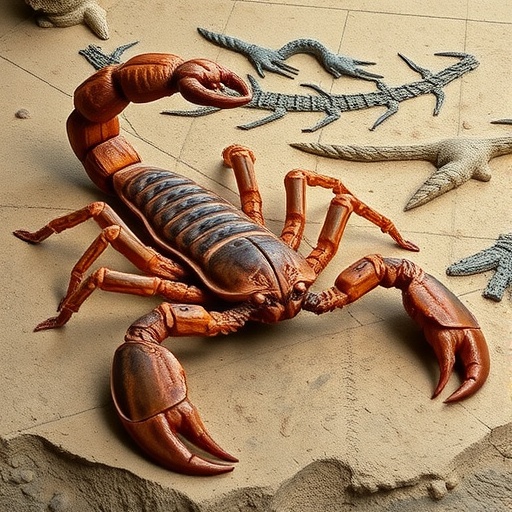
A monumental revelation in paleontology has emerged from recent research conducted by The University of Manchester and the Natural History Museum in London, confirming the existence of the largest scorpion ever to have existed: Praearcturus gigas. Unearthed from fossil records dating back approximately 415 million years, this gigantic arthropod challenges previous conceptions regarding early terrestrial predators and their gigantism.
Praearcturus gigas, measuring roughly one meter in length with formidable pincers surpassing 16 centimeters, represents a predatory titan that roamed the floodplains of what is now England and Wales during the Early Devonian period. The classification of this creature as a scorpion was solidified through meticulous comparative analysis employing modern imaging techniques, reshaping our understanding of scorpion evolution. Notably, the specimens central to this study have been housed within the Natural History Museum’s collections for over a century and a half, underscoring the enduring scientific value of preserved fossils.
Traditionally, the image of giant prehistoric arthropods has been largely confined to the Carboniferous period, characterized by oxygen-rich rainforests supporting oversized millipedes and gigantic insect analogues. However, Praearcturus gigas predates this era by at least 50 million years, inhabiting a world sparsely populated by complex terrestrial ecosystems and entirely devoid of extensive forestation. This places the species at an extraordinary evolutionary juncture, when terrestrial life was nascent and provided an ecological canvas for unusual biological experimentation.
Dr. Richard J. Howard, a leading curator and the study’s principal author, highlights the evolutionary implications of this discovery: the giant size of Praearcturus gigas disrupts prior assumptions that gigantism in arthropods was tightly linked to atmospheric oxygen levels associated with later forested landscapes. Instead, this early Devonian predator’s enormous size may reflect unique ecological dynamics, possibly encompassing a realm with minimal competition from other large predators, allowing it to assume an apex status in its environment.
Further insights were gained through state-of-the-art imaging and cross-collection comparisons conducted by palaeontologist Dr. Russell Garwood and his team at The University of Manchester. Their integrative approach permitted a reconstitution of Praearcturus’ morphology with unprecedented clarity. The findings suggest that Praearcturus may have exhibited semi-aquatic habits, supported by fossil evidence of flap-like abdominal structures akin to those observed in modern crustaceans such as lobsters. This anatomical feature indicates potential locomotion between aquatic and terrestrial habitats, reflecting an adaptive versatility at a time when life was transitioning from oceanic to terrestrial ecosystems.
The presence of abundant scorpion fossils during this period relative to other arachnids further corroborates the hypothesis that aquatic or freshwater environments offered a refuge conducive to the preservation and proliferation of these organisms. Praearcturus’ unique adaptation may thus illuminate the complex evolutionary strategies employed by early arthropods navigating novel terrestrial niches.
Moreover, the environmental implications are profound. The early Devonian landscape was characterized by modest biotic complexity; small plants and fungi had only just begun to colonize land, and atmospheric conditions were not dominated by the high oxygen levels associated with later periods. Consequently, the gigantism observed in Praearcturus is unlikely to be attributed to atmospheric factors alone. Instead, the lack of ecological competition alongside possibly aquatic assistance may have enabled the species to attain exceptional body sizes.
This research reframes a century-old mystery; Praearcturus was first described in 1871 but was misclassified as a giant crustacean resembling a woodlouse. The incompleteness of available fossils—lacking definitive scorpion features such as the tail—had long obfuscated its true identity. By leveraging better-preserved recent fossil finds and advancing imaging technology, the study conclusively identified diagnostic scorpion characteristics, illuminating the intricate evolutionary history of these formidable arthropods.
Such discoveries underscore the irreplaceable value of museum collections. Specimens accumulated over generations continue to yield transformative insights when revisited with novel analytical tools. As Dr. Howard articulates, these fossil archives are dynamic repositories of knowledge that can revolutionize our understanding of prehistoric life and evolutionary processes.
The revelation of Praearcturus gigas also prompts a reevaluation of the drivers behind Paleozoic megafaunal arthropod gigantism. While conventional thought has emphasized environmental cues such as oxygen richness, this study suggests that ecological opportunities and competitive dynamics may have been equally or more critical. This nuanced perspective enhances our comprehension of Paleozoic ecosystem structuring and the evolutionary pressures shaping early terrestrial fauna.
Intriguingly, the intermediate lifestyle of Praearcturus, oscillating between aquatic and terrestrial realms, reflects a pivotal evolutionary chapter during which animals began to diversify beyond ocean boundaries. This duality in habitat could signify an evolutionary experimentation phase, where ancestral lineages explored new environmental potentials, leading to the rich diversification of modern terrestrial arthropods.
In sum, the study of Praearcturus gigas presents a compelling narrative of prehistoric life, combining paleontological evidence and modern methodology to rewrite scorpion evolutionary history. It challenges orthodoxies, expands paradigms on gigantism, and offers a tangible connection to the formative epochs of terrestrial biodiversity.
This landmark research, published in Palaeontology, opens avenues for further investigation into Paleozoic ecosystems and the evolutionary chronology of arthropods, potentially inspiring new explorations into the complex dynamics of early life on Earth.
News Publication Date: 3-Jun-2026.
Web References:
https://onlinelibrary.wiley.com/doi/10.1111/pala.70064
References:
DOI: 10.1111/pala.70064
Cite Scienmag News
Gavin Prescott. (June 3, 2026). Ancient Giant: World’s Largest Scorpion Discovered in 415-Million-Year-Old Fossils. Scienmag. https://scienmag.com/ancient-giant-worlds-largest-scorpion-discovered-in-415-million-year-old-fossils/
Gavin Prescott. "Ancient Giant: World’s Largest Scorpion Discovered in 415-Million-Year-Old Fossils." Scienmag, 3 June 2026, https://scienmag.com/ancient-giant-worlds-largest-scorpion-discovered-in-415-million-year-old-fossils/. Accessed 3 September 2026.
Gavin Prescott. "Ancient Giant: World’s Largest Scorpion Discovered in 415-Million-Year-Old Fossils." Scienmag. June 3, 2026. https://scienmag.com/ancient-giant-worlds-largest-scorpion-discovered-in-415-million-year-old-fossils/


