


Understanding the Earth’s inner structure is one of the most intriguing challenges faced by geoscientists today. For many years, seismic waves produced by earthquakes have served as invaluable tools for probing the dark and enigmatic layers beneath our planet’s surface. Scientists liken these seismic waves to X-rays, as they offer critical insights into the Earth’s crust, mantle, and core. As these waves travel through different geological mediums, they reflect off internal structures, granting researchers the ability to visualize and understand the planet’s complex internal architecture.
The intricacies involved in interpreting seismic data come with significant challenges. As waves travel through the Earth’s varied geological formations, reflections can become distorted, complicating the process of data analysis. This phenomenon makes it all too easy for scientists to misidentify noise as genuine signals in seismic recordings. The urgency of accurately identifying and extracting these reflections from an overwhelming volume of data has brought to light the pressing need for advanced automatic phase-picking tools in seismology. Such innovations are crucial to manage the vast amounts of teleseismic earthquake data that often provide clues about deep structural phenomena within the Earth.
A recent study published in the open-access journal Artificial Intelligence in Geosciences unveils a pioneering deep learning approach to streamline the detection and picking of teleseismic phases. This new method aims to enhance both the efficiency and accuracy with which scientists process seismic data. Led by Dr. Congcong Yuan, a postdoctoral researcher at Cornell University, the research team developed a novel workflow that leverages advancements in artificial intelligence, setting a new standard in the field of seismology.
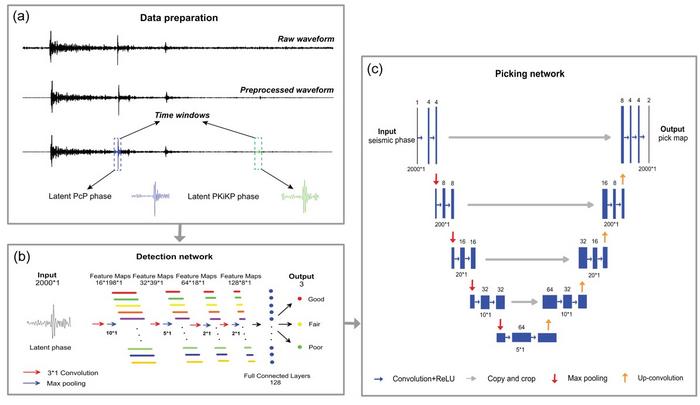
Divided into three distinct phases—preparation, detection, and picking—the workflow employs physical constraints to prepare seismic data effectively. During the preparation phase, signals that hold potential for being meaningful reflections are amplified, while irrelevant data is filtered out. In the subsequent detection phase, the algorithm is designed to recognize and weed out low-quality data that could otherwise skew results. This systematic approach ultimately leads to a more accurate picking phase where dual-rate precision is achieved in determining seismic event arrival times.
Dr. Yuan expresses enthusiasm about the transformative potential of this method, stating that it promises rapid, reliable, and robust processing of teleseismic data. By harnessing advanced deep learning techniques, researchers can extract richer and more meaningful datasets that contribute significantly to the understanding of geophysical processes. It creates new opportunities to explore various dynamics occurring deep within the Earth that have long remained elusive to researchers.
The implications of Yuan’s work extend beyond theoretical applications. The study is a collaboration with another research team focused on teleseismic imaging, enabling them to apply this innovative method to specific tectonic regions where understanding the seismic background can unravel crucial geological insights. The crux of their collaboration draws upon the premise that more high-quality seismic phase data will dramatically enhance our ability to unearth the underlying mechanisms that govern Earth’s geodynamics, particularly in areas prone to tectonic activity.
Professor Jie Zhang, a co-author of the study from the University of Science and Technology of China, highlights another significant aspect of their research. He notes that seismology has traditionally been encumbered by painstakingly slow, semi-automatic data processing systems. However, the advent of deep learning strategies marks a pivotal turning point for the field, transitioning it towards fully autonomous systems that promise not just efficiency but a leap in processing capabilities.
Seismologists are now navigating a rapidly evolving landscape where deep learning frameworks have started to redefine methodologies that have been in use for decades. Previously reliant on manual approaches, researchers are beginning to recognize the potential of these intelligent systems to discern complex patterns within enormous datasets. Consequently, this burgeoning intersection of seismology and machine learning serves as a beacon of hope for those dedicated to unveiling the Earth’s mysteries.
As the application of deep learning extends into various sectors, including geosciences, it reaffirms the critical nature of interdisciplinary research. The integration of cutting-edge technologies from machine learning not only complements traditional scientific inquiry but also propels it into new realms of possibility. In this context, the work by Yuan and his team serves as an exemplary model of innovation-driven research with the power to reshape our understanding of the Earth.
Ongoing efforts aim to expand these methodologies, pushing the boundaries of what can be achieved through artificial intelligence in other areas of earth sciences. The advancements achieved through this deep learning-based workflow will likely inspire further research and development, indicating a growing recognition of the role technology will play in transforming our scientific landscape moving forward. Researchers across geophysics and related fields will undoubtedly keep a close eye on how these developments unfold in the coming years, eager to leverage these techniques in their own investigations.
Looking ahead, the future of seismology undoubtedly lies at the confluence of technology and earth sciences. Continuous improvements in machine learning algorithms alongside seismic processing methodologies promise to redefine our capabilities in unraveling the deep-seated enigmas of the Earth’s interior. Given the established nature of these technologies, it remains to be seen what new insights into Earth’s dynamics this synergy will yield in the near future.
In summary, the advancements made by Dr. Congcong Yuan and his collaborators mark a significant milestone in the evolution of seismic phase detection technologies. The convergence of deep learning methods with traditional geosciences showcases the potential for achieving unprecedented accuracy in data interpretation, which will serve to strategically enhance the field of seismology. As the scientific community continues to embrace these innovations, the prospects for future exploration of Earth’s inner workings have never been more promising.
Cite Scienmag News
Violet Maxwell. (April 7, 2025). Revealing Earth’s Inner Secrets: Advancements in Teleseismic Phase Detection. Scienmag. https://scienmag.com/revealing-earths-inner-secrets-advancements-in-teleseismic-phase-detection/
Violet Maxwell. "Revealing Earth’s Inner Secrets: Advancements in Teleseismic Phase Detection." Scienmag, 7 April 2025, https://scienmag.com/revealing-earths-inner-secrets-advancements-in-teleseismic-phase-detection/. Accessed 4 September 2026.
Violet Maxwell. "Revealing Earth’s Inner Secrets: Advancements in Teleseismic Phase Detection." Scienmag. April 7, 2025. https://scienmag.com/revealing-earths-inner-secrets-advancements-in-teleseismic-phase-detection/


