

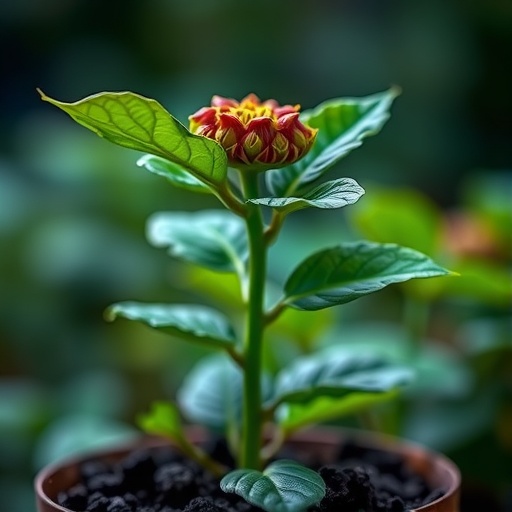

view more
Credit: Bryony Yates
Research has shed intriguing new light on the genetics underlying the diverse plant organ shapes we see in agriculture and nature.
Despite more than a century of scientific investigation into the role of inner and outer tissues, there is still much to learn about how leaves, stems, fruits, and grains get their genetically determined shapes.
A widespread assumption is that the external layers of plant organs such as the skin and underlying tissues play a predominant role in shaping the plant by resisting or yielding to pressure from inner tissues.
However, a study by John Innes Centre researchers suggests that genetic and cellular effects that lead to the shapes we see lie much deeper inside the plant.
They suggest that inner tissues have a more important role in shaping plant organs than previously thought, knowledge that may be applied to crops such as rice, tomatoes, and cucurbits, a class which includes melons, squash, and pumpkins.
To make the findings, they focused on a set of genes that affect stem thickness in the model plant Arabidopsis.
They used gene editing techniques to disrupt the genes that determine the way in which cells divide. They also used a genetic technique to label individual cells and their descendants (collectively called a clone) within the tissues.
By observing the size and shape of these clones within the stem tissues, they could track directions of cell division and growth over time.
The stem begins to form in a region at the tip of the plant called the rib meristem. Here cells divide in a particular orientation, mostly at right angles to the direction of stem growth.
As a result, under normal conditions, the inner region of the stem appears like a bundle of strings, each made of a single file of cells.
In gene-edited mutants in which some of these divisions are misoriented, the team observed that stem grew thicker, whilst the length was unaffected. These misoriented divisions added more “strings to the bundle” causing the stem to widen.
The results were surprising in two ways: the genes the team studied function in deeper layers of the stem, contrary to the expectation that the outer layers control growth; in addition, the orientation of cell divisions is usually considered to be a consequence, not a cause, of changes in the orientation of cell growth.
“Our study reveals how a specific set of genes controls the shape of plant organs by changing the direction in which cells divide. The way these genes work challenges the common assumption that plant organ growth is controlled by outer tissues such as the plant epidermis,” said corresponding author of the study, Professor Robert Sablowski, a group leader at the John Innes Centre.
The possible applications of this study to our food are interesting: the genes studied here have been implicated in the shaping of fruits and seeds, for example creating the difference between round or long melons, or between wide and thin rice grains.
“By understanding how these genes operate to change the shape of the stem, we shed light onto the shape of fruits and seeds that have been modified by humans during crop domestication and breeding,” said Professor Sablowski.
The next important question is to explain how exactly a change in orientation of cell division leads to mechanical changes in the tissues, leading to a change in growth direction.
Control of plant organ growth linked to cell division orientation in inner tissues appears in Current Biology.
Journal
Current Biology
Method of Research
Experimental study
Subject of Research
Cells
Article Title
Control of plant organ growth linked to cell division orientation in inner tissues
Article Publication Date
8-Jul-2026
Adrian Galvin
John Innes Centre
Adrian.Galvin@jic.ac.uk
Office: 07989 339598
Journal
Current Biology
Method of Research
Experimental study
Subject of Research
Cells
Article Title
Control of plant organ growth linked to cell division orientation in inner tissues
Article Publication Date
8-Jul-2026
Tags
bu içeriği 600 ile 800 kelime arasında olacak şekilde ve alt başlıklar ve madde içermiyecek şekilde ünlü bir science magazine için İngilizce olarak yeniden yaz. Teknik açıklamalar içersin ve Viral science news olacak şekilde İngilizce yaz. Haber dışında başka bir şey içermesin. Haber içerisinde 8 ile 10 paragraf olsun ve toplam uzunluk 600 ile 800 kelime arasında kalsın. Cevapta sadece haber olsun. Ayrıca haberi yazdıktan sonra içerikten yararlanarak aşağıdaki başlıkların bilgisi var ise haberin altında doldur. Eğer yoksa bilgisi ilgili kısmı yazma.:
Subject of Research:
Article Title:
News Publication Date:
Web References:
References:
Image Credits:
Keywords

