


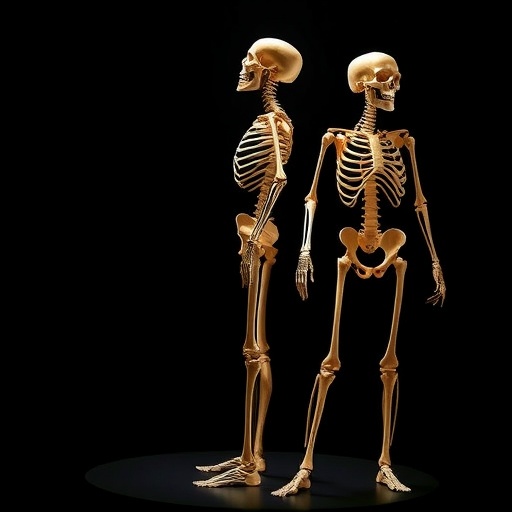
In the ever-evolving landscape of human biology, the assessment of skeletal remains has traditionally relied on methodologies that bifurcate sex into a stark female or male binary. This binary framework underpins much of human skeletal biology, particularly within forensic anthropology, which focuses on the medico-legal examination of skeletonized human remains. Conventionally, sex estimation depends heavily on the morphological characteristics of the pelvis, skull, and long bones, presumed to be distinct enough to categorize individuals definitively as male or female. Yet, this traditional paradigm fails to encapsulate the multifaceted nature of human sex, which encompasses a broad spectrum of biological and physiological traits beyond these skeletal markers.
New research emerging from Boston University’s Chobanian & Avedisian School of Medicine challenges this entrenched binary approach. In a forthcoming review published in the Annual Review of Anthropology, scholars critically interrogate the rigidity of binary sex assumptions in human skeletal biology. The research emphasizes that sex, defined through a combination of hormones, genetics, external and internal anatomy, and skeletal features, manifests along a continuum rather than discrete categories. This nuanced perspective reflects an advanced understanding of biological diversity that has thus far been largely unacknowledged or inadequately addressed within forensic practice.
The issue at hand delves into why updating the operational definitions and methodologies around sex and gender in skeletal biology has been sluggish, particularly concerning forensic anthropology’s role in legal and medical investigations. Despite growing theoretical acknowledgment of sex as a biological spectrum and gender as a socio-cultural construct, practical applications remain tethered to entrenched binary conventions. Dr. Sean Tallman, an associate professor specializing in anatomy and neurobiology, articulates this slow evolution in teaching and practice: forensic anthropology has yet to embrace a more inclusive, feminist, and queer-informed critique that could revolutionize how sex and gender are understood in skeletal contexts.
This rigidity in sex determination not only limits scientific accuracy but also inadvertently perpetuates exclusionary and harmful norms. In textbooks and educational materials, the portrayal of “typical” male and female skeletons is often exaggerated, emphasizing smaller, gracile structures for females and larger, more robust bones for males without acknowledging the substantial morphological overlap and variation. Such essentialist and oversimplified representations ignore the lived realities of intersex, transgender, and non-binary individuals, reinforcing stereotypes and marginalizing diverse bodies.
The Boston University researchers argue that forensic anthropologists, by adhering to these binary frameworks, risk complicity in maintaining biased and reductive narratives about human diversity. These narratives extend beyond mere academic oversight; they have profound ethical ramifications, potentially perpetuating systemic inequalities against marginalized communities, including LGBTQIA+ populations. Embracing sex- and gender-expansive frameworks in both research and practice could foster a more ethical science that respects and affirms the bio-cultural complexities of human identity.
In broadening the scope of sex and gender analysis, the researchers advocate for ethical guidelines that prioritize inclusivity and accuracy. They highlight the necessity for more comprehensive data collection methods that capture the rich variation seen in skeletal remains without forcing them into predetermined categories. Such an approach necessitates advanced analytical tools and interpretive frameworks capable of handling stratified biological data influenced by genetic, hormonal, and environmental factors.
Furthermore, the review underscores that sex- and gender-expansive research aligns with contemporary understandings from both biological sciences and social sciences, bridging gaps between empirical evidence and cultural realities. Recognition of sex as a spectrum moves forensic anthropology toward a more intersectional science that not only enriches biological profiles but also supports human rights and dignity.
The researchers also critique the prevailing educational narratives that fail to incorporate discussions about the spectrum of sex and gender variations. They call for a pedagogical shift that integrates queer theory, feminist science studies, and intersectionality into anthropological curricula. This change is vital for training the next generation of forensic anthropologists to approach biological data with both scientific rigor and social consciousness.
Technological advances in molecular genetics, endocrinology, and imaging techniques offer promising avenues to refine the identification and contextualization of skeletal sex characteristics. These innovations could facilitate more precise modeling of intra- and interindividual variability beyond gross morphological observation. A multidimensional assessment strategy promises to reconcile biological complexity with forensic necessity.
Ultimately, the review from Boston University delineates a clear path forward: embracing complexity in understanding human skeletal variation is not only scientifically accurate but also ethically imperative. It encourages researchers and practitioners to transcend outdated binaries and to engage with the spectrum of human biology and identity. Such transformation will enhance the reliability of forensic analyses while fostering a more inclusive, equitable approach to human biological research.
In a field historically slow to incorporate changes in social understanding, this work stands as a call to action. Forensic anthropology and human skeletal biology must integrate evolving concepts of sex and gender to reflect the full diversity of human experience. By doing so, the discipline not only advances scientifically but also asserts its commitment to social justice, shaping how human remains are examined and how identities are recognized in medico-legal contexts.
This research marks a significant milestone in the critical re-examination of established scientific paradigms, illustrating how the intersection of biology and culture is essential for fostering a more comprehensive understanding of the human condition. More than a mere academic debate, the shift beyond binary frameworks in skeletal sex estimation has the potential to transform forensic practice, improve legal outcomes, and affirm the rights and identities of all individuals.
Cite Scienmag News
Drew Townsend. (June 15, 2026). Rethinking Human Skeletal Biology: Moving Beyond the Male/Female Binary. Scienmag. https://scienmag.com/rethinking-human-skeletal-biology-moving-beyond-the-male-female-binary/
Drew Townsend. "Rethinking Human Skeletal Biology: Moving Beyond the Male/Female Binary." Scienmag, 15 June 2026, https://scienmag.com/rethinking-human-skeletal-biology-moving-beyond-the-male-female-binary/. Accessed 4 September 2026.
Drew Townsend. "Rethinking Human Skeletal Biology: Moving Beyond the Male/Female Binary." Scienmag. June 15, 2026. https://scienmag.com/rethinking-human-skeletal-biology-moving-beyond-the-male-female-binary/


