


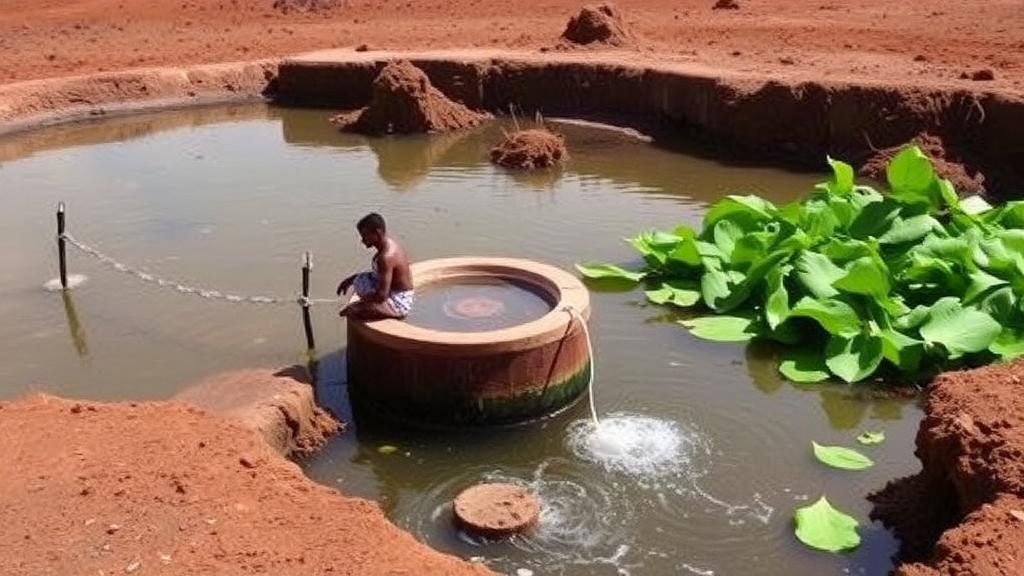
In the drought-prone Sahel, the water that farmers use to irrigate their vegetables may matter far more than how carefully they handle them afterward. A new study from Northern Burkina Faso, published in Environmental Monitoring and Assessment, finds that the source of irrigation water is the single strongest driver of microbial contamination on raw lettuce and tomatoes sold from smallholder farms. The finding challenges a widespread assumption in food safety programs: that improving on-farm hygiene practices alone can substantially reduce the risk that raw vegetables carry dangerous bacteria to consumers.
The research team, led by Adama Pamba Séré of the University Joseph KI-ZERBO in Ouagadougou, sampled 120 farms across three sites in the Northern Region of Burkina Faso, collecting 66 lettuce and 54 tomato samples. Each farm drew irrigation water from one of three sources: open reservoirs, shallow wells, or deep boreholes. The researchers scored each farm’s compliance with Good Agricultural Practices and Good Hygiene Practices through detailed field audits, then quantified two key pathogens, Escherichia coli and Salmonella, using ISO reference methods. What sets the study apart is its statistical rigor: rather than relying on a single test, the team applied five independent analytical methods, including analysis of variance, logistic regression, random forest modeling, principal component analysis, and k-means clustering, to determine which factor best predicts contamination.
The results were unambiguous. Irrigation water source explained roughly half of the variation in E. coli loads on the vegetables, with an effect size of 0.51, a value considered large in statistical terms. Vegetables irrigated with reservoir water carried an average of 3.00 log colony-forming units per gram of E. coli, those irrigated with well water averaged 2.25, and those irrigated with borehole water averaged just 1.19. Notably, no Salmonella was detected in any sample irrigated with borehole water, while reservoir water emerged as the primary risk factor for Salmonella presence, nearly quadrupling the odds of contamination compared with other sources.
Random forest modeling, a machine learning technique that ranks predictors by their importance, confirmed the pattern. Water source accounted for 41.1 percent of predictive importance, while hygiene practices contributed only 9.8 percent. This ranking held steady across all five analytical methods, giving the researchers high confidence that the result is not an artifact of any particular statistical approach. The convergence of multiple methods on the same conclusion is rare in food safety research and lends the finding considerable weight.
The study also translates its results into a practical tool. The researchers developed a Water-Security Risk Score that extension services can deploy in the field to help farmers and advisors quickly assess the contamination risk associated with their irrigation water. Rather than requiring laboratory analysis, the score is based on the water source itself, offering a simple decision rule: borehole water carries the lowest risk, wells carry moderate risk, and open reservoirs carry the highest.
The implications extend beyond Burkina Faso. The authors situate their findings within the broader Sahelian context, where smallholder vegetable production increasingly depends on irrigation as rainfall becomes less reliable. Open reservoirs, which collect runoff and are often shared with livestock, are common across the region. The study suggests that monitoring the microbial quality of these water sources, rather than focusing exclusively on post-harvest handling, should be a priority for food safety interventions across the Sahel.
The research also highlights the limits of hygiene-focused programs. While Good Agricultural and Hygiene Practices remain important for reducing contamination, the study shows that they cannot compensate for a heavily contaminated water source. A farmer who follows every recommended practice but irrigates with reservoir water still faces a substantially higher contamination risk than one who uses borehole water with mediocre hygiene. This does not mean hygiene practices are irrelevant, but it does mean that water quality is the dominant lever.
The study’s methodology is worth noting for its transparency. The authors used ISO 16649-2 for E. coli enumeration and ISO 6579-1 for Salmonella detection, both internationally recognized reference methods. The field audits scored compliance against Codex Alimentarius food hygiene principles. The dataset, comprising 120 observations, is not yet publicly deposited but is available upon reasonable request, and the authors commit to depositing it in a public repository upon acceptance.
For consumers of raw vegetables in the Sahel, the message is sobering but actionable. The path from reservoir to plate is not merely a metaphor: the water that touches the crop in the field is the strongest determinant of what reaches the consumer. As climate change intensifies pressure on water resources across the region, ensuring that irrigation water is safe may become one of the most effective public health interventions available.
Beyond the headline finding, the study’s design offers useful context for interpreting how strongly water source dominates. The three water sources represent a natural gradient of protection: open reservoirs are exposed to runoff, livestock, and direct human contact; shallow wells offer partial shielding from surface contamination; and boreholes tap deeper aquifers that are typically less vulnerable to fecal intrusion. The roughly 2.5-fold difference in mean E. coli loads between reservoir- and borehole-irrigated vegetables maps neatly onto this gradient, which strengthens the plausibility of a causal link rather than a mere statistical association. The absence of Salmonella in borehole-irrigated samples is particularly striking, since it suggests that a sufficiently protected water source may effectively eliminate one of the most serious foodborne pathogens from the raw vegetable pathway.
The choice of E. coli as an indicator organism deserves explanation for readers unfamiliar with microbiological monitoring. E. coli itself is not always pathogenic, but its presence signals recent fecal contamination and correlates with the likelihood that other enteric pathogens, including Salmonella, are also present. Enumeration in colony-forming units per gram, expressed here on a logarithmic scale, means that the difference between 3.00 and 1.19 log CFU/g is not a modest one: it represents roughly a sixty-fold reduction in bacterial load. Because many foodborne pathogens have low infectious doses, even order-of-magnitude reductions in contamination can translate into meaningful declines in public health risk.
The statistical framework the authors employed is also notable in a field where single-method analyses are common. Analysis of variance with an eta-squared of 0.51 indicates that water source alone accounts for about half of the variability in contamination, an unusually large effect for environmental health data, where many interacting factors typically dilute any single predictor. Logistic regression, which estimates the odds of Salmonella presence rather than its continuous load, independently identified reservoir water as the primary risk factor with an odds ratio of 3.82. Random forest modeling, a machine learning approach that grows many decision trees on resampled data, provided a third, methodologically distinct perspective and ranked water source at more than four times the importance of hygiene practices. Principal component analysis and k-means clustering, which make no assumptions about outcome relationships, allowed the team to check whether farms naturally grouped by water source and contamination profile. That all five approaches converged on the same hierarchy of predictors is the study’s strongest methodological asset.
The regional context amplifies the significance of these results. The World Health Organization has estimated the global burden of foodborne disease at hundreds of millions of illnesses annually, with the heaviest toll in low- and middle-income countries, and sub-Saharan Africa bears a disproportionate share. Prior research in Ouagadougou and elsewhere in Burkina Faso has documented Salmonella contamination of vegetables, street foods, and surface waters, and studies from neighboring Ghana and Ethiopia have similarly linked irrigation water quality to produce contamination. The present study adds value by quantifying the relative weight of water source against on-farm practices within a single coherent framework, something earlier descriptive surveys generally could not do.
The Water-Security Risk Score also reflects a pragmatic response to the realities of extension work in the Sahel. Laboratory capacity for routine microbiological testing of irrigation water is limited in many rural districts, and turnaround times can be long. A score based on water source requires no equipment, only knowledge of where a farm’s water comes from, which farmers themselves know. This makes the tool immediately deployable, though it should be understood as a screening heuristic rather than a substitute for periodic laboratory verification, since individual reservoirs and wells can vary considerably in quality depending on season, rainfall, and local sanitation conditions.
Several caveats temper the findings. The study covered three sites and 120 farms in one region of one country, and seasonal variation in water quality was not the central focus. Reservoir water quality can shift dramatically between wet and dry seasons as dilution, evaporation, and runoff patterns change, so contamination levels measured at one time may not represent the annual picture. The authors also note that the dataset is not yet publicly deposited, which limits independent reanalysis until the promised repository deposit occurs. Nonetheless, the consistency of the water-source effect across sites, crops, and analytical methods suggests a robust underlying pattern rather than a local artifact.
For policymakers, the practical implication is that investments in protected water infrastructure, such as boreholes or treated water points for irrigation, may yield larger food safety returns than hygiene training alone. This does not argue for abandoning hygiene programs, which remain essential for preventing contamination during harvesting, washing, and transport, but it reframes the hierarchy of interventions. Where farmers cannot switch water sources, intermediate measures such as sand filtration, storage settling, or drip irrigation that avoids direct water contact with edible plant parts could reduce the transfer of pathogens from water to crop. Testing these mitigation options in Sahelian field conditions would be a natural next step for this research program.
Subject of Research: Food Safety
Article Title: From reservoir to plate: monitoring irrigation water source as the dominant driver of vegetable microbial contamination risk in Sahelian smallholder systems
Article References: Séré, A. P., Sanou, A., Roamba, E. N., Ouattara, N., Dakuyo, R., Kaboré, K., Konaté, K., Kaboré, D., & Dicko, M. H. (2026). From reservoir to plate: monitoring irrigation water source as the dominant driver of vegetable microbial contamination risk in Sahelian smallholder systems. Environmental Monitoring and Assessment, 198(11), Article 1217. https://doi.org/10.1007/s10661-026-16056-9
Image Credits: AI Generated
DOI: 10.1007/s10661-026-16056-9
Keywords: food safety, irrigation water, Burkina Faso, Escherichia coli, Salmonella, smallholder farming, reservoir, plate, monitoring, irrigation, water, source
Cite Scienmag News
Violet Maxwell. (October 17, 2026). Reservoir water emerges as top source of vegetable contamination in Sahel farms. Scienmag. https://scienmag.com/reservoir-water-emerges-as-top-source-of-vegetable-contamination-in-sahel-farms/
Violet Maxwell. "Reservoir water emerges as top source of vegetable contamination in Sahel farms." Scienmag, 17 October 2026, https://scienmag.com/reservoir-water-emerges-as-top-source-of-vegetable-contamination-in-sahel-farms/. Accessed 17 October 2026.
Violet Maxwell. "Reservoir water emerges as top source of vegetable contamination in Sahel farms." Scienmag. October 17, 2026. https://scienmag.com/reservoir-water-emerges-as-top-source-of-vegetable-contamination-in-sahel-farms/


