


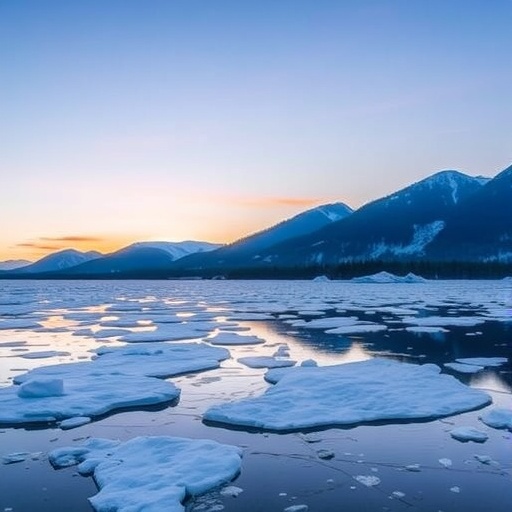
For lakes across the Northern Hemisphere, winter ice is more than a frozen lid. It acts as a seasonal regulator that controls underwater ecosystems, influences energy balance, and shapes how heat is stored and released. Yet new evidence shows that the ice season is shrinking faster than expected as regional winter air temperatures rise.
A new study in Proceedings of the National Academy of Sciences reports that lake ice loss accelerates sharply once temperatures cross specific winter thresholds. Instead of changing gradually with warming, many lakes appear to shift into a more vulnerable regime when the cold season becomes insufficiently severe.
Researchers examined ice phenology records and corresponding air temperature data from 724 lakes spanning 2000–2022. By comparing how ice-on and ice-off dates respond across time, the team quantified asymmetrical sensitivity to warming in both autumn freeze-up and spring melt.
The analysis found that spring ice-off timing is far more temperature-sensitive than autumn freeze-up. This means warming tends to drive faster melting than freezing, extending the period when lakes remain ice-free. Such imbalance can alter oxygen conditions, nutrient cycling, and habitat structure during critical winter-to-spring transitions.
Most importantly, the study identifies winter temperature thresholds between about −13.7 °C and −6.8 °C. When average winter air temperature rises above these limits, the rate of ice-cover loss increases rapidly. In some cases, the phenological sensitivity—how strongly timing responds to climate forcing—may increase dramatically, up to roughly 22-fold.
The thresholds are governed largely by broad climatic controls, particularly winter air temperature and surface albedo, rather than by local lake geometry or depth. This suggests the risk of crossing a threshold depends more on regional winter climate than on individual lake morphology.
Using high-emission projections, the researchers estimate that by the end of the century the winter ice-cover duration could shorten by about 40 days for Northern Hemisphere lakes. They also project that the share of lakes above the critical thermal thresholds may rise from 23% to 70%.
The findings point to nonlinear, threshold-driven dynamics in freshwater freeze–thaw systems. The study argues that incorporating such nonlinear sensitivities into next-generation climate models is essential to produce reliable forecasts of water quality and aquatic ecosystem change.
Scientists warn that abrupt reductions in ice cover could trigger cascading effects for ecosystems and for communities that rely on stable winter conditions. Even modest additional warming may push many mid-latitude lakes toward regimes with potentially persistent consequences.
Cite Scienmag News
Russell Cooper. (July 29, 2026). Researchers Uncover Nonlinear Mechanism Driving Northern Hemisphere Lake Ice Loss. Scienmag. https://scienmag.com/researchers-uncover-nonlinear-mechanism-driving-northern-hemisphere-lake-ice-loss/
Russell Cooper. "Researchers Uncover Nonlinear Mechanism Driving Northern Hemisphere Lake Ice Loss." Scienmag, 29 July 2026, https://scienmag.com/researchers-uncover-nonlinear-mechanism-driving-northern-hemisphere-lake-ice-loss/. Accessed 6 September 2026.
Russell Cooper. "Researchers Uncover Nonlinear Mechanism Driving Northern Hemisphere Lake Ice Loss." Scienmag. July 29, 2026. https://scienmag.com/researchers-uncover-nonlinear-mechanism-driving-northern-hemisphere-lake-ice-loss/


