


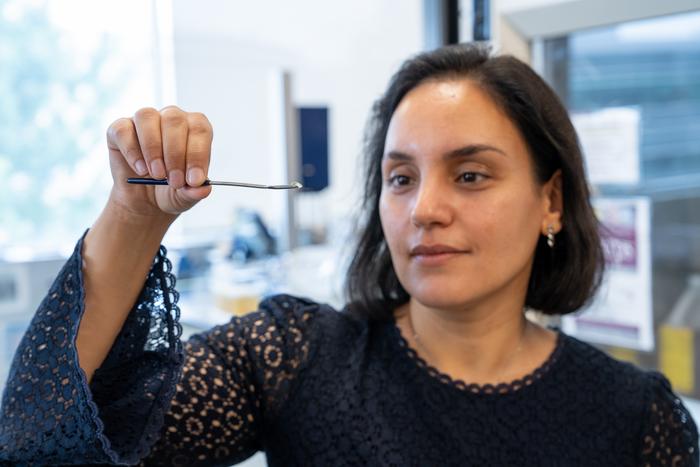
The great promise of bacteriophages is that they naturally destroy bacteria, often in situations where antibiotics fail.

Credit: McMaster University
The great promise of bacteriophages is that they naturally destroy bacteria, often in situations where antibiotics fail.
Until now, though, there has been no way to access them quickly and efficiently, especially in emergency cases of antibiotic resistant infections.
Researchers at McMaster University, working with a colleague from Université Laval, have developed a simple new way to store, identify, and share phages, making them more accessible to patients who need them.
“Bacteriophages are often talked about as a beacon of hope, but they are harder to use than traditional antibiotics, because there are so many varieties,” says lead investigator Zeinab Hosseinidoust, a McMaster chemical engineer who holds the Canada Research Chair in Bacteriophage Bioengineering.
The research team’s work is described in a paper published today in the journal Nature Communications.
Bacteriophages, or phages as they are called less formally, are beneficial viruses that could change the course of medicine and agriculture, especially as antibiotic resistance grows worldwide.
Each form of bacteriophage is specialized to attack a particular form of bacteria and nothing else, allowing phages to be directed specifically at infections while leaving beneficial bacteria alone.
A major challenge to harnessing their huge potential is creating easier and faster access to collections of phages.
“We don’t have a central library of phages to refer to when we need to use them. For the time being we have only decentralized local libraries of phages in places such as research labs and privately-owned clinics,” Hosseinidoust says. “What makes all this even more challenging is that we’ve been relying on the same basic tools and laborious lab techniques to handle and screen phages that our predecessors were using over 100 years ago when phages were first discovered.”
What adds to these critical barriers is that live phages must be suspended in vials of liquid and refrigerated or frozen, making storage cumbersome and hindering the efficient transport and sharing of phage collections.
The researchers have overcome these obstacles by developing a dry storage platform that plays the starring role in their user-friendly new system for quickly matching specific infections to the phages that can stop them.
Phages are natural, safe and effective. They are the most common organisms on Earth, inhabiting our bodies and all corners of the environment, but their potential benefits are still coming into view.
Even today, scientists have only identified a fraction of all the properties of phages.
Work to develop the potential of phages slowed significantly in the 1940s and 50s, when penicillin took the infection-control spotlight, particularly in the West. Though phages continued to be studied and deployed in central and eastern Europe, global interest in phages is growing once again now that the power of antibiotics is waning after generations of overuse.
The heart of the new system is a novel, pill-like medium that stores phages without refrigeration and combines them with an agent that produces a visible glow when a phage responds to a target infection.
Using this medium, the researchers can load a portable testing tray about the size of a paperback book with hundreds or even thousands of phage samples to check simultaneously in what is often an urgent search for a match.
The new technology enables phages to be stored at room temperature for months at a time until they are needed, combining a biobank and testing lab in one small package.
A user simply adds a sample of the target bacterium to each well of a pre-loaded well-plate, and any positive results become visible 30 minutes to two hours later.
“Having quick access to such portable testing labs would bring speed and order to the way things happen today, when a clinic or hospital facing an emergency situation is often forced to send a desperate call-out for candidate phages to test for possible use,” says co-investigator Tohid Didar, a mechanical engineer who holds the Canada Research Chair in NanoBiomaterials.
Fereshteh Bayat, a postdoctoral researcher in Didar and Hosseinidoust’s labs, had developed the concept of the technology as her PhD project.
“I have always wanted to contribute to something that has a positive impact on people’s lives,” Bayat says. “To see this materialize is very fulfilling.”
The McMaster researchers worked with Dr. Sylvain Moineau at Université Laval in Quebec City, which is home to the world’s largest biobank of referenced phages, and with their McMaster colleague Carlos Filipe who is an expert in the stabilization of biomolecules.
The new technology would also make it easier to use phages in non-medical applications, such as in agriculture, to control animal and plant infections, the researchers say. They are seeking partners to develop the technology for wide use.
“If everything moves forward to commercial application as we anticipate, this could revolutionize the way we use phages for different purposes,” says Didar.
Journal
Nature Communications
Method of Research
Experimental study
Article Title
High throughput platform technology for rapid target identification in personalized phage therapy
Article Publication Date
11-Jul-2024
COI Statement
The patent for using pullulan/trehalose to stabilize biological agents has been licensed to Elarex.
Carlos Filipe is a co-founder and currently a scientific advisor to Elarex. A patent application has
been filed by McMaster University (inventors F.B, T.F.D, Z.H.) to the Canadian Intellectual
Property patent office pertaining to the high throughput aspect(s) of this work (application number
PCT/CA2024/050748).
Cite Scienmag News
Denise Maddox. (July 11, 2024). Researchers develop a way to make lifesaving phages accessible, transportable and much easier to use. Scienmag. https://scienmag.com/researchers-develop-a-way-to-make-lifesaving-phages-accessible-transportable-and-much-easier-to-use/
Denise Maddox. "Researchers develop a way to make lifesaving phages accessible, transportable and much easier to use." Scienmag, 11 July 2024, https://scienmag.com/researchers-develop-a-way-to-make-lifesaving-phages-accessible-transportable-and-much-easier-to-use/. Accessed 4 September 2026.
Denise Maddox. "Researchers develop a way to make lifesaving phages accessible, transportable and much easier to use." Scienmag. July 11, 2024. https://scienmag.com/researchers-develop-a-way-to-make-lifesaving-phages-accessible-transportable-and-much-easier-to-use/

