


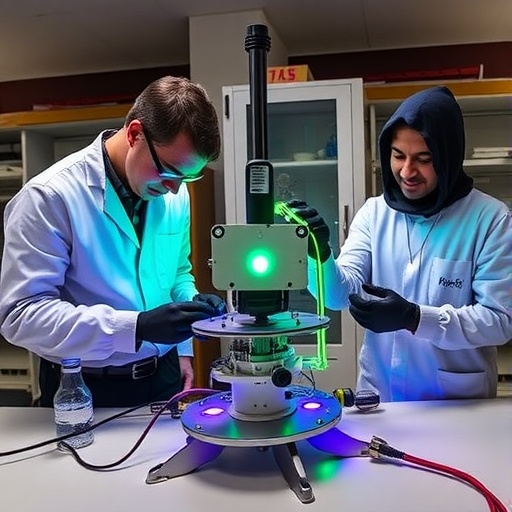
Researchers in India have demonstrated a full-color near-eye display that could help make augmented-reality glasses thinner, brighter and more energy efficient. The experimental system uses three holographic gratings stacked inside a transparent glass waveguide, with one grating engineered for red light, another for green and a third for blue. Together, the layers transmitted full-color images through the waveguide, offering a potential alternative to more complicated optical architectures used in current AR systems.
The work addresses one of the central challenges in building practical augmented-reality eyewear: how to deliver bright, sharp digital images to the eye without making the glasses bulky or draining their batteries. Unlike conventional displays, holographic waveguides can guide light through a thin, transparent sheet of glass while allowing the wearer to continue seeing the real world. Microscopic holographic structures embedded in or attached to the waveguide redirect light into the glass, trap it through total internal reflection and then release it toward the viewer’s eye.
The researchers, from India’s CSIR-Central Scientific Instruments Organisation and the Academy of Scientific and Innovative Research, created a separate holographic grating for each of the three primary display colors. Each grating is recorded in its own photopolymer layer and then combined into a multilayer structure. This arrangement gives the red, green and blue channels their own optical paths and allows each one to be adjusted independently for efficient light control.
That independence is important because red, green and blue light behave differently as they pass through optical materials. Their wavelengths are not identical, so a single grating must be carefully designed if it is expected to handle all three colors. When multiple colors are recorded together in one photopolymer film, the resulting structure can lose diffraction efficiency, reducing the amount of light directed toward the viewer. The outcome is often a dimmer image or a system that requires more power from its display source.
The new design uses a prism-free fabrication process intended to avoid another major manufacturing obstacle. Conventional methods for producing multilayer holographic couplers often rely on bulky prisms to direct light at precise angles during recording. Aligning several gratings in this way can be technically demanding, and even small errors may reduce image quality. In the new approach, the color gratings are recorded separately and stacked during fabrication, preserving their relative alignment without requiring a complex post-recording alignment procedure.
The stacked structure functions as both an in-coupler and an out-coupler in the researchers’ transparent waveguide. During operation, light from a miniature display is directed normally onto the input coupler. The holographic gratings redirect that light into the glass at a sufficiently steep angle for total internal reflection to occur. The image then travels through the waveguide rather than spreading into the surrounding air. When it reaches the output coupler, the light is redirected out of the glass and toward the wearer’s eye, where it appears as a virtual image superimposed on the physical environment.
To test the concept, the team used a miniature digital display and a collimating lens to send test images onto the waveguide. The experiments produced separately visible red, green and blue images, as well as combined full-color images. The successful propagation of all three channels demonstrated that the stacked holographic structure could guide the color components through the same transparent optical element without relying on a prism-based alignment method.
The result is significant because brightness remains a persistent limitation for see-through AR displays. A waveguide must send enough light to the eye to remain visible against indoor lighting, sunlight and other real-world conditions, while still allowing the device to operate from a small battery. By optimizing each color channel separately, the researchers aim to improve the overall light efficiency of the display. More efficient coupling could allow brighter virtual images at the same input power, or comparable brightness with lower power consumption.
The technology could eventually support navigation glasses, industrial maintenance systems, medical visualization tools, educational devices, training platforms and vehicle head-up displays. However, the laboratory demonstration is still an early stage rather than a finished product. The researchers plan to improve the field of view and color uniformity, then integrate the optical system into a compact, eyeglasses-like prototype. Future evaluations will need to examine brightness, image quality, power use, eye comfort and long-term reliability. If those challenges can be addressed, stacked holographic gratings could help move full-color AR displays closer to lightweight devices that are practical for everyday use.
News Publication Date: 11-Aug-2026
Web References: CSIR-Central Scientific Instruments Organisation; Academy of Scientific and Innovative Research; Optica Publishing Group; DOI: 10.1364/AO.604532
References: S. Saxena, R. Kaur and R. Kumar, “Self-aligned prism-free fabricated stacked holographic couplers for full color augmented reality display,” Applied Optics, volume 65, 2026. DOI: 10.1364/AO.604532
Keywords
Augmented reality, AR glasses, holographic gratings, holographic waveguides, near-eye displays, full-color displays, optical engineering, photopolymer films, total internal reflection, prism-free fabrication, wearable technology, energy-efficient displays.
Cite Scienmag News
Bethany Barker. (August 11, 2026). Researchers Align Green-Light Optical Components on Laboratory Optics Table. Scienmag. https://scienmag.com/researchers-align-green-light-optical-components-on-laboratory-optics-table/
Bethany Barker. "Researchers Align Green-Light Optical Components on Laboratory Optics Table." Scienmag, 11 August 2026, https://scienmag.com/researchers-align-green-light-optical-components-on-laboratory-optics-table/. Accessed 3 September 2026.
Bethany Barker. "Researchers Align Green-Light Optical Components on Laboratory Optics Table." Scienmag. August 11, 2026. https://scienmag.com/researchers-align-green-light-optical-components-on-laboratory-optics-table/


