


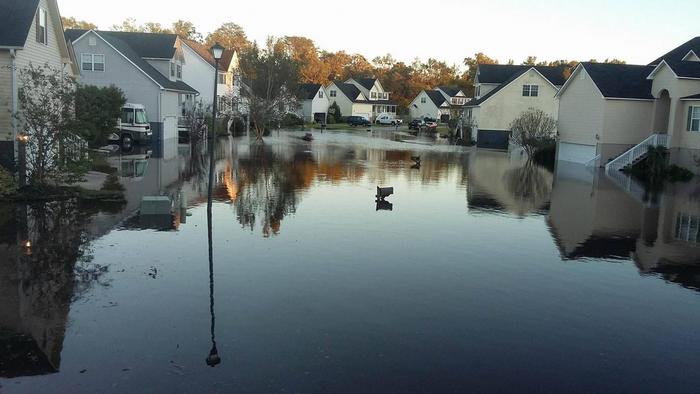
LAWRENCE — Around the globe, communities at risk from repeated flooding due to climate change face stark decisions. Some communities in peril of flooding may resolve, or be urged, to relocate to a safer location — something known as “managed retreat.” In the United States, flood-prone communities in coastal states like Louisiana and Alaska already have commenced managed retreat inland.

Credit: National Weather Service
LAWRENCE — Around the globe, communities at risk from repeated flooding due to climate change face stark decisions. Some communities in peril of flooding may resolve, or be urged, to relocate to a safer location — something known as “managed retreat.” In the United States, flood-prone communities in coastal states like Louisiana and Alaska already have commenced managed retreat inland.
“It’s retreating from risk, and we hope to provide decision support for the equitable implementation of retreat to build climate resilience,” said Elaina Sutley, associate professor of civil, environmental & architectural engineering at the University of Kansas.
Sutley is leading a three-year, $650,000 multidisciplinary study of managed retreat as part of a collaboration funded by the National Science Foundation and Canada’s New Frontiers in Research Fund via the 2023 International Joint Initiative for Research on Climate Change Adaptation and Mitigation Competition. Each agency funds the scientists at institutions in their respective countries.
The KU-headed partnership is dubbed “Retreating from risk (RFR): Decision-supports for the equitable implementation of retreat to build climate resilience.” Beyond KU, the effort involves Stony Brook and Texas Tech universities as well as researchers abroad.
“This is multidisciplinary collaboration between partners in the United States, Canada and Indonesia, who are all faced with flood disasters, whether that’s coastal flooding associated with a hurricane or not,” Sutley said. “Inland flooding, seasonal flooding and repeated nuisance flooding — all three of these countries are facing it. Managed retreat has become a somewhat common adaptation strategy, particularly for flooding. The U.S. team will also consider retreating from wildfire disasters.”
While the study of managed retreat will focus on communities suffering from floods and wildfires, Sutley said the work could guide decision making for communities faced with different kinds of repeating natural disasters.
“Floods aren’t the only hazard this work is applicable to,” she said. “In many ways, flooding isn’t much different from a lot of hazards. How can we best move out of a place that is going to be hit repeatedly by disaster and has a record of being hit repeatedly?”
The KU researcher said the goal is to understand how managed-retreat approaches are being considered across many geographies, nations and cultures, then identify any key strategies that are shared, as well as understand where there are necessary differences.
“There are many different strategies,” Sutley said. “In the U.S., one of the most common ways we see managed retreat executed is with the buyout program from FEMA. This project, through our international collaboration, is trying to understand how different cities and governments — faced with different types of hazards, with different political, social and cultural contexts — have considered managed retreat. Did they successfully adopt it or one of its strategies? What challenges or barriers did they run into that prevented them from adopting it? What challenges came up when they went through this process? What can we learn within countries across geographies, and then across countries and geographies?”
Sutley said the team would take care to seek and incorporate Indigenous knowledge and practices where applicable, partnering with communities that may already have faced relocation or exploitation historically.
“The new Frontiers Research Fund of Canada require that you consider and include Indigenous communities,” Sutley said. “That’s part of some of their equity legislation. It’s key to work with people who have relationships and experience doing this — taking time to build trust that’s needed. Those are going to be key tenets. While the locations we’ve identified in the United States to partner with aren’t on reservations, for example, they certainly do have people who’ve been disproportionately impacted by historical and modern-day policies and practices that our team is very sensitive to.”
From these studies, the collaborating researchers will document political, financial, social, cultural and policy barriers to adopting managed retreat. The study will include data collection via surveys, interviews, focus groups and roundtable discussions, ensuring the work incorporates viewpoints from people involved in the decision-making process at all levels.
“How can we use all of that information to guide future communities who may consider managed retreat as an option?” Sutley said. “What are the pros? What are the things that make this a really great option in these different areas? Really, I think we’re going to hear very different things from one community to the next but also from one kind of stakeholder in that decision process to the next. So, we’re taking more of an open-ended approach.”
The results will help guide policymakers, community leaders and future research efforts. The researchers plan to produce “contextually relevant decision-support tools,” such as a training module, best-practices guidebook or conversation toolkits, to guide community leaders in engaging constituents on managed retreat.
Sutley said managed retreat is an urgent issue and the work would yield tools at the end of its three-year span.
“Any research that can offer guidance is needed as soon as possible,” she said. “We’re really trying to learn from communities at different stages of dealing with this question — those who are over and done with it, those at the beginning and those in the middle. We’re studying communities at all these different stages so we can understand how the process unfolds in these different contexts. The findings are meant to be relevant both immediately and long term.”
Cite Scienmag News
Sloane Callahan. (July 19, 2024). Research will establish best ‘managed retreat’ practices for communities faced with climate change disaster. Scienmag. https://scienmag.com/research-will-establish-best-managed-retreat-practices-for-communities-faced-with-climate-change-disaster/
Sloane Callahan. "Research will establish best ‘managed retreat’ practices for communities faced with climate change disaster." Scienmag, 19 July 2024, https://scienmag.com/research-will-establish-best-managed-retreat-practices-for-communities-faced-with-climate-change-disaster/. Accessed 4 September 2026.
Sloane Callahan. "Research will establish best ‘managed retreat’ practices for communities faced with climate change disaster." Scienmag. July 19, 2024. https://scienmag.com/research-will-establish-best-managed-retreat-practices-for-communities-faced-with-climate-change-disaster/

