Tuesday, October 27, 2026
Science
No Result
View All Result
  • Login
  • HOME
  • SCIENCE NEWS
  • CONTACT US
  • HOME
  • SCIENCE NEWS
  • CONTACT US
No Result
View All Result
Scienmag
No Result
View All Result
Home Science News Medicine

Research report: Subjective sleep quality and sustained attention before and after a 24-hour smartphone restriction in adolescent swimmers: a single-group pretest–posttest study

October 27, 2026
in Medicine
Ophelia Keating
By Ophelia Keating Scienmag Editorial Profile - Health Services Research
Reading Time: 2 mins read
0
Research report: Subjective sleep quality and sustained attention before and after a 24-hour smartphone restriction in adolescent swimmers: a single-group pretest–posttest study

Research report: Subjective sleep quality and sustained attention before and after a 24-hour smartphone restriction in adolescent swimmers: a single-group pretest–posttest study

65
SHARES
587
VIEWS
Share on FacebookShare on Twitter
ADVERTISEMENT

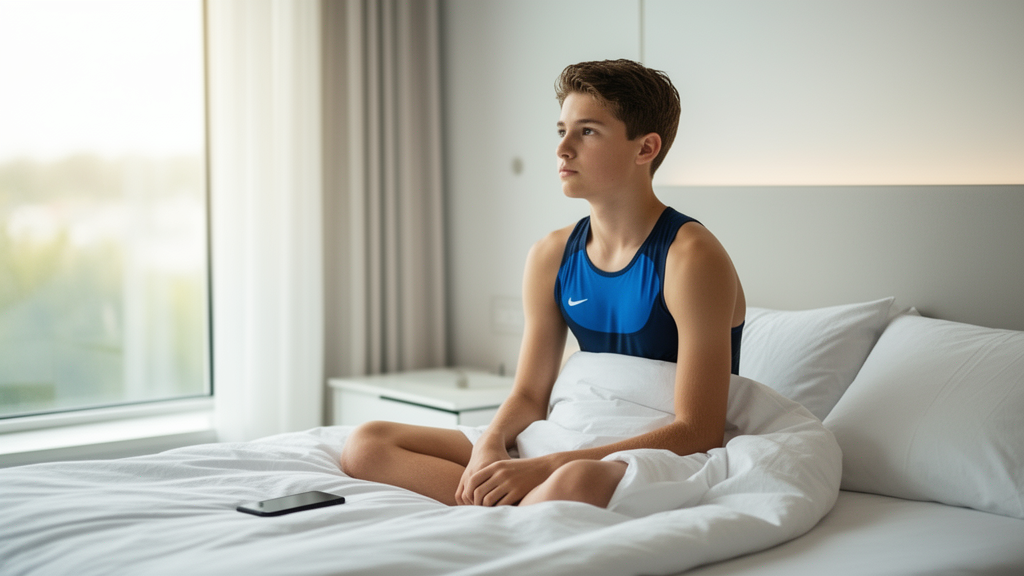
A single-group pretest–posttest study investigated the impact of a 24-hour smartphone restriction on the subjective sleep quality and sustained attention of adolescent competitive swimmers. The research, conducted by Gönen Dogan, Dilan Futsi, Oznur Akyuz, Hakan Guler, and colleagues, examined 43 competitive swimmers aged 10–16 years (mean age 12.84 ± 1.90 years; 26 male) who underwent a 24-hour smartphone restriction period. This intervention was rigorously verified using tamper-evident sealed bags to ensure compliance. The study employed two primary metrics: subjective sleep quality, assessed using a 10-cm visual analogue scale (VAS) where 0 cm represented good sleep and 10 cm represented poor sleep, and sustained attention, measured via the Bourdon Attention Test, which evaluated both accuracy and completion time.

The results indicated statistically significant improvements in both sleep quality and sustained attention following the restriction period. Regarding sleep quality, the VAS scores demonstrated a decrease from a mean of 2.93 ± 1.96 cm before the intervention to 1.91 ± 1.80 cm after the restriction. This change represents a mean difference of −1.01 cm, which was highly statistically significant (p < .001; dz = 0.69), suggesting better self-rated sleep quality post-restriction. Furthermore, the Bourdon Attention Test revealed marked cognitive benefits. Total accuracy increased by 6.30 correct responses (95% CI 3.80 to 8.80; p < .001; dz = 0.78), and the total completion time decreased by 32.4 seconds (95% CI 20.5 to 44.3; p < .001; dz = 0.84).

Further analysis explored potential moderating factors within the cohort. The researchers found no statistically significant differences in the pre–post changes based on the swimmers’ sex or their habitual screen time. However, a notable association was identified: swimmers who reported higher levels of habitual screen time across both sessions tended to report poorer sleep quality (p = .023, ηp² = 0.12).

Despite the positive outcomes observed in this single-group pretest–posttest design, the authors cautioned that the results must be interpreted with clinical prudence. Because the study lacked a control condition—meaning there was no comparison group that did not undergo the restriction—the observed improvements cannot be definitively attributed solely to the smartphone restriction. The researchers acknowledge that these changes may partially reflect practice effects or other confounding variables inherent in a single-group design. Therefore, they emphasize that future research should employ randomized controlled studies to isolate the specific effects of smartphone restriction on adolescent health and performance.

Subject of Research: The effects of a 24-hour smartphone restriction on subjective sleep quality and sustained attention in adolescent competitive swimmers.

Article Title: Subjective sleep quality and sustained attention before and after a 24-hour smartphone restriction in adolescent swimmers: a single-group pretest–posttest study

Article References: dogan, G., futsi, D., akyuz, O., guler, H., & gunay, E. (2026). Subjective sleep quality and sustained attention before and after a 24-hour smartphone restriction in adolescent swimmers: a single-group pretest–posttest study. BMC Pediatrics. https://doi.org/10.1186/s12887-026-07951-8

Image Credits: AI Generated

DOI: 10.1186/s12887-026-07951-8

Keywords: Smartphone use, Adolescent health, Sleep quality, Sustained attention, Competitive swimming, Behavioral intervention, Cognitive function, Digital detox, Subjective, sleep, quality, sustained

Cite Scienmag News

Ophelia Keating. (October 27, 2026). Research report: Subjective sleep quality and sustained attention before and after a 24-hour smartphone restriction in adolescent swimmers: a single-group pretest–posttest study. Scienmag. https://scienmag.com/research-report-subjective-sleep-quality-and-sustained-attention-before-and-after-a-24-hour-smartphone-restriction-in-adolescent-swimmers-a-single-group-pretest-posttest-study/


Ophelia Keating. "Research report: Subjective sleep quality and sustained attention before and after a 24-hour smartphone restriction in adolescent swimmers: a single-group pretest–posttest study." Scienmag, 27 October 2026, https://scienmag.com/research-report-subjective-sleep-quality-and-sustained-attention-before-and-after-a-24-hour-smartphone-restriction-in-adolescent-swimmers-a-single-group-pretest-posttest-study/. Accessed 27 October 2026.

Ophelia Keating. "Research report: Subjective sleep quality and sustained attention before and after a 24-hour smartphone restriction in adolescent swimmers: a single-group pretest–posttest study." Scienmag. October 27, 2026. https://scienmag.com/research-report-subjective-sleep-quality-and-sustained-attention-before-and-after-a-24-hour-smartphone-restriction-in-adolescent-swimmers-a-single-group-pretest-posttest-study/
Tags: adolescent healthadolescent swimmers sleep quality improvementbehavioral interventionBourdon Attention Test in adolescent researchcognitive benefits of smartphone abstinenceCognitive functionCompetitive swimmingdigital detoxeffects of digital device restriction on adolescent healthimpact of screen time reduction on athletic performancepretest–posttest sleep study in adolescentsqualitysleepsleep hygiene and sports performancesleep qualitysmartphone restriction effects on sleep and attentionsmartphone usesmartphone use and sustained attention in young athletessubjectivesubjective sleep assessment in youth athletessustainedsustained attentionvisual analogue scale for sleep qualityyouth athlete cognitive and sleep behavior
Share26Tweet16
Previous Post

Research report: Mental well-being during the COVID-19 pandemic and its antecedents of crafting, work and home demands and resources: longitudinal profile analyses in Germany, Switzerland and Austria

Next Post

Combined rTMS and Cognitive Load Training Significantly Reduces Depression in Adolescents

Related Posts

Antimalarial Drugs Linked to Longer Life in Huge Health-Record Study
Medicine

Antimalarial Drugs Linked to Longer Life in Huge Health-Record Study

October 27, 2026
Online Health Skills, Stress and Rest Guilt Linked to Eating Self-Control in Shanghai Adults
Medicine

Online Health Skills, Stress and Rest Guilt Linked to Eating Self-Control in Shanghai Adults

October 27, 2026
Tibetan Herbal Formula and Ellagic Acid Ease Lung Injury in Mice by Taming Inflammasome Pyroptosis
Medicine

Tibetan Herbal Formula and Ellagic Acid Ease Lung Injury in Mice by Taming Inflammasome Pyroptosis

October 27, 2026
Generative AI Risks Exacerbating Health Inequality and Cyberchondria in Fragile Systems
Medicine

Generative AI Risks Exacerbating Health Inequality and Cyberchondria in Fragile Systems

October 27, 2026
High-Flow Oxygen During NIV Breaks Shows No Clear Advantage Over Standard Oxygen
Medicine

High-Flow Oxygen During NIV Breaks Shows No Clear Advantage Over Standard Oxygen

October 27, 2026
Built Environment Thresholds Shape Bike-Sharing Feeder Trips in Tianjin
Medicine

Built Environment Thresholds Shape Bike-Sharing Feeder Trips in Tianjin

October 27, 2026
Next Post
Combined rTMS and Cognitive Load Training Significantly Reduces Depression in Adolescents

Combined rTMS and Cognitive Load Training Significantly Reduces Depression in Adolescents

  • Mothers who receive childcare support from maternal grandparents show more optimized

    Mothers who receive childcare support from maternal grandparents show more parental warmth, finds NTU Singapore study

    27656 shares
    Share 11059 Tweet 6912
  • University of Seville Breaks 120-Year-Old Mystery, Revises a Key Einstein Concept

    1061 shares
    Share 424 Tweet 265
  • Bee body mass, pathogens and local climate influence heat tolerance

    682 shares
    Share 273 Tweet 171
  • Researchers record first-ever images and data of a shark experiencing a boat strike

    546 shares
    Share 218 Tweet 137
  • Groundbreaking Clinical Trial Reveals Lubiprostone Enhances Kidney Function

    531 shares
    Share 212 Tweet 133
Science

Embark on a thrilling journey of discovery with Scienmag.com—your ultimate source for cutting-edge breakthroughs. Immerse yourself in a world where curiosity knows no limits and tomorrow’s possibilities become today’s reality!

RECENT NEWS

  • Acoustic study reveals how Igbo masquerade chanters shape their ritual voice
  • Radar Time Series Standardized to Track Congo Forest Loss in Weeks, Not Months
  • Antimalarial Drugs Linked to Longer Life in Huge Health-Record Study
  • New federated learning framework balances fairness, accuracy and blockchain cost

Categories

  • Agriculture
  • Anthropology
  • Archaeology
  • Athmospheric
  • Biology
  • Biotechnology
  • Blog
  • Bussines
  • Cancer
  • Chemistry
  • Climate
  • Earth Science
  • Editorial Policy
  • Marine
  • Mathematics
  • Medicine
  • Pediatry
  • Policy
  • Psychology & Psychiatry
  • Science Education
  • Science News
  • Social Science
  • Space
  • Technology and Engineering

Subscribe to Blog via Email

Enter your email address to subscribe to this blog and receive notifications of new posts by email.

Join 5,151 other subscribers

© 2025 Scienmag - Science Magazine

Welcome Back!

Login to your account below

Forgotten Password?

Retrieve your password

Please enter your username or email address to reset your password.

Log In
No Result
View All Result
  • HOME
  • SCIENCE NEWS
  • CONTACT US

© 2025 Scienmag - Science Magazine

Discover more from Science

Subscribe now to keep reading and get access to the full archive.

Continue reading