Tuesday, October 27, 2026
Science
No Result
View All Result
  • Login
  • HOME
  • SCIENCE NEWS
  • CONTACT US
  • HOME
  • SCIENCE NEWS
  • CONTACT US
No Result
View All Result
Scienmag
No Result
View All Result
Home Science News Psychology & Psychiatry

Combined rTMS and Cognitive Load Training Significantly Reduces Depression in Adolescents

October 27, 2026
in Psychology & Psychiatry
Glenn Wilkins
By Glenn Wilkins Scienmag Editorial Profile - Clinical Psychology
Reading Time: 3 mins read
0
Combined rTMS and Cognitive Load Training Significantly Reduces Depression in Adolescents

Combined rTMS and Cognitive Load Training Significantly Reduces Depression in Adolescents

65
SHARES
587
VIEWS
Share on FacebookShare on Twitter
ADVERTISEMENT

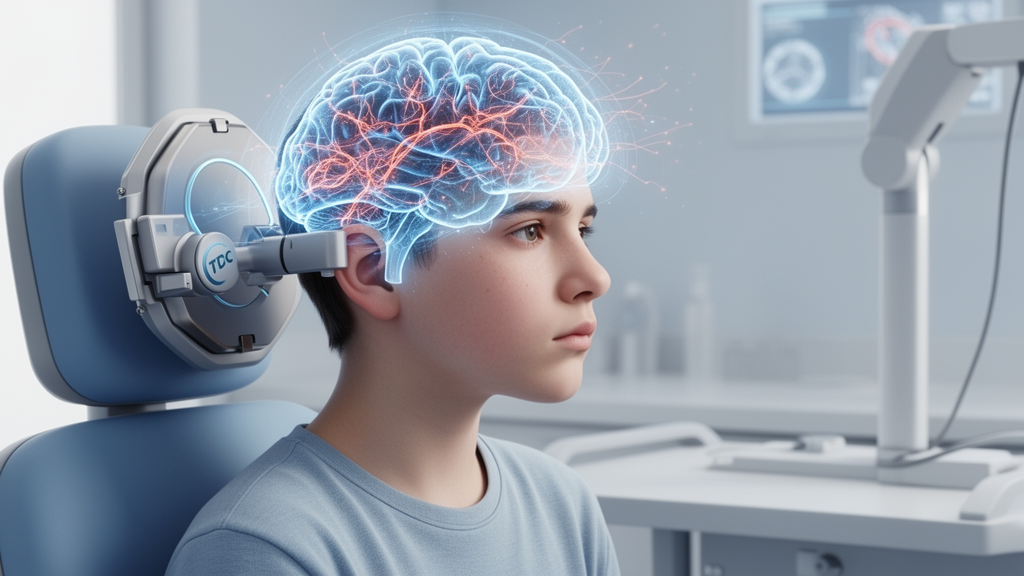
A recent randomized controlled trial investigated the therapeutic potential of integrating cognitive load-based interventions with repetitive transcranial magnetic stimulation (rTMS) to treat major depressive disorder (MDD) in adolescents, revealing that the combined approach yielded superior clinical outcomes compared to either treatment administered independently or a sham control.

The study, conducted at the Shandong Mental Health Center, involved a single-center, randomized, double-blind, sham-controlled trial design. Researchers recruited adolescents aged 11 to 18 years who were diagnosed with MDD from the outpatient department between June 2022 and December 2024. A total of sixty-four participants were randomly assigned to one of four distinct treatment arms: the combined rTMS plus cognitive load intervention group, the rTMS alone group, the cognitive load intervention group paired with sham rTMS, or a control group consisting of sham rTMS and control training.

The intervention protocols were highly specific and tailored to the participants. The combined group received 10 Hz rTMS delivered over the left dorsolateral prefrontal cortex. This stimulation was administered over 10 sessions spanning two weeks. Concurrently, participants engaged in an 8-week cognitive load program. This program utilized activities such as story writing and positive imagery, with the task difficulty being individually adjusted to meet the specific needs of each adolescent.

To assess the efficacy of these interventions, researchers measured both depression and positive affect before and after the treatment period. The primary tools employed for these measurements were the Self-Rating Depression Scale (SDS) to quantify depressive symptoms and the positive affect subscale of the Positive and Negative Affect Schedule (PANAS) to gauge emotional well-being.

The results demonstrated a clear advantage for the combined treatment strategy. The group receiving both rTMS and cognitive load intervention exhibited significantly lower depression scores following treatment, averaging 34.50 ± 3.59. This score was substantially lower than those reported by the cognitive load group (46.67 ± 10.23), the rTMS-only group (42.08 ± 9.87), and the control group (71.75 ± 8.36).

Furthermore, the combined group reported higher levels of positive affect (4.00 ± 0.54) compared to the cognitive load group (3.38 ± 0.90) and the control group (1.99 ± 0.52). The findings indicate that the synergistic effect of combining neurostimulation with targeted cognitive training leads to more robust improvements in both depressive symptoms and emotional state.

It is also noteworthy that both the single-treatment groups (rTMS alone and cognitive load intervention) demonstrated improved outcomes when compared to the control group, suggesting that both components of the intervention hold therapeutic value on their own. Crucially, the study reported no adverse events among the participants, indicating a favorable safety profile for the protocols tested.

The conclusions drawn from these preliminary findings suggest that combining left dorsolateral prefrontal cortex rTMS with cognitive load intervention provides greater reductions in depressive symptoms and larger increases in positive affect than either intervention utilized in isolation or the sham control. These results highlight a promising avenue for treating depression in adolescents.

The authors caution that these findings are preliminary and strongly warrant replication in larger, more extensive trials that incorporate longer-term follow-up to confirm the durability and generalizability of these therapeutic effects. The study was registered with the Medical Research Registration and Filing Information System under registration number MR‑37‑24‑036405.

Subject of Research: The synergistic effect of combining repetitive transcranial magnetic stimulation and cognitive load training to treat major depressive disorder in adolescents.

Article Title: The effect of transcranial magnetic stimulation combined with cognitive load training on adolescents with major depressive disorder: a randomized controlled trial

Article References: Liu, J., Zou, L., Xu, F., Chen, Z., Chen, Z., Fan, H., & Yang, L. (2026). The effect of transcranial magnetic stimulation combined with cognitive load training on adolescents with major depressive disorder: a randomized controlled trial. BMC Psychiatry. https://doi.org/10.1186/s12888-026-08805-4

Image Credits: AI Generated

DOI: 10.1186/s12888-026-08805-4

Keywords: Transcranial Magnetic Stimulation, Cognitive Load Training, Major Depressive Disorder, Adolescent Mental Health, Randomized Controlled Trial, Neuropsychology, Depression Treatment, effect, transcranial, magnetic, stimulation, combined

Cite Scienmag News

Glenn Wilkins. (October 27, 2026). Combined rTMS and Cognitive Load Training Significantly Reduces Depression in Adolescents. Scienmag. https://scienmag.com/combined-rtms-and-cognitive-load-training-significantly-reduces-depression-in-adolescents/

Glenn Wilkins. "Combined rTMS and Cognitive Load Training Significantly Reduces Depression in Adolescents." Scienmag, 27 October 2026, https://scienmag.com/combined-rtms-and-cognitive-load-training-significantly-reduces-depression-in-adolescents/. Accessed 27 October 2026.

Glenn Wilkins. "Combined rTMS and Cognitive Load Training Significantly Reduces Depression in Adolescents." Scienmag. October 27, 2026. https://scienmag.com/combined-rtms-and-cognitive-load-training-significantly-reduces-depression-in-adolescents/

Tags: adolescent depression treatmentadolescent major depressive disorderAdolescent Mental HealthCognitive Load Trainingcognitive load-based interventionscombinedcombined rTMS and cognitive load trainingdepression treatmentdorsolateral prefrontal cortex stimulationEffectinnovative depression treatment approachesmagneticmajor depressive disordermental health treatment for adolescentsneuropsychologyneurostimulation therapy for depressionnon-invasive brain stimulationpersonalized depression therapyRandomized Controlled Trialrandomized controlled trial depressionsham-controlled depression studiesstimulationTranscranialtranscranial magnetic stimulation
Share26Tweet16
Previous Post

Research report: Subjective sleep quality and sustained attention before and after a 24-hour smartphone restriction in adolescent swimmers: a single-group pretest–posttest study

Next Post

MicroRNA miR-221-3p Linked to Increased Respiratory Risks in Children Undergoing General Anesthesia

Related Posts

Delphi Study Establishes Consensus on Trauma-Informed Parenting Strategies
Psychology & Psychiatry

Delphi Study Establishes Consensus on Trauma-Informed Parenting Strategies

October 27, 2026
Research Reveals FOMO Is Driven by Automatic, Intuitive Emotional Responses
Psychology & Psychiatry

Research Reveals FOMO Is Driven by Automatic, Intuitive Emotional Responses

October 27, 2026
Research report: Mental well-being during the COVID-19 pandemic and its antecedents of crafting, work and home demands and resources: longitudinal profile analyses in Germany, Switzerland and Austria
Psychology & Psychiatry

Research report: Mental well-being during the COVID-19 pandemic and its antecedents of crafting, work and home demands and resources: longitudinal profile analyses in Germany, Switzerland and Austria

October 27, 2026
Digital Cues Boost Refillable Packaging Adoption Through Framing and Social Endorsement
Psychology & Psychiatry

Digital Cues Boost Refillable Packaging Adoption Through Framing and Social Endorsement

October 27, 2026
Farsi mental pain scales validated in suicidal Iranian adolescents
Psychology & Psychiatry

Farsi mental pain scales validated in suicidal Iranian adolescents

October 27, 2026
Korean School Counselors Fall Into Five Distinct Profiles in Supporting LGBTQ+ Students
Psychology & Psychiatry

Korean School Counselors Fall Into Five Distinct Profiles in Supporting LGBTQ+ Students

October 27, 2026
Next Post
MicroRNA miR-221-3p Linked to Increased Respiratory Risks in Children Undergoing General Anesthesia

MicroRNA miR-221-3p Linked to Increased Respiratory Risks in Children Undergoing General Anesthesia

  • Mothers who receive childcare support from maternal grandparents show more optimized

    Mothers who receive childcare support from maternal grandparents show more parental warmth, finds NTU Singapore study

    27656 shares
    Share 11059 Tweet 6912
  • University of Seville Breaks 120-Year-Old Mystery, Revises a Key Einstein Concept

    1061 shares
    Share 424 Tweet 265
  • Bee body mass, pathogens and local climate influence heat tolerance

    682 shares
    Share 273 Tweet 171
  • Researchers record first-ever images and data of a shark experiencing a boat strike

    546 shares
    Share 218 Tweet 137
  • Groundbreaking Clinical Trial Reveals Lubiprostone Enhances Kidney Function

    531 shares
    Share 212 Tweet 133
Science

Embark on a thrilling journey of discovery with Scienmag.com—your ultimate source for cutting-edge breakthroughs. Immerse yourself in a world where curiosity knows no limits and tomorrow’s possibilities become today’s reality!

RECENT NEWS

  • Acoustic study reveals how Igbo masquerade chanters shape their ritual voice
  • Radar Time Series Standardized to Track Congo Forest Loss in Weeks, Not Months
  • Antimalarial Drugs Linked to Longer Life in Huge Health-Record Study
  • New federated learning framework balances fairness, accuracy and blockchain cost

Categories

  • Agriculture
  • Anthropology
  • Archaeology
  • Athmospheric
  • Biology
  • Biotechnology
  • Blog
  • Bussines
  • Cancer
  • Chemistry
  • Climate
  • Earth Science
  • Editorial Policy
  • Marine
  • Mathematics
  • Medicine
  • Pediatry
  • Policy
  • Psychology & Psychiatry
  • Science Education
  • Science News
  • Social Science
  • Space
  • Technology and Engineering

Subscribe to Blog via Email

Enter your email address to subscribe to this blog and receive notifications of new posts by email.

Join 5,151 other subscribers

© 2025 Scienmag - Science Magazine

Welcome Back!

Login to your account below

Forgotten Password?

Retrieve your password

Please enter your username or email address to reset your password.

Log In
No Result
View All Result
  • HOME
  • SCIENCE NEWS
  • CONTACT US

© 2025 Scienmag - Science Magazine

Discover more from Science

Subscribe now to keep reading and get access to the full archive.

Continue reading