


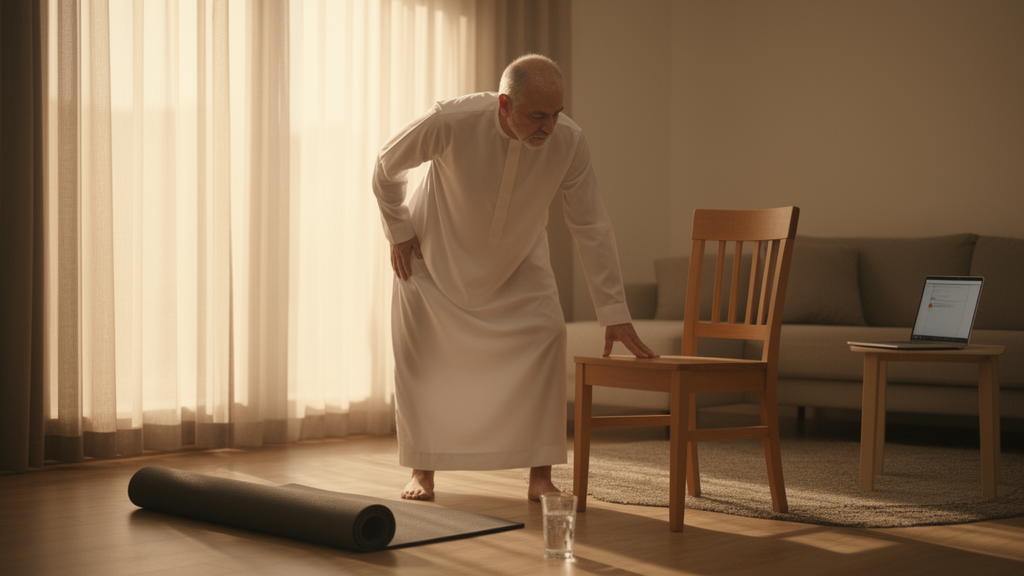
A qualitative focus-group study of 36 adults with low-risk musculoskeletal pain at a tertiary medical centre in Riyadh found that participants associated informal self-management with delayed access to professional physiotherapy. Most preferred virtual physiotherapy as follow-up after an in-person assessment and supervised practice, rather than as the entry point to rehabilitation. The study, published in BMC Health Services Research , did not test the clinical effectiveness of virtual care or establish causal relationships.
Researchers conducted eight gender-separated focus groups with adults recruited through physiotherapy triage referrals at the tertiary centre between July and October 2025. Participants had clinically confirmed back, neck, knee, shoulder or multisite musculoskeletal conditions and were classified as low risk using the STarT MSK prognostic tool. The sample included 19 women and 17 men, with most participants aged 30 to 59 years.
Chronic pain lasting at least three months was reported by 63.9%, and knee pain was the most common complaint at 38.8%. Mean pain intensity was 4.9, with a standard deviation of 2.2, on the Numeric Pain Rating Scale. Each session lasted 30 to 60 minutes and took place in private clinic rooms or over Zoom.
Audio recordings were transcribed in Arabic, initially with automated tools and then checked line by line against the recordings by the research team. A second researcher independently reviewed a random 20% sample. The analysis was conducted in Arabic through the six phases of reflexive thematic analysis developed by Braun and Clarke, and the study was reported in accordance with the Consolidated Criteria for Reporting Qualitative Research.
Reflexive journals, field notes and team discussions supported the analysis; member checking was not conducted, consistent with the method’s epistemological approach. Four interconnected themes emerged. The first, “self-management without structured guidance,” described patients using analgesics, topical treatments, compresses, massage, cupping, activity modification and other home practices while obtaining information from peers, social media, YouTube and AI chatbots.
Some participants found useful movement through self-directed exploration, while others reduced activity because they feared worsening pain or performing exercises incorrectly. The researchers interpreted these varied approaches as responses to limited professional guidance rather than evidence of a uniform lack of motivation. The second theme concerned barriers to physiotherapy engagement and adherence.
Participants described uncertainty about exercise technique, boredom with repeated exercises, long waiting times, irregular scheduling, geographic and financial constraints, and disruption caused by seeing different therapists. One participant reported waiting nine months between a medical appointment and a first physiotherapy session, although the researchers cautioned that this was an illustrative account rather than independently verified service-level data. Attention from a consistent therapist, follow-up asking whether exercises had continued, and support from extended family were described as factors that helped participants continue exercising.
The third theme addressed communication and educational needs. Patients reported difficulty understanding the source of their pain, interpreting diagnostic information and applying advice to daily life. They requested condition-specific teaching through illustrated materials, videos and professional contact.
Health literacy was not measured with a validated instrument, so the authors treated these accounts as evidence of unmet informational and communication needs rather than a quantified patient deficit. Similar difficulties were described across educational backgrounds, although the study did not formally compare groups. Across four of the eight focus groups, participants raised an educational need concerning adaptation of Islamic prayer, or Salah, during musculoskeletal pain.
They described receiving instructions to alter prayer positions but little or no physiotherapy guidance on safe movement during bowing and prostration. This theme was not included in the interview guide and emerged spontaneously during analysis. The study did not evaluate any prayer modification or establish its clinical safety.
The fourth theme was conditional acceptance of virtual and hybrid physiotherapy. Because structured virtual physiotherapy was not available as a service at the study site when data were collected, participants described anticipated preferences rather than experiences of virtual rehabilitation. Most preferred an initial face-to-face assessment and supervised practice before remote follow-up, allowing a therapist to examine the affected area and correct exercise technique.
Reported constraints included unstable internet connections, competing domestic demands, limited home equipment and exercises that could not be reproduced outside a clinic. Preferences for the number of in-person sessions before transition varied, indicating a general preference for hybrid care rather than support for a specific delivery protocol. The findings have important boundaries.
The study included only low-risk, Arabic-speaking patients recruited from one tertiary military healthcare setting in Riyadh, and its predominantly chronic sample may not represent people with acute pain or patients treated through primary care, private-sector or rural services. Of the 73 patients who completed screening, 37 were not enrolled because of risk-stratification exclusions or voluntary non-consent; reasons for voluntary non-consent among eligible low-risk patients were not systematically recorded. No formal strategy was used to maximise demographic or clinical variation.
Mixed in-person and Zoom sessions may have affected interaction and data richness, while the absence of a formal forward–backward translation process may have affected the nuance of translated quotations. As a single-site qualitative study, the research provides contextual understanding rather than statistical generalisability or causal inference. It cannot establish that access barriers caused particular self-management behaviours or that virtual care would improve clinical outcomes.
Gender-related observations were exploratory because no formal comparison was undertaken and moderator and group dynamics may have influenced disclosure. The findings formed the first phase of a broader programme and informed a culturally adapted hybrid virtual self-management programme for low-risk patients at the same institution, which is being evaluated separately in a prospective cohort study. Its effectiveness therefore remains unestablished by this qualitative work.
Subject of Research: Qualitative study of musculoskeletal pain self-management and preferences for hybrid physiotherapy in Riyadh
Article Title: Patients’ experiences of musculoskeletal pain self-management and perspectives on virtual physiotherapy in Saudi Arabia: a reflexive thematic analysis
Article References: AlMuhana, N., Alimam, D., Moslem, W., Shehan, S. B., Al Torairi, N., & Alsobayel, H. (2026). Patients’ experiences of musculoskeletal pain self-management and perspectives on virtual physiotherapy in Saudi Arabia: a reflexive thematic analysis. BMC Health Services Research, 26(1), Article 1343. https://doi.org/10.1186/s12913-026-15695-5
Image Credits: AI Generated
DOI: 10.1186/s12913-026-15695-5
Keywords: musculoskeletal pain, self-management, virtual physiotherapy, hybrid care, qualitative research, focus groups, health literacy, Saudi Arabia, access barriers, Islamic prayer, Patients, experiences
Cite Scienmag News
Ophelia Keating. (October 20, 2026). Research report: Patients’ experiences of musculoskeletal pain self-management and perspectives on virtual physiotherapy in Saudi Arabia: a reflexive thematic analysis. Scienmag. https://scienmag.com/research-report-patients-experiences-of-musculoskeletal-pain-self-management-and-perspectives-on-virtual-physiotherapy-in-saudi-arabia-a-reflexive-thematic-analysis/
Ophelia Keating. "Research report: Patients’ experiences of musculoskeletal pain self-management and perspectives on virtual physiotherapy in Saudi Arabia: a reflexive thematic analysis." Scienmag, 20 October 2026, https://scienmag.com/research-report-patients-experiences-of-musculoskeletal-pain-self-management-and-perspectives-on-virtual-physiotherapy-in-saudi-arabia-a-reflexive-thematic-analysis/. Accessed 20 October 2026.
Ophelia Keating. "Research report: Patients’ experiences of musculoskeletal pain self-management and perspectives on virtual physiotherapy in Saudi Arabia: a reflexive thematic analysis." Scienmag. October 20, 2026. https://scienmag.com/research-report-patients-experiences-of-musculoskeletal-pain-self-management-and-perspectives-on-virtual-physiotherapy-in-saudi-arabia-a-reflexive-thematic-analysis/


