


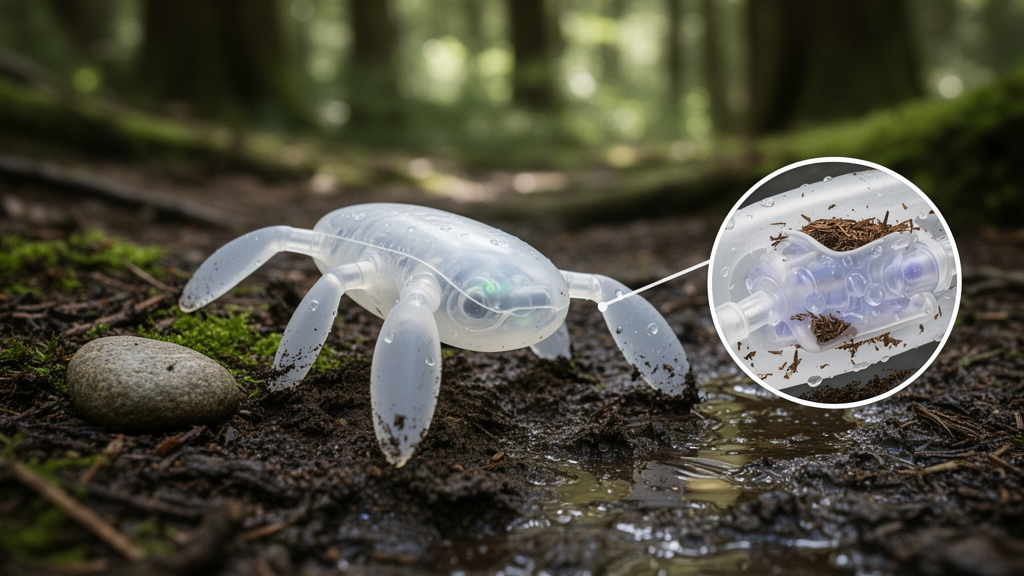
A review of untethered soft robots finds that the operating habitat is not merely a deployment setting but a primary constraint on body structure, materials, actuation, sensing and energy delivery. The synthesis organizes 100 representative studies with demonstrated untethered operation or wireless power or actuation across terrestrial, aquatic, aerial and in vivo environments. Its central result is that no broadly optimal design or actuation method emerges: each environment filters the available technologies according to how energy can reach the robot and how the robot must interact with its surroundings.
Performance figures therefore need to be interpreted with scale, test surface, depth, flow, load, power source and locomotion mode attached. Removing a physical tether changes the engineering problem because energy, actuation, sensing and control can no longer be assumed to arrive through a cable. Onboard batteries, pumps and controllers add mass and volume, while external magnetic, acoustic, optical or radiofrequency systems shift part of the burden to field generators that may restrict range or workspace.
The review therefore uses “untethered” in an operational sense: the demonstrated task is performed without a physical connection, although external fields, wireless commands, remote sensing or offboard computation may still be used. A remotely commanded robot is not automatically autonomous, and an electrically powered platform is not necessarily energy-independent. Comparisons are limited to configurations that meet those criteria, with tethered results and component-level demonstrations treated only as enabling evidence.
On land, habitat complexity changes the dominant mechanical challenge in several distinct ways. On relatively flat ground, robots must modulate friction to convert cyclic deformation into net movement. One untethered piezoelectric crawler followed a 27.9-centimetre S-shaped, light-defined path in 36.9 seconds using photoresistors and an onboard control circuit, but that result should not be confused with autonomous exploration of unknown terrain.
Independently controlled legs improve foothold placement and maneuverability, whereas body-driven crawling offers structural simplicity. When obstacles become comparable to the robot’s size, jumping becomes attractive because a launch impulse can clear discontinuities quickly. Combustion, laser-induced cavitation and snap-through structures can deliver large impulsive forces, but repeated loading, fuel handling, directional control and uncertain landing remain important limitations.
Vertical surfaces introduce a different problem: gravity pulls continuously against adhesion, so an untethered climber must support its body while still releasing and reattaching efficiently. Vacuum and electroadhesive devices can provide strong reversible attachment, but both generally require continuing energy. Passive or mechanically switchable fibrillar surfaces inspired by gecko toes are therefore especially relevant when sustained adhesion must consume little power.
Granular terrain creates still other demands. Curved shape-memory-alloy limbs support and propel robots over loose surfaces, whereas a tip-extending robot reduces subsurface resistance by fluidizing grains ahead of itself and steers around buried obstacles. Surface locomotion and burrowing are distinct tasks, and results from one should not be presented as evidence of the other.
Evaluation should therefore include repeated trials, substrate properties, payload, operating duration and task completion rather than speed alone. Aquatic habitats divide into surface, submerged and deep-sea regimes. At the air-water interface, capillary forces support robots only within a critical size and mass range, making wetting state, mass distribution and the stability of the supporting interface central concerns.
Superhydrophobic surfaces, travelling-wave fins, drag-based kicking, Marangoni propulsion and transient jumping each manipulate a different part of that interface. A 3.6-millimetre Stenus-inspired propulsor reportedly reached a peak of about 201 body lengths per second, illustrating how scale can magnify normalized speed, while a 35-millimetre water-surface jumper reached a take-off velocity of 3.52 metres per second and a height of 63 centimetres. Those values describe specialized interface manoeuvres, not sustained submerged swimming.
Reliable waterproofing is also essential because water ingress can damage electronics, alter buoyancy and deplete a fluidic working medium. Below the surface, hydrodynamic drag dominates, so propulsion architecture, maneuverability and depth control become more consequential than capillary support. Body-undulating swimmers may generate high thrust, whereas fin oscillation and flapping wings can offer stability and precise attitude control.
An untethered electrohydraulic-fin surface swimmer reached a reported 1.13 body lengths per second, while a separate pectoral-fin dielectric-elastomer device reached 0.69 body lengths per second. A jelly-like dielectric-elastomer swimmer travelled at 0.91 centimetres per second for 15.7 minutes on a 500-milliampere-hour battery. Active buoyancy can regulate depth without continuous thrust, but pumps, gears and phase-change systems add complexity.
Peak speed, endurance speed, maneuverability and pressure tolerance are separate measures and should not be collapsed into a single performance value. The deep sea imposes an even stricter test: hydrostatic pressure can compress structures, make polymers more glass-like and damage electronics. One design principle demonstrated by a snailfish-inspired robot was to partition a printed circuit board into smaller, wire-connected units embedded in silicone, reducing stress concentrations associated with large rigid inclusions.
A separate plasticized electrohydraulic robot used poly-α-olefin to soften a polyethylene shell while also serving as the working fluid; it swam and manoeuvred untethered at 4,071 metres in the South China Sea. These were distinct design examples, not a single integrated system. Together, they show why pressure-tolerant robots require coordinated attention to distributed structures, material state, cold-resistant actuation and electronics integration rather than reliance on a conventional rigid pressure vessel alone.
Air sharply tightens the mass and power budget. Flapping robots must generate lift, thrust and control torque under low-Reynolds-number conditions, and actuator choice always involves a compromise. Dielectric elastomers provide large strain but require high voltage; piezoelectrics offer high bandwidth and power density but need mechanical amplification; electromagnetic actuators provide force at the cost of mass.
Energy delivery is equally consequential. An insect-scale vehicle achieved sustained untethered flight with integrated photovoltaics under illumination at about three times solar intensity, while a 1.8-gram piezoelectric flyer used a sub-gram radiofrequency receiver with a reported power density of 4,900 watts per kilogram. Helium-assisted systems trade agility for lower hovering power, and passive seed-like flyers can disperse with little or no onboard actuation.
Their reported descent speeds cannot be compared directly with powered flight because gravity supplies much of their motion. Inside the body, wireless control, miniaturization, tissue compatibility and controlled cargo release must be satisfied together. Magnetic fields penetrate tissue and permit steering without an electrical connection, making them prominent in vascular and gastrointestinal robots.
Magnetic millirobots have carried a 91.4-milligram tablet in a stomach model, and microfiberbots have navigated neurovascular phantoms and a rabbit femoral artery while supporting elongation for constrictions and aggregation for embolization. Acoustic systems can generate propulsion, deformation and streaming flows, although acoustic communication by itself is not propulsion. Cargo strategies also differ: an acoustic micro-clampbot can grasp individual cells, ultrasound-activated cilia can move particles without direct contact, and red-blood-cell-derived or algae-based robots can carry integrated payloads and release them through optical disruption, acidic disassembly or pH-responsive caps.
Phantom, ex vivo and in vivo demonstrations remain distinct evidence levels and do not by themselves establish therapeutic effectiveness or broad biological safety. The quantitative comparison reinforces the habitat–actuation coupling. Terrestrial systems draw on the widest range of technologies, aerial systems cluster around electrical or passive aerodynamic approaches, and in vivo systems depend mainly on magnetic, acoustic and biohybrid mechanisms because these can transmit force through tissue or biological fluids.
Acoustic microswimmers can occupy the highest body-length-normalized region because their bodies are only tens of micrometres long, even though their millimetre-per-second absolute speeds are modest. Chemical and fluidic robots populate the high absolute-speed band, while biohybrid systems tend to move more slowly. Such comparisons are descriptive rather than a league table: peak speed, sustained speed, passive descent, propulsion, carried payload and pushed load are different measures, and results obtained under different test conditions cannot establish universal superiority.
The review identifies several barriers to sustained deployment: materials that can survive relevant abrasion, ultraviolet exposure, thermal cycling, water uptake, biofouling and biological immune responses; power architectures that account for sensing, computation and communication as well as locomotion; reliable transitions among land, water and air; extraterrestrial systems adapted to local gravity, atmosphere, radiation, vacuum and abrasive surfaces; and closed-loop control linking observation to corrective action. Material lifetime and end-of-life routes should be chosen before deployment, and self-healing should be judged by restoration of system function after realistic damage rather than by material recovery alone. Hybrid energy systems may improve endurance, but their added mass and external infrastructure must be reported.
Physical untethering, energy autonomy and task autonomy should be evaluated as separate properties: a robot can be free of a cable while still depending on an external magnetic field, operator or imaging system.
Subject of Research: Habitat-specific design, actuation and energy delivery in untethered soft robots across terrestrial, aquatic, aerial and in vivo environments.
Article Title: Habitat‐Specific Design Strategies for Untethered Soft Robots
Article References: Li, S., Miao, Z., Wong, T.-W., & Li, T. (2026). Habitat‐Specific Design Strategies for Untethered Soft Robots. Advanced Science, Article e78287. https://doi.org/10.1002/advs.78287
Image Credits: AI Generated
DOI: 10.1002/advs.78287
Keywords: untethered soft robots, habitat-specific design, soft robotics, robotic actuation, terrestrial robots, aquatic robots, aerial robots, in vivo robots, energy autonomy, closed-loop control, Habitat, Specific
Cite Scienmag News
Denise Maddox. (October 20, 2026). Research report: Habitat‐Specific Design Strategies for Untethered Soft Robots. Scienmag. https://scienmag.com/research-report-habitat%e2%80%90specific-design-strategies-for-untethered-soft-robots/
Denise Maddox. "Research report: Habitat‐Specific Design Strategies for Untethered Soft Robots." Scienmag, 20 October 2026, https://scienmag.com/research-report-habitat%e2%80%90specific-design-strategies-for-untethered-soft-robots/. Accessed 20 October 2026.
Denise Maddox. "Research report: Habitat‐Specific Design Strategies for Untethered Soft Robots." Scienmag. October 20, 2026. https://scienmag.com/research-report-habitat%e2%80%90specific-design-strategies-for-untethered-soft-robots/


