

Sunday, October 25, 2026
Science
No Result
View All Result
  • Login
  • HOME
  • SCIENCE NEWS
  • CONTACT US
  • HOME
  • SCIENCE NEWS
  • CONTACT US
No Result
View All Result
Scienmag
No Result
View All Result
Home Science News Cancer

Research report: Clinicopathological and molecular correlates of micropapillary/solid and lepidic patterns in lung adenocarcinoma

October 25, 2026
in Cancer
Nathaniel Bowman
By Nathaniel Bowman Scienmag Editorial Profile - Precision Oncology
Reading Time: 2 mins read
0
Research report: Clinicopathological and molecular correlates of micropapillary/solid and lepidic patterns in lung adenocarcinoma

Research report: Clinicopathological and molecular correlates of micropapillary/solid and lepidic patterns in lung adenocarcinoma

65
SHARES
587
VIEWS
Share on FacebookShare on Twitter
ADVERTISEMENT

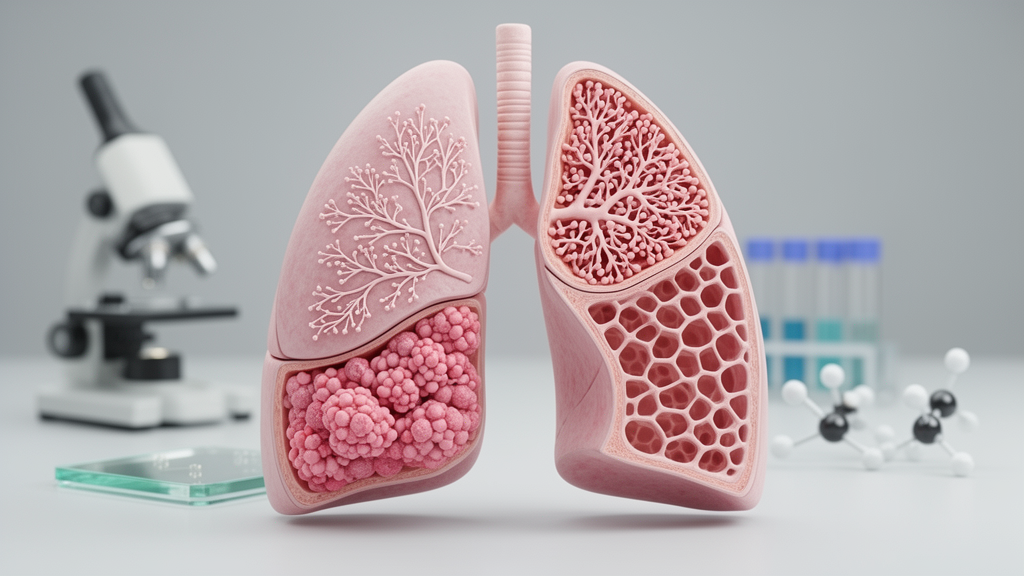
In a retrospective study of 73 Chinese patients with invasive non-mucinous lung adenocarcinoma, tumors containing micropapillary/solid components were associated with a higher proportion of men and patients with a smoking history, while tumors containing lepidic components had a lower Ki-67 proliferation index. The findings suggest that these histological components can mark biologically distinct features of the disease even when they are not the predominant pattern in a tumor. Researchers evaluated micropapillary/solid and lepidic components irrespective of whether either was dominant, focusing on their associations with pathological features, genomic alterations and perioperative circulating tumor DNA, or ctDNA.

Most of the cohort had early-stage disease: 52 of 73 patients, or 71.2%, had stage I disease, comprising 37 classified as stage IA and 15 as stage IB. The other 21 patients, representing 28.8%, had stage II–IV disease. The investigators used definitive histological subtyping and next-generation sequencing data to compare tumor characteristics.

Men accounted for 55.2% of patients whose tumors contained micropapillary/solid components, compared with 22.7% of those whose tumors did not, a difference associated with a P value of 0.006. Patients with a smoking history made up 44.8% of the micropapillary/solid-positive group, versus 20.5% of the negative group, with P = 0.037. Histological combinations further separated the groups by proliferative activity.

Tumors that were micropapillary/solid positive and lepidic negative had the highest Ki-67 expression, at 30%, and differed significantly from tumors that were micropapillary/solid negative and lepidic positive, for which the reported P value was 0.037. Exploratory genomic analyses of this micropapillary/solid-positive, lepidic-negative subgroup also showed numerical enrichment of KRAS, MET, STK11 and CDKN2A alterations, alongside a lower EGFR alteration rate. None of these genomic differences reached statistical significance, so the findings do not establish a mutation-defined subtype.

The study also used individualized tumor-informed ctDNA detection to examine changes around surgery. Detectable ctDNA was found before surgery in 7 of 31 patients and after surgery in 5 of 28 patients with available samples. All detections occurred among patients whose tumors lacked a lepidic component, but this association was not statistically significant.

Overall, the analysis associates micropapillary/solid and lepidic components with distinct clinical and proliferative characteristics, while the possible genomic and ctDNA relationships remain signals that warrant further investigation.

Subject of Research: Histological and molecular correlates of micropapillary/solid and lepidic patterns in invasive non-mucinous lung adenocarcinoma

Article Title: Clinicopathological and molecular correlates of micropapillary/solid and lepidic patterns in lung adenocarcinoma

Article References: Fang, X., Zhang, L., Li, J., Li, S., Wang, H., Zhu, T., Lu, Y., & Xia, H. (2026). Clinicopathological and molecular correlates of micropapillary/solid and lepidic patterns in lung adenocarcinoma. BMC Cancer. https://doi.org/10.1186/s12885-026-16913-3

Image Credits: AI Generated

DOI: 10.1186/s12885-026-16913-3

Keywords: lung adenocarcinoma, micropapillary/solid pattern, lepidic pattern, Ki-67, next-generation sequencing, circulating tumor DNA, tumor genomics, retrospective cohort, proliferation, molecular residual disease, Clinicopathological, molecular

Cite Scienmag News

Nathaniel Bowman. (October 25, 2026). Research report: Clinicopathological and molecular correlates of micropapillary/solid and lepidic patterns in lung adenocarcinoma. Scienmag. https://scienmag.com/research-report-clinicopathological-and-molecular-correlates-of-micropapillary-solid-and-lepidic-patterns-in-lung-adenocarcinoma/


Nathaniel Bowman. "Research report: Clinicopathological and molecular correlates of micropapillary/solid and lepidic patterns in lung adenocarcinoma." Scienmag, 25 October 2026, https://scienmag.com/research-report-clinicopathological-and-molecular-correlates-of-micropapillary-solid-and-lepidic-patterns-in-lung-adenocarcinoma/. Accessed 25 October 2026.

Nathaniel Bowman. "Research report: Clinicopathological and molecular correlates of micropapillary/solid and lepidic patterns in lung adenocarcinoma." Scienmag. October 25, 2026. https://scienmag.com/research-report-clinicopathological-and-molecular-correlates-of-micropapillary-solid-and-lepidic-patterns-in-lung-adenocarcinoma/

Tags: circulating tumor DNAcirculating tumor DNA in lung cancerclinicopathologicalclinicopathological features of lung adenocarcinomaearly-stage lung adenocarcinomagenomic alterations in lung adenocarcinomahistological subtyping in lung cancer prognosisKi-67Ki-67 proliferation index in lung tumorslepidic patternlepidic pattern in lung cancerlung adenocarcinomamicropapillary and solid tumor componentsmicropapillary/solid patternmolecularmolecular characterization of lung tumorsmolecular residual diseasenext-generation sequencingproliferationretrospective cohortretrospective study of lung adenocarcinomasmoking history and lung cancer subtypestumor genomics
Share26Tweet16
Previous Post

Chloroplast genomes reveal unexpected diversity within four Actinidia species

Next Post

Study confirms two novel alternatively spliced human RAB8B transcripts

Related Posts

Epigenetic YAP1–TEAD–TET1 pathway drives liver cancer without driver mutations
Cancer

Epigenetic YAP1–TEAD–TET1 pathway drives liver cancer without driver mutations

October 25, 2026
Multi-omics study links ELF1 to B-cell states in breast cancer
Cancer

Multi-omics study links ELF1 to B-cell states in breast cancer

October 25, 2026
Five Years Without Recurrence: Short-Course Immunotherapy Reshapes dMMR Colon Cancer Care
Cancer

Five Years Without Recurrence: Short-Course Immunotherapy Reshapes dMMR Colon Cancer Care

October 25, 2026
Lung cancer in Martinique shows high never-smoker share and frequent EGFR mutations
Cancer

Lung cancer in Martinique shows high never-smoker share and frequent EGFR mutations

October 25, 2026
Tumor Cell PD-L1 Score Predicts Longer Survival in Gastric Cancer Treated with Chemotherapy Alone
Cancer

Tumor Cell PD-L1 Score Predicts Longer Survival in Gastric Cancer Treated with Chemotherapy Alone

October 24, 2026
How Antiviral Innate Immunity Shapes Viral Myocarditis Outcomes
Cancer

How Antiviral Innate Immunity Shapes Viral Myocarditis Outcomes

October 24, 2026
Next Post
Study confirms two novel alternatively spliced human RAB8B transcripts

Study confirms two novel alternatively spliced human RAB8B transcripts

  • Mothers who receive childcare support from maternal grandparents show more optimized

    Mothers who receive childcare support from maternal grandparents show more parental warmth, finds NTU Singapore study

    27656 shares
    Share 11059 Tweet 6912
  • University of Seville Breaks 120-Year-Old Mystery, Revises a Key Einstein Concept

    1061 shares
    Share 424 Tweet 265
  • Bee body mass, pathogens and local climate influence heat tolerance

    682 shares
    Share 273 Tweet 171
  • Researchers record first-ever images and data of a shark experiencing a boat strike

    546 shares
    Share 218 Tweet 137
  • Groundbreaking Clinical Trial Reveals Lubiprostone Enhances Kidney Function

    531 shares
    Share 212 Tweet 133
Science

Embark on a thrilling journey of discovery with Scienmag.com—your ultimate source for cutting-edge breakthroughs. Immerse yourself in a world where curiosity knows no limits and tomorrow’s possibilities become today’s reality!

RECENT NEWS

  • Study confirms two novel alternatively spliced human RAB8B transcripts
  • Research report: Clinicopathological and molecular correlates of micropapillary/solid and lepidic patterns in lung adenocarcinoma
  • Chloroplast genomes reveal unexpected diversity within four Actinidia species
  • Two-Dimensional Flash Memory Redefines Speed, Power, and Reliability Trade-Offs

Categories

  • Agriculture
  • Anthropology
  • Archaeology
  • Athmospheric
  • Biology
  • Biotechnology
  • Blog
  • Bussines
  • Cancer
  • Chemistry
  • Climate
  • Earth Science
  • Editorial Policy
  • Marine
  • Mathematics
  • Medicine
  • Pediatry
  • Policy
  • Psychology & Psychiatry
  • Science Education
  • Science News
  • Social Science
  • Space
  • Technology and Engineering

Subscribe to Blog via Email

Enter your email address to subscribe to this blog and receive notifications of new posts by email.

Join 5,151 other subscribers

© 2025 Scienmag - Science Magazine

Welcome Back!

Login to your account below

Forgotten Password?

Retrieve your password

Please enter your username or email address to reset your password.

Log In
No Result
View All Result
  • HOME
  • SCIENCE NEWS
  • CONTACT US

© 2025 Scienmag - Science Magazine

Discover more from Science

Subscribe now to keep reading and get access to the full archive.

Continue reading