


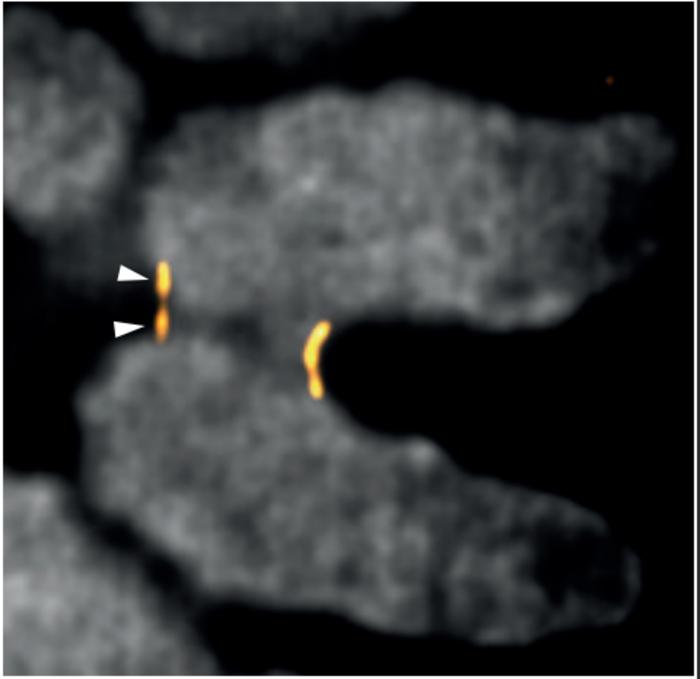
Researchers from the Kops group in collaboration with researchers from the University of Edinburgh, made a surprising new discovery in the structure of the centromere, a structure that is involved in ensuring that chromosomes are segregated properly when a cell divides. Mistakes in chromosome segregation can lead to cell death and cancer development. The researchers discovered that the centromere consists of two subdomains. This fundamental finding has important implications for the process of chromosome segregation and provides new mechanisms underlying erroneous divisions in cancer cells. The research was published in Cell on May 13th 2024.

Credit: Credit: Carlos Sacristan. Copyright: Hubrecht Institute.
Researchers from the Kops group in collaboration with researchers from the University of Edinburgh, made a surprising new discovery in the structure of the centromere, a structure that is involved in ensuring that chromosomes are segregated properly when a cell divides. Mistakes in chromosome segregation can lead to cell death and cancer development. The researchers discovered that the centromere consists of two subdomains. This fundamental finding has important implications for the process of chromosome segregation and provides new mechanisms underlying erroneous divisions in cancer cells. The research was published in Cell on May 13th 2024.
Our bodies consist of trillions of cells, most of which have a limited life span and therefore need to reproduce to replace the old ones. This reproduction process is referred to as cell division or mitosis. During mitosis, the parent cell will duplicate its chromosomes in order to pass down the genetic material to the daughter cells. The resulting identical pairs of chromosomes, the sister chromatids, are held together by a structure called the centromere. The sister chromatids then need to be evenly split over the two daughter cells to ensure that each daughter cell is an exact copy of the parent cell. If errors happen during the segregation, one daughter cell will have too many chromosomes, while the other has too few. This can lead to cell death or cancer development.
The role of the centromere
The centromere is a part of the chromosome that plays a vital role in chromosome segregation during mitosis. The process of dividing the sister chromatids over the cells is guided by the interaction between the centromeres and structures known as spindle microtubules. These spindle microtubules are responsible for pulling the chromatids apart and thus separating the two sister chromatids. Carlos Sacristan Lopez, the first author of this study, explains: ‘If the attachment of the centromere to the spindle microtubules does not occur properly it leads to chromosome segregation mistakes which are frequently observed in cancer.’ Understanding the structure of the centromere can contribute to more insights into the function of the centromere and its role in erroneous chromosomal segregation.
A surprising discovery
To investigate the centromere structure, the researchers used a combination of imaging and sequencing techniques. The super-resolution microscopy imaging took place at the Hubrecht Institute, while the group of Bill Earnshaw performed the sequencing. This collaboration led to a surprising new discovery in the centromere structure. Previously believed to consist of a compact structure attaching to multiple spindle microtubules, it was instead revealed that the centromere consists of two subdomains. Carlos explains: ‘This discovery was very surprising, as subdomains bind microtubules independently of each other. Yet, to form correct attachments, they must remain closely connected. In cancer cells, however, we often observe that subdomains uncouple, resulting in erroneous attachments and chromosome segregation errors.’
This very exciting and fundamental discovery contributes to our understanding of the origin of chromosome segregation errors which are frequently seen in cancer.
Publication
Vertebrate centromeres in mitosis are functionally bipartite structures stabilized by cohesin. Carlos Sacristan, Kumiko Samejima, Lorena Andrade Ruiz, Moonmoon Deb, Maaike L.A. Lambers, Adam Buckle, Chris A. Brackley, Daniel Robertson, Tetsuya Hori, Shaun Webb, Robert Kiewisz, Tristan Bepler, Eloïse van Kwawegen, Patrik Risteski, Kruno Vukušić, Iva M. Tolić, Thomas Müller-Reichert, Tatsuo Fukagawa, Nick Gilbert, Davide Marenduzzo, William C. Earnshaw, and Geert J.P.L. Kops.
***************************************************************************************************************************************************************************************************************************
About Geert Kops:
Geert Kops is director of the Hubrecht Institute, group leader, professor of Molecular Tumor Cell Biology at the University Medical Center Utrecht and Oncode Investigator.
About the Hubrecht Institute:
The Hubrecht Institute is a research institute focused on developmental and stem cell biology. Because of the dynamic character of the research, the institute has a variable number of research groups, around 20, that do fundamental, multidisciplinary research on healthy and diseased cells, tissues and organisms. The Hubrecht Institute is a research institute of the Royal Netherlands Academy of Arts and Sciences (KNAW), situated on Utrecht Science Park. Since 2008, the institute is affiliated with the UMC Utrecht, advancing the translation of research to the clinic. The Hubrecht Institute has a partnership with the European Molecular Biology Laboratory (EMBL). For more information, visit www.hubrecht.eu.
Journal
Cell
Method of Research
Experimental study
Subject of Research
Cells
Article Title
Vertebrate centromeres in mitosis are functionally bipartite structures stabilized by cohesin
Article Publication Date
13-May-2024
Cite Scienmag News
Nathaniel Bowman. (May 13, 2024). Research on centromere structure yields new insights into the mechanisms of chromosome segregation errors. Scienmag. https://scienmag.com/research-on-centromere-structure-yields-new-insights-into-the-mechanisms-of-chromosome-segregation-errors/
Nathaniel Bowman. "Research on centromere structure yields new insights into the mechanisms of chromosome segregation errors." Scienmag, 13 May 2024, https://scienmag.com/research-on-centromere-structure-yields-new-insights-into-the-mechanisms-of-chromosome-segregation-errors/. Accessed 7 September 2026.
Nathaniel Bowman. "Research on centromere structure yields new insights into the mechanisms of chromosome segregation errors." Scienmag. May 13, 2024. https://scienmag.com/research-on-centromere-structure-yields-new-insights-into-the-mechanisms-of-chromosome-segregation-errors/

