


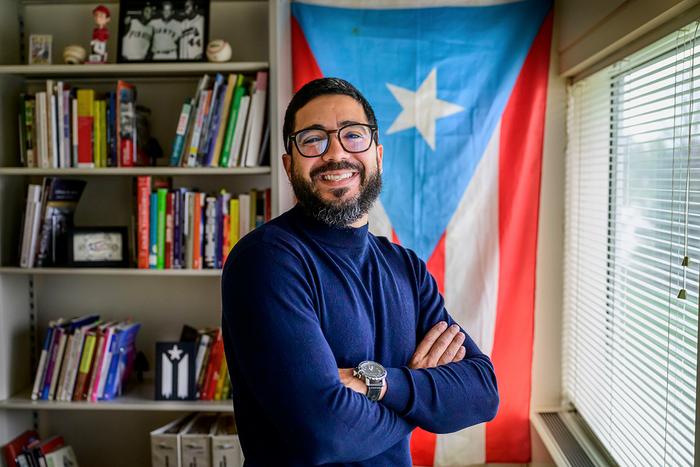
CHAMPAIGN, Ill. — Social media can be a useful tool for communicating during extreme weather events. Omar Pérez Figueroa, an urban and regional planning professor at the University of Illinois Urbana-Champaign, examined how Twitter (now X) was used when Hurricane María hit Puerto Rico in 2017.

Credit: Photo by Fred Zwicky
CHAMPAIGN, Ill. — Social media can be a useful tool for communicating during extreme weather events. Omar Pérez Figueroa, an urban and regional planning professor at the University of Illinois Urbana-Champaign, examined how Twitter (now X) was used when Hurricane María hit Puerto Rico in 2017.
His findings are published in the Journal of Environmental Studies and Sciences.
Pérez Figueroa studies how impoverished and marginalized communities address environmental inequalities, water governance and disaster resilience.
For his research on social media and risk communication, he collected data from Twitter before the platform changed its name, so he continued to refer to it as Twitter for his study. He analyzed a sample of more than 2,000 tweets from before Hurricane María made landfall to six months after the storm to determine “what the event tells us about the reactions and behavior of people, and what is useful to understand to be better prepared.”
Pérez Figueroa analyzed the timing of the tweets and their geographic distribution. Most of them were made prior to landfall, with smaller peaks of activity at later times – for example, when the Federal Emergency Management Agency deleted Puerto Rican disaster statistics from its website. In the U.S., those tweeting about the hurricane were highly concentrated in Florida, California, New York and Texas, all areas with large Puerto Rican populations.
The sample included tweets from Puerto Rico, despite the collapse of the island’s power grid. Pérez Figueroa said Twitter doesn’t require a strong signal, making sending messages under disaster conditions more accessible.
He identified three main categories of messages: information about what was happening on the ground in Puerto Rico; understanding the social and political conditions that turned the hurricane into a disaster; and emotional messages seeking help or expressing support. Those in Puerto Rico used social media to inform others about their condition and location, ask for and receive help, and document the disaster.
Pérez Figueroa wrote that many tweets about the sociopolitical causes of the disaster blamed local and federal governments for their slow and inefficient response. He said it underscored the use of social media in solidarity and grassroots recovery efforts; as a tool to pressure for prompt government response and the development of policies that address vulnerabilities; and to communicate needs and raise awareness among people not directly affected by the local event about where to donate.
The tweets included information about the Guajataca Dam failure as it occurred.
“Being able to access critical data during and after a disaster can provide the difference between life and death, especially for those on the ground. Recognizing the increasing use of social media for disaster response and aid can increase communities’ disaster resilience, especially when the communities hardest hit have limited communication and are remote, like the case of Puerto Rico,” Pérez Figueroa wrote.
In addition to aiding in preparedness and recovery for future disasters, the research served as a case study to test and refine a framework for examining disaster social media communication, Pérez Figueroa said.
“Understanding how individuals use Twitter during disasters and in the immediate aftermath will be important as hurricanes occur more frequently, and as the public continues to turn to social media as a mainstream news source. Public health and disaster response organizations will benefit from a more detailed understanding as to who and how communication on social media can play a role in mitigating the public health burdens that result from disaster events,” he wrote.
Pérez Figueroa said areas for future research include how traditional media can influence discussions on social media, how narratives on the two differ, whether social media influences emergency responders and policymakers to improve disaster response, and how groups from different socioeconomic levels use social media during disasters.
Editor’s notes: To contact Omar Pérez Figueroa, email operez10@illinois.edu.
The paper “A content analysis of social media discourse during Hurricane María: filling a void when traditional media are silent” is available online.
Journal
Journal of Environmental Studies and Sciences
Method of Research
Content analysis
Subject of Research
Not applicable
Article Title
A content analysis of social media discourse during Hurricane María: filling a void when traditional media are silent
Article Publication Date
26-Mar-2024
COI Statement
The authors declare no competing interests.
Cite Scienmag News
Russell Cooper. (April 9, 2024). Research examines tweets during Hurricane María to analyze social media use during disasters. Scienmag. https://scienmag.com/research-examines-tweets-during-hurricane-maria-to-analyze-social-media-use-during-disasters/
Russell Cooper. "Research examines tweets during Hurricane María to analyze social media use during disasters." Scienmag, 9 April 2024, https://scienmag.com/research-examines-tweets-during-hurricane-maria-to-analyze-social-media-use-during-disasters/. Accessed 4 September 2026.
Russell Cooper. "Research examines tweets during Hurricane María to analyze social media use during disasters." Scienmag. April 9, 2024. https://scienmag.com/research-examines-tweets-during-hurricane-maria-to-analyze-social-media-use-during-disasters/

