


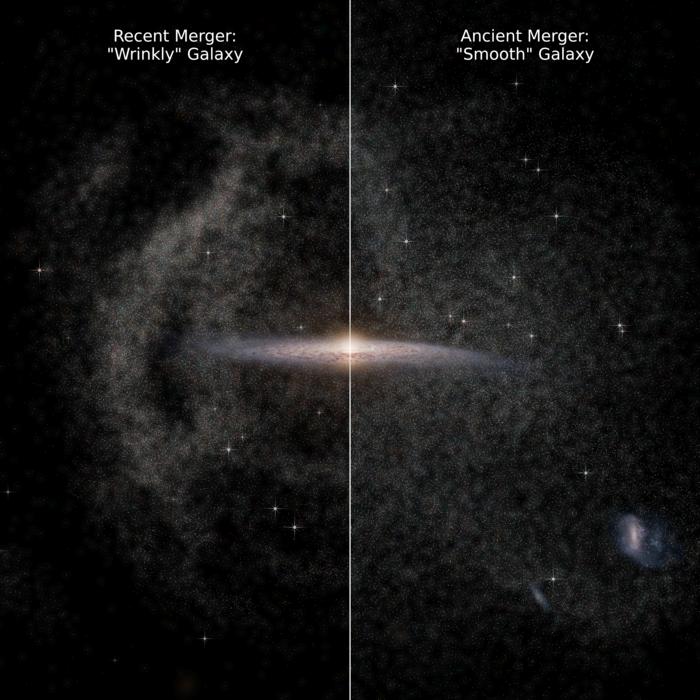
Rensselaer Polytechnic Institute’s Heidi Jo Newberg, Ph.D., professor of astronomy; Tom Donlon, Ph.D., a visiting researcher at Rensselaer and a postdoctoral researcher at the University of Alabama; and their team have recently published research that reveals a shocking discovery about the history of our universe: the Milky Way Galaxy’s last major collision occurred billions of years later than previously thought.

Credit: Halo stars: ESA/Gaia/DPAC, T Donlon et al. 2024; Background Milky Way and Magellanic Clouds: Stefan Payne-Wardenaar;; LICENCE: CC BY-SA 3.0 IGO or ESA Standard License
Rensselaer Polytechnic Institute’s Heidi Jo Newberg, Ph.D., professor of astronomy; Tom Donlon, Ph.D., a visiting researcher at Rensselaer and a postdoctoral researcher at the University of Alabama; and their team have recently published research that reveals a shocking discovery about the history of our universe: the Milky Way Galaxy’s last major collision occurred billions of years later than previously thought.
The discovery was made possible by the European Space Agency’s Gaia spacecraft, which is mapping more than a billion stars throughout the Milky Way and beyond, tracking their motion, luminosity, temperature, and composition. Newberg, a renowned astrophysicist and Milky Way expert, and Donlon focused on the so-called “wrinkles” in our galaxy, which are formed when other galaxies collide with the Milky Way.
“We get wrinklier as we age, but our work reveals that the opposite is true for the Milky Way. It’s a sort of cosmic Benjamin Button, getting less wrinkly over time,” said Donlon, lead author of the new Gaia study, which also served as his doctoral thesis at Rensselaer. “By looking at how these wrinkles dissipate over time, we can trace when the Milky Way experienced its last big crash – and it turns out this happened billions of years later than we thought.”
By comparing their observations of the wrinkles with cosmological simulations, the team was able to determine that our last significant collision with another galaxy did not, in fact, occur between eight and 11 billion years ago, as previously believed.
“For the wrinkles of stars to be as obvious as they appear in Gaia data, they must have joined us no less than three billion years ago – at least five billion years later than was previously thought,” said Newberg, Donlon’s thesis adviser at Rensselaer. “New wrinkles of stars form each time the stars swing back and forth through the center of the Milky Way. If they’d joined us eight billion years ago, there would be so many wrinkles right next to each other that we would no longer see them as separate features.”
The collision is thought to have resulted in a large number of stars with unusual orbits. Previously, scientists dated it at between eight and 11 billion years ago in a collision called the Gaia-Sausage-Enceladus (GSE) merger. Rather, Newberg and Donlon’s findings indicate that the stars may have resulted from the Virgo Radial Merger, which crashed through the center of the Milky Way less than three billion years ago.
“Gaia is a hugely productive mission that’s transforming our view of the cosmos,” says Timo Prusti, Ph.D., Project Scientist for Gaia at the European Space Agency. “Results like this are made possible due to incredible teamwork and collaboration between a huge number of scientists and engineers across Europe and beyond.”
“Through this study, Doctors Newberg and Donlon have made a startling discovery about the history of the Milky Way galaxy,” said Curt Breneman, Ph.D., dean of the School of Science. “Gaia data is offering unprecedented opportunities to better understand our universe, and I am thrilled that Rensselaer researchers were able to harness the power of this incredibly detailed new data.”
Newberg and Donlon were joined in research by Robyn Sanderson, Ph.D., of the University of Pennsylvania and Flatiron Institute; Emily Bregou, Ph.D., Arpit Arora, Ph.D., and Nondh Panithanpaisal, Ph.D. of the University of Pennsylvania; and Danny Horta, Ph.D., of the Flatiron Institute and the Astrophysics Research Institute.
Photos and animation may be downloaded at this link. Credit: Halo stars: ESA/Gaia/DPAC, T Donlon et al. 2024; Background Milky Way and Magellanic Clouds: Stefan Payne-Wardenaar;; LICENCE: CC BY-SA 3.0 IGO or ESA Standard License (content can be used under either license).
###
About Rensselaer Polytechnic Institute:
Founded in 1824 for the application of science to the common purposes of life, Rensselaer Polytechnic Institute is the first technological research university in the United States. Today, it is recognized as a premier university, noted for its robust and holistic learning community that connects creativity with science and technology. RPI is dedicated to inventing for the future, from shaping the scientists, engineers, technologists, architects, and entrepreneurs who will define what’s next for humanity, to research that bridges disciplines to solve the world’s toughest problems. Learn more at rpi.edu.
Contact:
Katie Malatino
malatk@rpi.edu
838-240-5691
For general inquiries: newsmedia@rpi.edu
Visit the Rensselaer research and discovery blog:
Follow us on Twitter: @RPINews
Journal
Monthly Notices of the Royal Astronomical Society
Article Title
The debris of the ‘last major merger’ is dynamically young
Article Publication Date
16-May-2024
Cite Scienmag News
Grant Pearson. (June 6, 2024). Rensselaer researchers upend theory about the formation of the Milky Way Galaxy. Scienmag. https://scienmag.com/rensselaer-researchers-upend-theory-about-the-formation-of-the-milky-way-galaxy/
Grant Pearson. "Rensselaer researchers upend theory about the formation of the Milky Way Galaxy." Scienmag, 6 June 2024, https://scienmag.com/rensselaer-researchers-upend-theory-about-the-formation-of-the-milky-way-galaxy/. Accessed 3 September 2026.
Grant Pearson. "Rensselaer researchers upend theory about the formation of the Milky Way Galaxy." Scienmag. June 6, 2024. https://scienmag.com/rensselaer-researchers-upend-theory-about-the-formation-of-the-milky-way-galaxy/

