


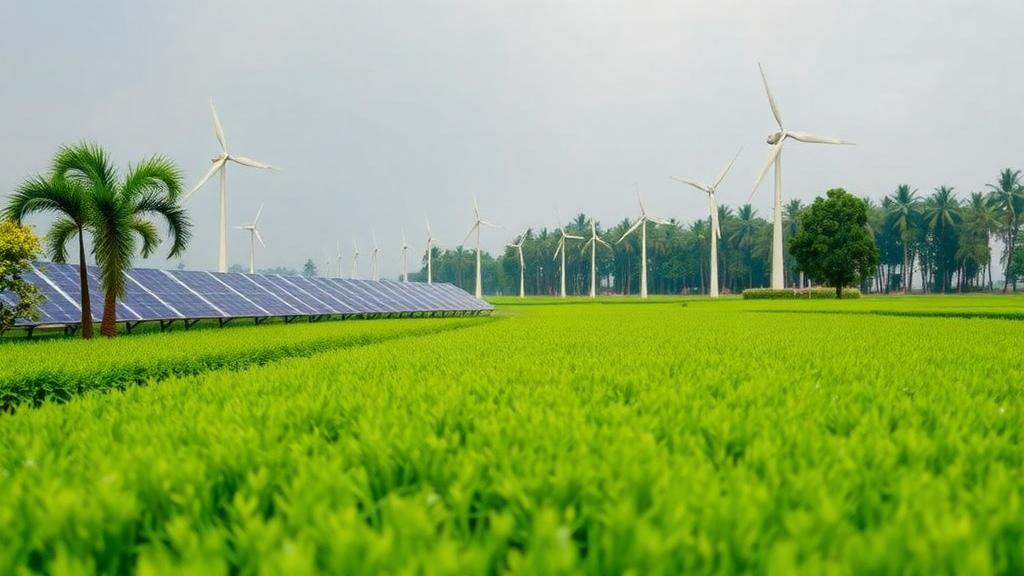
When global energy prices spike, the consequences ripple far beyond household bills and inflation figures. For South Asia, a region home to nearly a quarter of humanity and some of the world’s most climate-vulnerable landscapes, the question of whether clean energy can buffer ecosystems against such shocks is not academic. A new study published in Theoretical and Applied Climatology suggests the answer is more complicated than the usual optimistic narrative about renewables. Drawing on nearly five decades of data from six South Asian countries, researchers led by Md. Rony Masud of Bangladesh Bank and Rikkyo University in Tokyo have found that while renewable energy genuinely improves ecological sustainability, it offers no protection during episodes of major price volatility.
The study’s central metric is the Load Capacity Factor, or LCF, an increasingly popular indicator in environmental economics. Unlike the ecological footprint alone, which measures how much biologically productive land and water a population demands, or biocapacity alone, which measures how much nature can regenerate, the LCF is the ratio of the two. A value above one means a country is living within its ecological means; a value below one signals that demand is outstripping what ecosystems can supply. Because it captures both sides of the ledger, the LCF is considered a more honest gauge of sustainability than carbon emissions alone, which ignore pressures such as cropland degradation, overfishing, and deforestation.
To build their dataset, the authors combined indicators from the World Bank’s World Development Indicators with biocapacity and footprint accounts from the Global Footprint Network, covering six South Asian economies across a span of roughly forty-seven years. That temporal depth matters. It allows the analysis to span multiple global energy cycles, including the oil shocks of earlier decades and the turbulence that followed geopolitical disruptions to gas and oil supplies in recent years. The region is a particularly instructive laboratory: South Asian economies remain heavily dependent on imported fossil fuels, energy demand is growing rapidly with industrialisation and urbanisation, and ecological stress is already severe in countries such as Bangladesh, Pakistan, and India.
The first headline finding is deceptively simple. Renewable energy consumption raises the Load Capacity Factor, confirming that shifting the energy mix toward solar, hydro, and other clean sources does improve the balance between what nature provides and what economies consume. This aligns with a growing body of panel studies across Asia and beyond that have linked renewables to reduced ecological footprints. But the researchers add a crucial caveat: during periods of sharp global energy price volatility, renewables provided no safeguard. In other words, the ecological gains from clean energy do not automatically translate into resilience when fossil fuel markets convulse. The likely mechanism is structural. South Asian economies still rely on fossil fuels for the bulk of their primary energy, and when prices spike, the resulting macroeconomic stress, currency pressure, and fiscal strain can overwhelm the modest ecological margins created by a still-small renewable sector.
The second finding is more uncomfortable for the financial establishment. Financial development, measured across the long panel, repeatedly undermined sustainability. Credit expansion in these economies appears to prioritise resource-intensive activities, such as construction, manufacturing, and energy-hungry infrastructure, over green investment. This echoes a broader international literature suggesting that deeper financial markets are not automatically greener markets. Without deliberate policy steering, banks and capital markets tend to finance whatever offers the quickest return, and in developing economies that often means carbon- and land-intensive growth. The study’s authors argue that this pattern calls for green credit allocation policies, in which regulators and central banks actively channel lending toward low-carbon and resource-efficient projects rather than assuming market forces will do the job.
The third finding is perhaps the most surprising, and the one the authors highlight as a hidden insight. Agriculture and natural resource extraction, taken individually, showed no significant effect on the Load Capacity Factor. Yet their interaction was significantly positive. When resource revenues flow into agriculture, ecological pressure eases. The interpretation offered is that income from natural resources, such as gas royalties, mineral rents, or forestry revenues, can support agricultural efficiency, funding irrigation improvements, better inputs, and mechanisation that raise yields on existing land rather than driving expansion into forests and wetlands. In a region where agriculture employs hundreds of millions and land conversion is a leading driver of footprint growth, this synergy between resource wealth and farming efficiency offers a policy lever that most sustainability frameworks overlook.
This result complicates the well-known resource curse hypothesis, which holds that natural resource abundance tends to corrode economic institutions and environmental quality. The South Asian evidence suggests the curse is not destiny. Resource rents are neither inherently damaging nor inherently beneficial; their ecological impact depends on what they finance. If they underwrite extractive expansion, they degrade ecosystems. If they are recycled into productivity gains on existing farmland, they can reduce the pressure to convert remaining natural habitat. The study’s authors describe this as natural resource wealth collaborating with farming to lessen ecological pressure, a framing that turns a passive endowment into an active policy instrument.
Methodologically, the study is careful about the pitfalls that plague long-run panel analysis. The authors tested for cross-sectional dependence, the fact that South Asian economies are exposed to common global shocks, using frameworks developed by Pesaran, and allowed for slope heterogeneity across countries with the Pesaran-Yamagata procedure. Stationarity was assessed with tests that accommodate smooth structural breaks, an important consideration given oil shocks, financial crises, and the pandemic. The long-run relationship among the variables was confirmed with Westerlund’s error-correction framework, and estimation relied on techniques designed for spatially dependent panels, including the Driscoll-Kraay approach, with robustness checks using alternative common-correlated-effects estimators. In plain terms, the team took extensive precautions to ensure that the reported relationships are not statistical artefacts of shared global trends or country-specific idiosyncrasies.
The policy implications the authors draw are threefold. First, they call for a sustainable energy framework that treats renewables not as a silver bullet but as one component of a broader resilience strategy, one that must also address the region’s exposure to fossil fuel price swings through efficiency, storage, and diversification. Second, they urge green financial credit allocation, redirecting the flow of credit that currently feeds resource-intensive growth. Third, they recommend coordinated resource-focused agricultural policies, ensuring that revenues from natural resources are deliberately linked to farm productivity rather than dissipated through general budgets or captured by elites. Each recommendation follows directly from the empirical results, and together they sketch an agenda that is more granular than the generic advice to grow renewables and develop finance.
The timing of the study gives it added urgency. Global energy markets have been repeatedly destabilised in recent years by geopolitical conflict, supply disruptions, and the uneven pace of the transition away from fossil fuels, and net oil-importing South Asian economies have absorbed these shocks through subsidies, import bills, and inflation. The finding that renewable energy loses its protective capacity precisely during such episodes suggests that the region’s ecological future depends not only on how fast clean energy is deployed but on how the wider economy is structured to withstand turbulence. As the authors conclude, the straightforward narrative that renewables alone will deliver sustainability does not survive contact with five decades of South Asian data. What survives instead is a more demanding picture: clean energy helps, finance must be steered, and the region’s natural resource wealth, properly harnessed, could become an unexpected ally of its farms and forests.
Subject of Research: The impact of energy transitions, financial development, agriculture, and natural resources on ecological sustainability in South Asia during global energy price shocks
Article Title: Energy Transitions, Natural Resource Sustainability, and Load Capacity Factor in South Asia: Evidence in the Context of Global Energy Price Shocks
Article References: Masud, M. R., Hasan, R., Karim, R., & Bhowmik, R. C. (2026). Energy Transitions, Natural Resource Sustainability, and Load Capacity Factor in South Asia: Evidence in the Context of Global Energy Price Shocks. Theoretical and Applied Climatology, 157(10), Article 684. https://doi.org/10.1007/s00704-026-06520-4
Image Credits: AI Generated
DOI: 10.1007/s00704-026-06520-4
Keywords: Load Capacity Factor, renewable energy, South Asia, energy price shocks, ecological footprint, biocapacity, financial development, natural resource rents, agriculture, green finance, energy transition, sustainability
Cite Scienmag News
Sloane Callahan. (October 1, 2026). Renewables Alone Cannot Shield South Asia’s Ecosystems from Energy Price Shocks, Study Finds. Scienmag. https://scienmag.com/renewables-alone-cannot-shield-south-asias-ecosystems-from-energy-price-shocks-study-finds/
Sloane Callahan. "Renewables Alone Cannot Shield South Asia’s Ecosystems from Energy Price Shocks, Study Finds." Scienmag, 1 October 2026, https://scienmag.com/renewables-alone-cannot-shield-south-asias-ecosystems-from-energy-price-shocks-study-finds/. Accessed 17 October 2026.
Sloane Callahan. "Renewables Alone Cannot Shield South Asia’s Ecosystems from Energy Price Shocks, Study Finds." Scienmag. October 1, 2026. https://scienmag.com/renewables-alone-cannot-shield-south-asias-ecosystems-from-energy-price-shocks-study-finds/


