Deep in the mountain forests of southern China, entomologists have quietly added three new species to a strange and little-known lineage of orthopterans — large, winged insects that look like a cross between crickets and katydids, and whose males carry some of the most bizarre abdominal architecture in the entire insect world. The additions, published in the Deutsche Entomologische Zeitschrift, bring the genus Woznessenskia to 17 species and push its known range further into the biodiverse hotspots of Yunnan Province. For a group that was virtually invisible to science until 2002, the pace of discovery is remarkable, and the new work suggests far more species remain hidden in the misty subtropical valleys of the Himalayan foothills.
Woznessenskia belongs to the family Gryllacrididae, the raspy crickets or leaf-rolling crickets, a family whose members are famous for producing sound not by rubbing their wings together like typical crickets, but by scraping their abdomens against rows of tiny pegs on their own bodies. The genus was established by the Russian orthopterist Gorochov in 2002 with the type species W. finitima, and since then it has grown steadily as Chinese and Vietnamese collections have been examined. Before this latest study, 14 species were recognised, nine of them from China, distributed across Guangdong, Hainan, Guangxi, Sichuan, Yunnan and Xizang. The new paper, led by researchers affiliated with the Museum of Hebei University, raises that total to 17, all confined to China and Vietnam.
The three new species — W. truncatoprocera, W. dentata and W. dulongjianga — were all captured in Yunnan Province, one of the most species-rich corners of China. Two of them, W. truncatoprocera and W. dentata, share the exact same type locality on Jinuoshan, the Jinuo Mountain near Jinghong, where collector Jie Su swept a single male of each from the vegetation on consecutive days in June 2023. The third, W. dulongjianga, is known from the Dulongjiang valley in Nujiang Prefecture, a remote region bordering Myanmar that has yielded a steady stream of new insects in recent decades. Each of the first two species is represented by only a single male specimen, a fact the authors flag as a reminder of how sparse sampling remains across these mountain landscapes.
What makes these insects so technically fascinating is the elaborate armature at the tip of the male abdomen. In W. truncatoprocera, the ninth abdominal tergite carries a pair of sclerotised, S-shaped processes, while the tenth tergite bears a pair of long posterior projections whose bases are cylindrical and whose apical areas are distinctly incurved, slightly curved dorsally, depressed, and truncated at the tips — each apex armed with eight to ten fine teeth. The species name derives from the Latin truncat- and procer-, referring precisely to these truncate processes. In W. dentata, the projections are similar but their apices are nearly rounded, with the fine teeth positioned on the apical margins and inner margins near the tips, a difference the authors describe as distinctly different despite the two species being superficially alike. The name dentata, from the Latin dentatus, refers to this toothed armature.
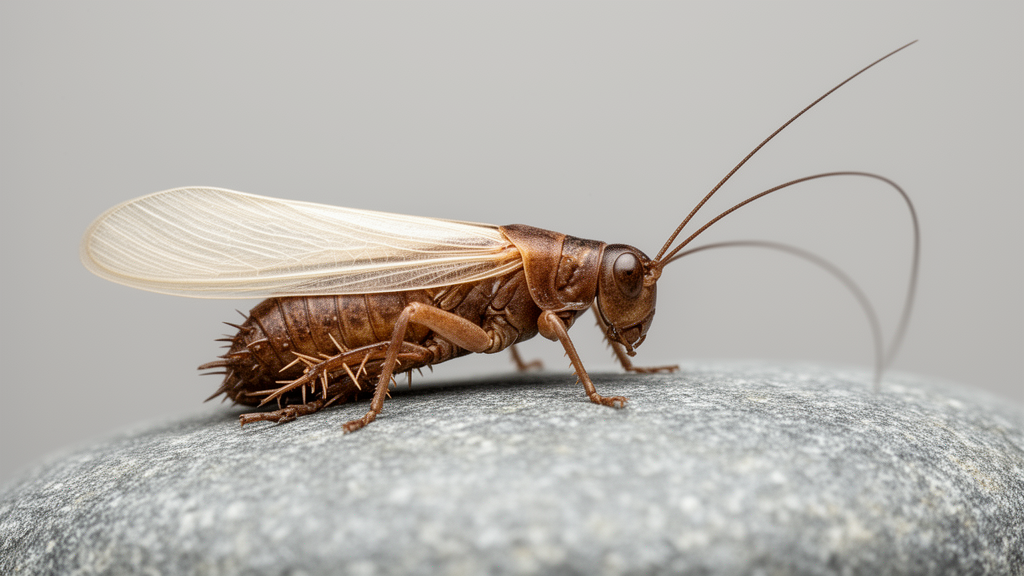
These abdominal structures are not random oddities; they are the primary diagnostic characters used to separate species within the genus, because external appearance, wing venation and leg spination are otherwise remarkably conservative across Woznessenskia. The tegmina — the elongated forewings — follow a consistent venation pattern in all three new species: the radius vein releases the radius sector near the middle, both fork near the apex, the media anterior releases the media posterior near the third base, and the cubitus anterior releases two branches near the same point, with the media posterior and cubitus anterior briefly fusing near the middle of the wing. The cubitus posterior remains unbranched and free throughout, and four anal veins complete the pattern. The hind wing is slightly longer than the tegmen, extending past the apex of a stretched hind tibia — a hallmark of these strong-flying insects.
Leg morphology follows the family blueprint with equal precision. Each fore coxa carries a single spine at the anterior margin, the fore and middle femora are unarmed on their ventral surfaces, and each fore and middle tibia bears four pairs of movable long spines plus a pair of short apical spurs below, with the middle tibia adding one inner apical spur on the dorsal surface. The hind femur carries eight to ten inner and seven to eight outer ventral spines in W. truncatoprocera, eleven to twelve inner and ten to eleven outer in W. dentata, and eight to ten inner and six to eight outer in the female of W. dulongjianga. The hind tibia bears six to seven spines on each dorsal margin, with one pair of dorsal apical spurs and two pairs of ventral apical spurs at the apex. These counts, though seemingly arcane, are exactly the kind of quantitative detail that allows orthopterists to distinguish closely related species across collections.
Colouration adds a second layer of diagnostic signal. All three new species are yellowish-brown with black fastigium verticis and occiput, black antennae, and transparent tegmina and hind wings with dark brown veins. The pronotum in each carries a black stripe along its entire margin, with the remaining surface concolorous with the body. W. truncatoprocera shows three black spots on the lateral areas of the face, while W. dentata instead carries a separate brown longitudinal stripe under each eye — a character the authors use to distinguish it not only from its new congener but also from the previously described W. incurva. In W. dulongjianga, the genae bear a single brown spot under each eye, and the pronotal black stripes are distinctly broadened at the anterior and posterior margins. The apical half of the male abdomen is black in the first two species, with the processes of the ninth tergite black at the basal half and apices.
Beyond the new species, the study delivers something equally valuable: the first-ever descriptions of the females of W. brevisa and W. bimacula, both originally described by Guo and Shi in 2011 from male specimens alone. The female of W. bimacula, collected from the type locality in Maguan, Yunnan, shows a distinctly sclerotised seventh abdominal sternite with several transverse riffles near the apical third, then suddenly strongly widened laterally and elevated to form a pair of auricular lateral lobes with rounded apices, the posterior margin slightly concave. The subgenital plate is short with numerous transverse riffles and a slightly concave apex, and the ovipositor is moderately upcurved with a rounded tip, measuring 13.9 millimetres. The female of W. brevisa, tentatively attributed from a specimen collected in Lingshui, Hainan, shows a similar auricular lobed seventh sternite but with an obtusely angular notch on the posterior margin, and a longer ovipositor of 15.5 millimetres.
The authors also provide fresh diagnostic photographs of W. arcoida, W. incurva and W. lianhua, species whose original descriptions relied on line drawings or, in the case of W. incurva, a partially damaged male holotype. The new images, captured with a Leica M205A digital imaging system and edited in Adobe Photoshop, allow direct visual comparison of male abdominal apices, female seventh sternites, subgenital plates and ovipositors across the genus — a resource that will accelerate future species descriptions. All specimens examined are deposited in the Museum of Hebei University in China, and the new species have been registered in the ZooBank nomenclatural database with unique identifiers.
Fieldwork for the study followed the seasonal rhythm of the insects themselves. Gryllacridids in China are primarily distributed in southern regions, and their peak emergence occurs from July to August, so the team collected during this window using sweep-netting by day and headlamps by night, exploiting the insects’ phototaxis with light traps where appropriate. Specimens were preserved in 95 percent ethanol and studied under a Nikon SMZ-1500 stereomicroscope, with measurements taken using Vernier calipers according to standard conventions — body length from the apex of the fastigium verticis to the posterior margin of the ninth abdominal tergite, pronotum length along the mid-line, tegmen length from base to apex, hind femur length from base to the genicular lobe, and ovipositor length from the base of the subgenital plate to the apex. The holotype of W. truncatoprocera measures 26.5 millimetres in body length with a 37.1 millimetre tegmen, while the female paratypes of W. dulongjianga range from 24.0 to 26.3 millimetres with ovipositors of 11.4 millimetres.
Why should anyone care about a handful of new raspy crickets from Yunnan? Because Woznessenskia is a textbook example of how much diversity remains undocumented in the mountainous subtropics of Asia, and how quickly that diversity can be catalogued when targeted fieldwork meets modern imaging. The genus has grown from four species in 2002 to seventeen today, with nine of the new additions described in just the past four years. Each new species is a signal that the forests of Yunnan, Hainan, Guangxi and Xizang hold lineages still waiting to be named, and that the strange, toothed, S-shaped abdominal armature of these insects — evolved for functions entomologists are only beginning to probe — is a richer archive of evolutionary history than anyone suspected. The three new species from Yunnan are unlikely to be the last.
Subject of Research: Remarks on the genus Woznessenskia (Orthoptera, Gryllacrididae) with three new species from China
Article Title: Remarks on the genus Woznessenskia ( Orthoptera , Gryllacrididae ) with three new species from China
Article References: Lv, W.-Q., Su, J., & Shi, F.-M. (2025). Remarks on the genus Woznessenskia (Orthoptera, Gryllacrididae) with three new species from China. Deutsche Entomologische Zeitschrift, 72(2), 237-249. https://doi.org/10.3897/dez.72.160010
Image Credits: AI Generated
Keywords: Remarks, genus, Woznessenskia, Orthoptera, Gryllacrididae, three, species, China, scientific research
Cite Scienmag News
Gavin Prescott. (October 18, 2026). Remarks on the genus Woznessenskia (Orthoptera, Gryllacrididae) with three new species from China. Scienmag. https://scienmag.com/remarks-on-the-genus-woznessenskia-orthoptera-gryllacrididae-with-three-new-species-from-china/
Gavin Prescott. "Remarks on the genus Woznessenskia (Orthoptera, Gryllacrididae) with three new species from China." Scienmag, 18 October 2026, https://scienmag.com/remarks-on-the-genus-woznessenskia-orthoptera-gryllacrididae-with-three-new-species-from-china/. Accessed 18 October 2026.
Gavin Prescott. "Remarks on the genus Woznessenskia (Orthoptera, Gryllacrididae) with three new species from China." Scienmag. October 18, 2026. https://scienmag.com/remarks-on-the-genus-woznessenskia-orthoptera-gryllacrididae-with-three-new-species-from-china/