


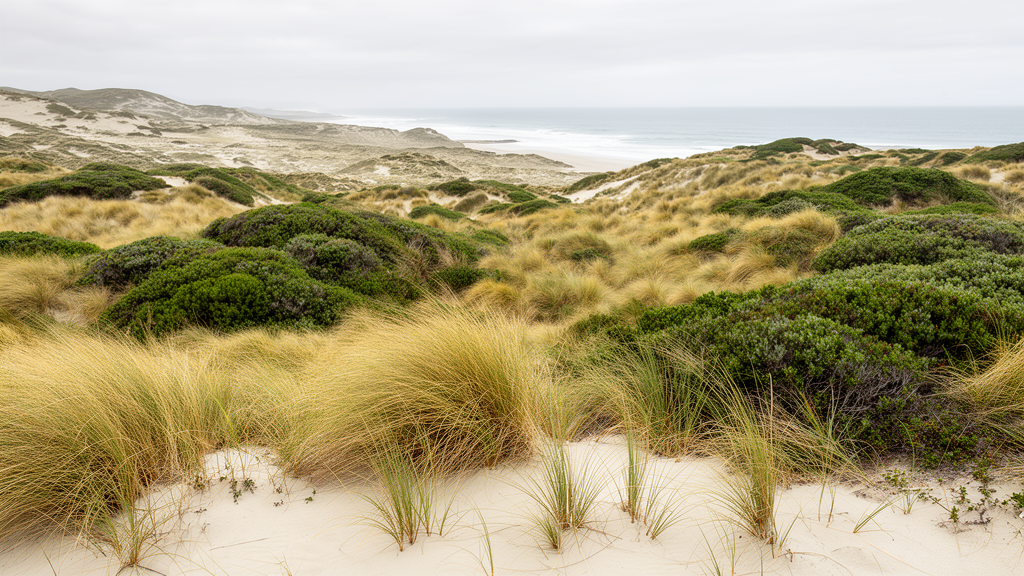
On the prograding coast of Manawatū, New Zealand, one of the country’s most mobile coastal dunefields is quietly losing its defining feature: movement. At Tawhirihoe Scientific Reserve, a roughly triangular 152-hectare reserve just south of the Rangitikei River mouth, researchers have documented how alien plants introduced over more than a century to stabilise drifting sand have over-stabilised the dunefield, crowding out native species and apparently interrupting the natural succession that once carried dune vegetation from bare sand toward shrubland and forest. The findings, published in Vegetation Classification and Survey, reveal a dunefield in which only the foredunes and dune-slack wetlands remain in a mostly natural state, while native rear-dune vegetation is becoming rare.
The scale of the change is striking. Coverage of unvegetated, mobile sand has declined to just 21 percent of the studied area and is projected to decline further. At the current rate of loss, the researchers calculate there will be no mobile dunefield inside the reserve by 2045. Alien species now occupy nearly double the area of the mobile dunefield as do natives, and biodiversity is trending toward the invaders, especially behind the foredunes. Only about 10 percent of the reserve’s surface is actually in native vegetation, dominated by the Spinifex foredune community closest to the sea.
The problem is not unique to this reserve. Coastal dunes worldwide are a major habitat for rare and specialist floras, hosting more than 5,000 plant species, many of them local endemics. Yet over the last century the global extent of coastal dunes has been greatly reduced from an original 446,500 lineal kilometres. In densely populated regions such as the Mediterranean, only 20 percent of dunes remain in natural condition. New Zealand has lost 70 percent of its active dunes, reducing their area to about 40,000 hectares, and the Manawatū district has lost the largest proportion of dunelands of any region in the country, at 81.3 percent since the 1950s.
Much of this loss stems from deliberate stabilisation. Dune mobility can be aggressive, with recorded rates of inland movement exceeding one kilometre per year, and transgressive sand can bury farmland and infrastructure. Managers worldwide have responded with groynes, seawalls, sand-fences, foredune shaping, beach replenishment and even chemically formed stabilising soil matrices. A global review found that 93 percent of mobile dunelands examined had experienced a loss of bare sand over the last 150 years. In New Zealand, the most widespread dune alien is marram, Ammophila arenaria, introduced from Europe in the 1870s and extensively planted from the 1910s to the 1930s; by 1992 it had occupied 74 percent of the country’s dunelands.
At Tawhirihoe, trial plantings of marram began in 1913 along the coastal edge of the dunefield to prevent mobile sand from transgressing into farmland. The technique successfully slowed and even stopped foredune collapse for some decades. Then in the 1980s most of the reserve’s duneland was planted with alien Monterey pine, Pinus radiata, and macrocarpa as part of the wider Santoft dune stabilisation programme. Conservation activists pulled out many pine seedlings in the main mobile dunefield, and most remaining seedlings died, sparing the heart of the reserve. But the ecological consequences of the earlier bioengineering were already in motion, and marram traps sand readily, burying less competitive native sand-binders and rapidly invading native vegetation.
To assess the impact of alien invaders on dune mobility and native succession, the researchers sampled vegetation in mid-summer of 2009/2010 using 52 one-square-metre quadrats placed at random over the dry portions of the mobile dunefield, supplemented by 12 randomly selected wetland quadrats. Within each quadrat they recorded slope, maximum vegetation height, and percentage covers of sand, stones, wood, dead material and live vegetation, along with soil moisture and degrees of disturbance from wind, rabbits and vehicles. Cover of each plant species was estimated as the vertical projection of all its foliage onto a horizontal surface, effectively recording its shadow under solar zenith.
The multivariate analysis revealed seven vegetation types. Three have a high native component and follow an established successional trend: the Spinifex Foredune, dominated by the native sand-binder Spinifex sericeus, which forms 80 percent of that community’s vegetative cover; the Turfed Wetland, with the wettest soils in the survey and specialist turf species such as the local endemic Goodenia heenanii; and the Oioi Rushland, dominated by the clonal restiad Apodasmia similis on the floors of infilling wetlands. The other communities are becoming dominated by alien grasses and herbs and are associated with increasing dune stability.
The alien-dominated communities tell a different story. Marram Duneland, the most widespread community at 29 percent coverage of the dunefield, is dominated by Ammophila arenaria and the alien grass Lagurus ovatus, with natives accounting for only about a quarter of the vegetative cover. Sedgeland, the most frequently sampled community, has six times as many alien as native species, with aliens making up three quarters of its cover. Exotic Grassland, scattered on flatter ground at the rear of the dunefield, is densely vegetated by the tall alien grasses Arrhenatherum elatius, Ammophila arenaria and Holcus lanatus to 85 percent cover, with almost no bare sand. This community has no known correspondents in other dunelands, and its successional future is unknown.
Comparison with the first detailed survey of the area in 1997 shows the trajectory clearly. Eleven newly recorded alien species have appeared, six of them grasses, while 31 alien species, mainly wasteland weeds, and 14 native species, including six early successional turf wetland species, have been lost. In the five communities with more than 55 percent vegetation cover, alien species dominate in three, broadly occurring in the rear portion of the reserve. Even within the native-rich wetland communities, about 20 percent of the vegetative cover is alien. Increased cover of aliens appears associated with a decrease in the coverage of mobile sand, with bare sand declining at approximately 1 percent per annum.
The longer-term implications of this over-stabilisation are unknown, but the pattern is clear: alien species over-stabilise the dunefield, facilitating further alien invasion in a self-reinforcing loop. New Zealand’s normal dune successions trend toward forested vegetation, but at Tawhirihoe only the second ordination axis depicts that natural succession, while the first axis is dominated by habitat types with high cover and diversity of aliens, particularly alien grasses. The researchers conclude that intervention to destabilise the dunefield seems the most viable management option, though counter-intuitive. Breaching the foredunes could remobilise sand and allow natural formation of dune slacks and wetlands, but the most likely result inland would be reinvasion by aliens unless ongoing selective weeding favours natives. New Zealand may be unusual, if not unique, in still undergoing such losses today, so that conservation management is still possible, but such management may be hampered by lack of understanding of the degree to which mobility is a pre-human or natural situation for such dunelands.
Subject of Research: Ecology
Article Title: Invasive species over-stabilise the vegetation of a mobile dunefield, Manawatū, New Zealand, disrupting natural succession
Article References: Rapson, G. L., Murphy, A. L., & Smith, A. R. (2023). Invasive species over-stabilise the vegetation of a mobile dunefield, Manawatū, New Zealand, disrupting natural succession. Vegetation Classification and Survey, 4, 343-360. https://doi.org/10.3897/vcs.98391
Image Credits: AI Generated
DOI: 10.3897/VCS.98391
Keywords: invasive species, dunes, ecology, New Zealand, succession, biodiversity, conservation, Invasive, species, over-stabilise, vegetation, mobile
Cite Scienmag News
Gavin Prescott. (October 18, 2026). Invasive plants over-stabilise New Zealand dunefield, disrupting natural succession. Scienmag. https://scienmag.com/invasive-plants-over-stabilise-new-zealand-dunefield-disrupting-natural-succession/
Gavin Prescott. "Invasive plants over-stabilise New Zealand dunefield, disrupting natural succession." Scienmag, 18 October 2026, https://scienmag.com/invasive-plants-over-stabilise-new-zealand-dunefield-disrupting-natural-succession/. Accessed 18 October 2026.
Gavin Prescott. "Invasive plants over-stabilise New Zealand dunefield, disrupting natural succession." Scienmag. October 18, 2026. https://scienmag.com/invasive-plants-over-stabilise-new-zealand-dunefield-disrupting-natural-succession/


