


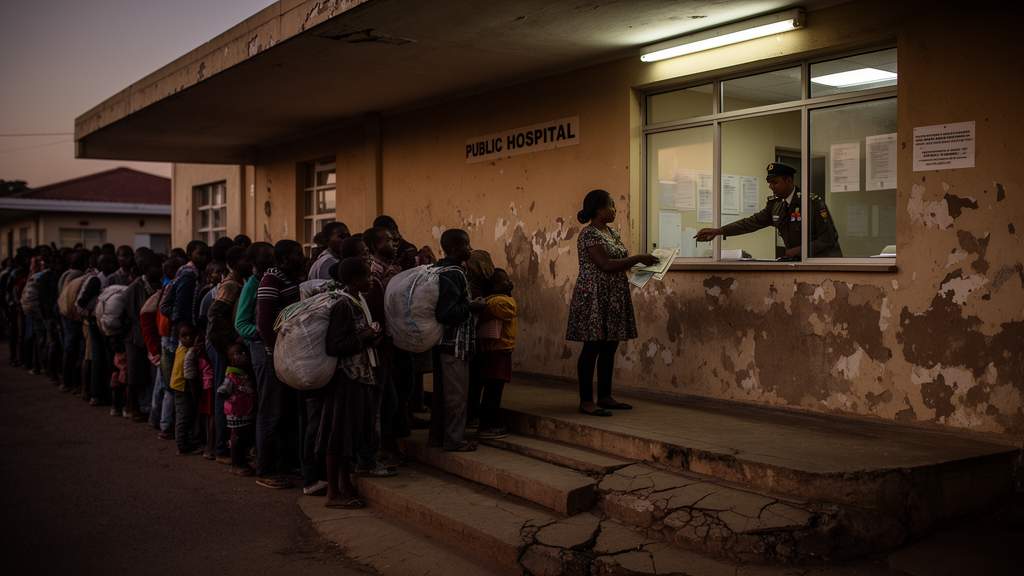
South Africa’s constitution promises universal health coverage to everyone who lives in the country, yet a new study reveals that international migrants are being systematically pushed out of public healthcare through a web of structural violence, austerity-driven underfunding, and everyday bureaucratic gatekeeping. The research, published in the journal Discover Social Science and Health, examines how the country’s governance frameworks remain poorly equipped to address the deep and intersecting health inequities faced by migrants, and how exclusion has intensified under conditions of political insecurity and weak public health governance.
The study, led by Rebecca Walker, Sostina S. Matina, and Jo Vearey of the African Centre for Migration and Society at the University of the Witwatersrand, alongside the GEMMS Global Health Research Group, argues that South Africa’s health system reproduces exclusion under the guise of legal frameworks while scapegoating foreign nationals for a poorly performing healthcare system. Despite constitutional guarantees of universal health coverage, international migrants routinely face administrative exclusion through discretionary gatekeeping by frontline healthcare workers and rising xenophobia within healthcare facilities. The authors describe this dynamic using the concept of “bordering through care,” a term borrowed from Torres and colleagues, which captures how healthcare facilities themselves begin to operate as borders that police who may access services.
Structural violence, a framework first articulated by Johan Galtung and later developed by physician-anthropologist Paul Farmer, refers to the ways in which social arrangements systematically prevent individuals and groups from meeting their basic needs. In the South African context, the researchers show how this violence operates along gendered dimensions, shaping whose suffering registers as a policy concern and whose exclusion accumulates unaddressed. Migration is a critical social determinant of health, yet the governance structures meant to translate constitutional rights into actual healthcare access remain poorly designed for a population on the move. The result is that migrants’ ill health is not simply a matter of individual misfortune but the predictable product of institutional arrangements that distribute risk unevenly across the population.
The technical mechanisms of exclusion are subtle but consequential. Frontline healthcare workers, who are not immigration officials and should not be required to act as such, exercise what scholars call bureaucratic discretion when deciding whether to admit migrant patients, request documentation, or refer them elsewhere. This discretionary gatekeeping means that access to care depends on the individual attitudes and interpretations of staff at the point of service rather than on clear, rights-based policy. The authors emphasize that healthcare facilities should not operate as borders to police healthcare users, yet in practice they increasingly do so, particularly as anti-migrant rhetoric has gained traction within political discourse and within the facilities themselves.
Austerity compounds these dynamics. South Africa’s public healthcare system, like all systems reliant on it, faces chronic underfunding and resource constraints that sharpen competition for scarce services. Under these conditions, foreign nationals become convenient scapegoats for a system that is struggling to serve anyone well. The researchers note that whilst all who rely on the public healthcare system in South Africa face challenges in access, migrants bear a disproportionate burden of exclusion, and the conditions of austerity, political insecurity, and weak governance have made their position increasingly precarious. The abrupt 2025 suspension of PEPFAR and USAID-funded programmes has further destabilised the system, removing critical support structures that had previously bolstered HIV treatment and other services upon which both migrants and South African citizens depended.
Concurrently, anti-migrant vigilante mobilisation at public healthcare facilities has intensified exclusionary rhetoric. The study highlights the role of groups such as Operation Dudula, which has conducted campaigns at hospitals and clinics, demanding that foreign nationals be denied services and intimidating both patients and healthcare workers. This vigilantism operates in tandem with formal exclusionary mechanisms, creating an environment in which migrants may fear seeking care even when they are legally entitled to it. The researchers argue that this convergence of informal vigilantism and formal bureaucratic gatekeeping represents a dangerous erosion of the constitutional promise of dignity and universal health coverage for all who live in South Africa.
The development of South Africa’s National Health Insurance, or NHI, should have been a strategic opportunity to achieve universal health coverage. Instead, the researchers find, the NHI framework revokes healthcare access for asylum seekers and undocumented migrants, embedding exclusion directly into the architecture of the country’s flagship health reform. This is a technically significant finding because it demonstrates how policy instruments designed to expand coverage can simultaneously narrow it, depending on how eligibility categories are drawn and which populations are included or excluded from the definition of “universal.” The authors call for a rights-based, migration-aware, and gender-responsive governance framework that responds to structural violence rather than reproducing it.
The gendered dimensions of exclusion deserve particular attention. The study shows how structural violence operates differently for men, women, and gender-diverse migrants, shaping whose suffering registers as a policy concern and whose exclusion accumulates unaddressed over time. Women migrants, for example, may face specific barriers to reproductive and maternal healthcare, while gender-based violence among migrants in precarious situations remains poorly recognised within mainstream health policy. The GEMMS research group, which co-directed the study and is funded by the National Institute for Health and Care Research using UK aid, brings an intersectional equity lens to these questions, working across the UK, South Africa, India, Cambodia, Zimbabwe, and Nepal to understand how gendered violence and poor mental health among migrants in precarious situations are shaped by global health governance.
The researchers propose a framework built on three pillars: renewed political commitment to dignity, accountability, and universal health coverage for all who live in South Africa. They argue that healthcare workers should not be conscripted into immigration enforcement, that facilities should not operate as borders, and that governance must be designed to respond to structural violence rather than deny it. The study calls for migration-aware and gender-responsive health governance that recognises migration as a critical social determinant of health and builds systems capable of serving diverse populations equitably, regardless of documentation status.
The findings carry implications far beyond South Africa. As countries worldwide grapple with rising xenophobia, austerity, and contested universal health coverage, the South African case illustrates how health systems can become sites of exclusion even when their constitutions promise inclusion. The researchers argue that achieving universal health coverage requires more than expanding insurance pools or building clinics; it requires confronting the structural violence embedded within governance frameworks and ensuring that the most marginalised populations are not sacrificed in the pursuit of system-wide reform. The study, published open access, offers a technically detailed and politically urgent analysis of how borders are drawn through care, and what it would take to dismantle them.
Subject of Research: How structural violence, austerity, and health governance shape migrant exclusion in South Africa's public healthcare system
Article Title: Examining the ways in which structural violence, austerity, and health governance shape migrant exclusion in public healthcare in South Africa
Article References: Walker, R., Matina, S. S., Vearey, J., Kapilashrami, A., Vearey, J., Bateman, A., Bhide, A., Bhui, K., Drewry, M., Green, G., Joosub-Vawda, N., Joshi, A., Kassaye Woldetsadik, T., Mangezvo, P., Muthusamy, S., Nkomo, T., Palmary, I., Papadopoulos, R., Reinhardt, G., … GEMMS Global Health Research Group (2026). Examining the ways in which structural violence, austerity, and health governance shape migrant exclusion in public healthcare in South Africa. Discover Social Science and Health. https://doi.org/10.1007/s44155-026-00503-6
Image Credits: AI Generated
DOI: 10.1007/s44155-026-00503-6
Keywords: Examining, ways, structural, violence, austerity, health, governance, shape, migrant, exclusion, public, healthcare
Cite Scienmag News
Courtney Benton. (October 18, 2026). Structural Violence and Austerity Drive Migrant Exclusion in South Africa’s Public Healthcare. Scienmag. https://scienmag.com/structural-violence-and-austerity-drive-migrant-exclusion-in-south-africas-public-healthcare/
Courtney Benton. "Structural Violence and Austerity Drive Migrant Exclusion in South Africa’s Public Healthcare." Scienmag, 18 October 2026, https://scienmag.com/structural-violence-and-austerity-drive-migrant-exclusion-in-south-africas-public-healthcare/. Accessed 18 October 2026.
Courtney Benton. "Structural Violence and Austerity Drive Migrant Exclusion in South Africa’s Public Healthcare." Scienmag. October 18, 2026. https://scienmag.com/structural-violence-and-austerity-drive-migrant-exclusion-in-south-africas-public-healthcare/


