


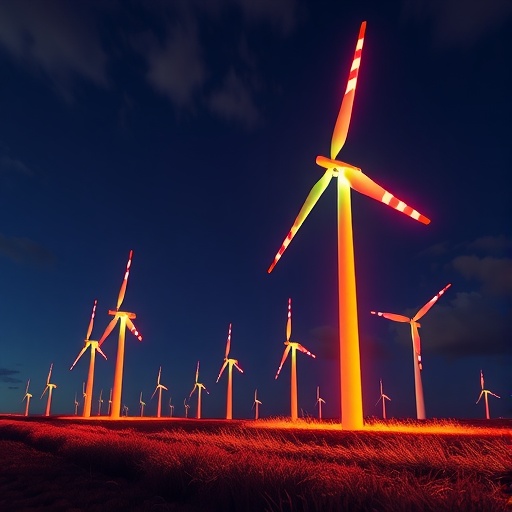
In a groundbreaking advancement poised to transform renewable energy generation, researchers have developed a sophisticated reinforcement learning approach that dramatically enhances wind farm power output through closed-loop collaborative control. This innovative methodology represents a substantial leap forward in the integration of artificial intelligence with environmental engineering, paving the way for smarter, more efficient wind energy systems worldwide. The study, widely anticipated to influence the future design and operation of wind farms, leverages the power of machine learning to optimize complex turbine interactions with unprecedented precision and adaptability.
Traditional wind farm operations face inherent challenges due to the turbulent and highly variable nature of wind patterns, coupled with aerodynamic interactions among turbines known as wake effects. These wake effects, where the airflow slowed by one turbine negatively impacts turbines positioned downstream, have long posed efficiency bottlenecks, limiting the potential aggregate power output of wind farms. Current control strategies often rely on static or heuristic-based operational modes that cannot dynamically respond to real-time environmental fluctuations or turbine interdependencies. This constraint has stymied efforts to maximize energy yield, underscoring a critical need for intelligent, adaptive control systems.
The newly introduced approach employs reinforcement learning, a subset of artificial intelligence where algorithms iteratively learn optimal decision-making policies through interaction with the environment, receiving feedback in the form of rewards. By embedding this technique into a closed-loop system, turbines continuously adjust their parameters—such as blade pitch angles and rotational speeds—in response to live data inputs on wind conditions and turbulence levels. This real-time adaptability enables the collective farm to collaboratively minimize wake interference while maximizing total power generation, effectively turning a network of individual turbines into a coordinated, self-optimizing ecosystem.
Key to this research is the collaborative control paradigm that contrasts sharply with the prevalent independent operation of turbines. By treating the farm as a single interconnected unit rather than an assembly of isolated machines, the system exploits synergistic effects, distributing loads and calibrating turbine settings to achieve a balance between maximizing overall output and maintaining structural safety. This collaborative layer is underpinned by sophisticated modeling and sensor fusion, integrating meteorological forecasts, on-site measurements, and turbine condition monitoring into the decision-making framework.
Implementing reinforcement learning in such a complex physical system required overcoming several technical hurdles. Firstly, the researchers developed accurate yet computationally efficient surrogate models to simulate turbine wakes and their interactions. These models serve as the virtual environment within which the reinforcement learning agents train, enabling rapid trial-and-error learning without the risks and costs associated with real-world test runs. The training process iteratively refines turbine control policies by evaluating the cumulative power production and constraint adherence over thousands of simulated environmental scenarios.
Moreover, safety and reliability considerations were addressed through the design of reward functions that penalize excessive mechanical stresses or risky operational states, ensuring the learned policies balance performance with durability. The closed-loop framework continually monitors turbine health metrics, dynamically adjusting control strategies to preempt mechanical fatigue or failures, thus extending the lifespan of the equipment and reducing maintenance costs.
Field tests conducted on operational wind farms demonstrated a significant uplift in power production—exceeding previously reported gains—validating the efficacy of the reinforcement learning-based collaborative control. These empirical results mark a departure from theoretical promise to tangible real-world benefits, highlighting the transformative potential of AI-driven approaches in clean energy sectors. Notably, the system achieved these improvements while respecting stringent grid codes and safety regulations, affirming its readiness for broad commercial deployment.
Beyond energy yield enhancements, this technology offers substantial environmental advantages by enabling each wind turbine to extract maximum energy from natural wind flows, thereby reducing the need for additional infrastructure build-out. This optimization contributes directly to lowering the carbon footprint of energy generation and supports global decarbonization targets. The ability of wind farms to deliver stable and increased power output also contributes to grid reliability, supporting the integration of variable renewable sources into energy markets.
This research underscores a broader trend of embedding autonomy and machine intelligence into critical infrastructure systems. As climate change accelerates the transition toward renewable energy, deploying intelligent control mechanisms that harvest maximum value from existing assets will be crucial. The melding of reinforcement learning with wind energy heralds a future where utility-scale renewable systems dynamically learn and adapt, much like natural ecosystems, to optimize their collective function amid variability.
Looking ahead, further advances may incorporate multi-agent reinforcement learning frameworks that enable even more granular coordination, potentially extending beyond individual farms to entire wind farm clusters or hybrid renewable energy installations. Integration with advanced forecasting technologies and edge computing platforms could further enhance system responsiveness and scalability. Additionally, coupling these intelligent controls with predictive maintenance and fault detection algorithms promises a holistic approach to optimizing both performance and operational costs.
The societal implications of this breakthrough extend beyond energy generation. By lowering the cost per kilowatt-hour of wind energy and enhancing its predictability and reliability, such smart control systems can expedite the adoption of renewables in emerging markets and remote regions. This aligns with global efforts to foster equitable energy access and sustainable development, positioning wind power as a cornerstone of a resilient, low-carbon energy future.
From a technical standpoint, the confluence of fluid dynamics, control theory, and artificial intelligence embodied in this study exemplifies the multidisciplinary nature of modern engineering innovation. By translating complex environmental and mechanical processes into actionable data-driven control signals, this research bridges fundamental science and practical application, setting new benchmarks for performance and efficiency in wind energy.
In conclusion, the integration of reinforcement learning algorithms into closed-loop collaborative control systems represents a paradigm shift for wind farm operations. This cutting-edge approach enables intelligent, adaptable, and coordinated turbine behavior that maximizes power production while preserving equipment integrity. As demonstrated by comprehensive simulations and successful field trials, these advancements hold the promise of accelerating the global energy transition, driving down costs, and enhancing the environmental sustainability of wind power generation worldwide. The intersection of AI and renewable energy, exemplified by this research, illuminates the path forward for harnessing clean energy in smarter, more effective ways.
Cite Scienmag News
Faith Mcneil. (May 6, 2026). Reinforcement Learning Boosts Wind Farm Power Output. Scienmag. https://scienmag.com/reinforcement-learning-boosts-wind-farm-power-output/
Faith Mcneil. "Reinforcement Learning Boosts Wind Farm Power Output." Scienmag, 6 May 2026, https://scienmag.com/reinforcement-learning-boosts-wind-farm-power-output/. Accessed 4 September 2026.
Faith Mcneil. "Reinforcement Learning Boosts Wind Farm Power Output." Scienmag. May 6, 2026. https://scienmag.com/reinforcement-learning-boosts-wind-farm-power-output/


