


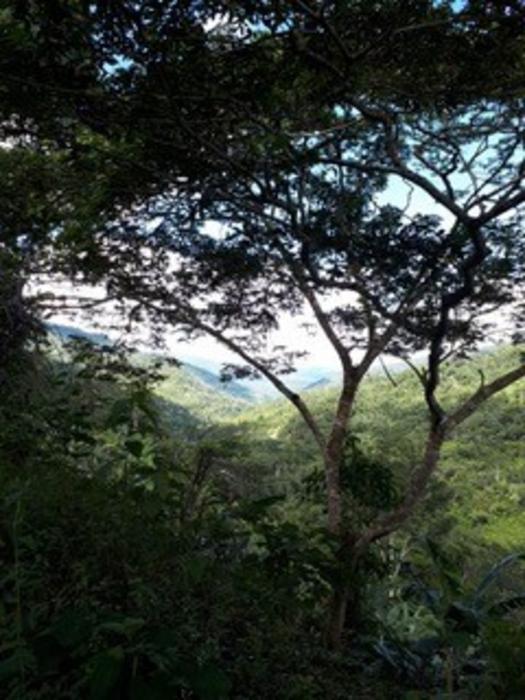
The diversity and ecological functionality of bird communities in tropical agroforestry systems are shaped by the surrounding landscape, in particular the extent and composition of the forest. An international research team led by the University of Göttingen has now investigated the composition and ecological traits of bird communities in 23 cocoa agroforestry systems in Peru. The Universities of Würzburg and Vienna and the Alliance Biodiversity International in Peru were also involved in the study. The scientists found very different results depending on the region, and therefore emphasise the importance of tailoring agroforestry management strategies according to the region. The results were published in the journal Conservation Science and Practice.

Credit: C Ocampo-Ariza
The diversity and ecological functionality of bird communities in tropical agroforestry systems are shaped by the surrounding landscape, in particular the extent and composition of the forest. An international research team led by the University of Göttingen has now investigated the composition and ecological traits of bird communities in 23 cocoa agroforestry systems in Peru. The Universities of Würzburg and Vienna and the Alliance Biodiversity International in Peru were also involved in the study. The scientists found very different results depending on the region, and therefore emphasise the importance of tailoring agroforestry management strategies according to the region. The results were published in the journal Conservation Science and Practice.
The cocoa agroforestry systems studied are located in two contrasting Peruvian regions: one with seasonally dry tropical forests and one with subtropical humid rainforests along the Andes. In both regions, cocoa agroforestry systems exist at different distances from natural forest, and increasing distance reduces the biodiversity in these agroforestry systems. The two regions differ greatly in their climate, as well as the structure and complexity of the forest vegetation. “We found a much higher richness of bird species in the humid subtropical forest than in the dry forest – 179 species compared to just 64,” says first author Dr Carolina Ocampo-Ariza from the University of Göttingen. “In the dry forest landscapes, distance from the natural forest strongly influences the composition of bird communities, but less so the proportion of creatures that eat insects, which is a particularly important factor for biological pest control in cocoa farms.” Compared with cocoa farms that were right next to natural forest, if there was a distance of one kilometre, farms in the subtropical forest experienced a decrease of 27 percent in the proportion of insects in the birds’ diet; whereas for farms in the dry forest, the decrease was just 3 percent.
“These large regional differences in Peru show that agroforestry management needs to be adapted regionally to support optimal preservation and promotion of bird diversity and its ecosystem services. This is particularly true for biological pest control, which is important for cocoa yields,” says Ocampo-Ariza. “The proximity of cocoa cultivation to the nearest natural forest plays a special role for bird diversity and its ecosystem services.” Co-author Professor Teja Tscharntke adds: “Forested landscapes are crucial for the biodiversity in agroforestry systems. In addition, it is necessary to maintain and encourage a large number of older shade-providing trees, in addition to complex vegetation, in the farming systems.”
Original publication: Carolina Ocampo-Ariza et al. “Regional differences of functional and taxonomic bird diversity in tropical agroforests of Peru”. Conservation Science and Practice 2024. Doi: https://conbio.onlinelibrary.wiley.com/doi/10.1111/csp2.13123.
Contact:
Dr Carolina Ocampo-Ariza
University of Göttingen
Faculty of Agricultural Sciences – Department of Agroecology
Email: carolinamaria.ocampoariza@uni-goettingen.de
www.uni-goettingen.de/en/600886.html
Professor Teja Tscharntke
University of Göttingen
Faculty of Agricultural Sciences – Department of Agroecology
Email: ttschar@gwdg.de
www.uni-goettingen.de/en/92552.html
The diversity and ecological functionality of bird communities in tropical agroforestry systems are shaped by the surrounding landscape, in particular the extent and composition of the forest. An international research team led by the University of Göttingen has now investigated the composition and ecological traits of bird communities in 23 cocoa agroforestry systems in Peru. The Universities of Würzburg and Vienna and the Alliance Biodiversity International in Peru were also involved in the study. The scientists found very different results depending on the region, and therefore emphasise the importance of tailoring agroforestry management strategies according to the region. The results were published in the journal Conservation Science and Practice.
The cocoa agroforestry systems studied are located in two contrasting Peruvian regions: one with seasonally dry tropical forests and one with subtropical humid rainforests along the Andes. In both regions, cocoa agroforestry systems exist at different distances from natural forest, and increasing distance reduces the biodiversity in these agroforestry systems. The two regions differ greatly in their climate, as well as the structure and complexity of the forest vegetation. “We found a much higher richness of bird species in the humid subtropical forest than in the dry forest – 179 species compared to just 64,” says first author Dr Carolina Ocampo-Ariza from the University of Göttingen. “In the dry forest landscapes, distance from the natural forest strongly influences the composition of bird communities, but less so the proportion of creatures that eat insects, which is a particularly important factor for biological pest control in cocoa farms.” Compared with cocoa farms that were right next to natural forest, if there was a distance of one kilometre, farms in the subtropical forest experienced a decrease of 27 percent in the proportion of insects in the birds’ diet; whereas for farms in the dry forest, the decrease was just 3 percent.
“These large regional differences in Peru show that agroforestry management needs to be adapted regionally to support optimal preservation and promotion of bird diversity and its ecosystem services. This is particularly true for biological pest control, which is important for cocoa yields,” says Ocampo-Ariza. “The proximity of cocoa cultivation to the nearest natural forest plays a special role for bird diversity and its ecosystem services.” Co-author Professor Teja Tscharntke adds: “Forested landscapes are crucial for the biodiversity in agroforestry systems. In addition, it is necessary to maintain and encourage a large number of older shade-providing trees, in addition to complex vegetation, in the farming systems.”
Original publication: Carolina Ocampo-Ariza et al. “Regional differences of functional and taxonomic bird diversity in tropical agroforests of Peru”. Conservation Science and Practice 2024. Doi: https://conbio.onlinelibrary.wiley.com/doi/10.1111/csp2.13123.
Contact:
Dr Carolina Ocampo-Ariza
University of Göttingen
Faculty of Agricultural Sciences – Department of Agroecology
Email: carolinamaria.ocampoariza@uni-goettingen.de
www.uni-goettingen.de/en/600886.html
Professor Teja Tscharntke
University of Göttingen
Faculty of Agricultural Sciences – Department of Agroecology
Email: ttschar@gwdg.de
www.uni-goettingen.de/en/92552.html
Journal
Conservation Science and Practice
Method of Research
Observational study
Subject of Research
Not applicable
Article Title
Regional differences of functional and taxonomic bird diversity in tropical agroforests of Peru
Article Publication Date
16-May-2024
Cite Scienmag News
Alan Morgan. (May 21, 2024). Regional differences in bird diversity in agroforestry systems. Scienmag. https://scienmag.com/regional-differences-in-bird-diversity-in-agroforestry-systems/
Alan Morgan. "Regional differences in bird diversity in agroforestry systems." Scienmag, 21 May 2024, https://scienmag.com/regional-differences-in-bird-diversity-in-agroforestry-systems/. Accessed 4 September 2026.
Alan Morgan. "Regional differences in bird diversity in agroforestry systems." Scienmag. May 21, 2024. https://scienmag.com/regional-differences-in-bird-diversity-in-agroforestry-systems/

