


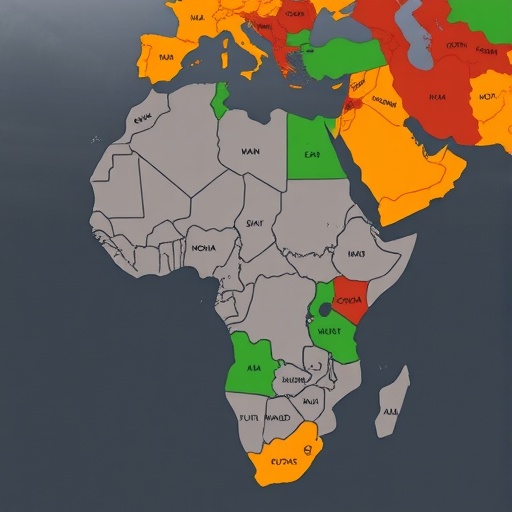
In early 2025, the United States Agency for International Development (USAID) underwent abrupt and substantial budget cuts, a decision that has since been linked to a notable rise in violent conflicts across numerous regions in Africa. A newly published study delves deeply into this phenomenon, revealing complex relationships between foreign aid withdrawal and political instability. These findings challenge simplistic assumptions about the role of aid in maintaining peace, hinting instead at intricate dynamics involving institutional stability and the consequences of sudden policy shifts.
USAID has historically held a central position in global foreign assistance, providing extensive funding and resources aimed at fostering public health initiatives, agricultural development, education, disaster relief, and strengthening democratic institutions. Its operations, spreading across more than 100 countries, encapsulate an extensive array of projects designed to build resilience and improve governance. However, the dramatic pivot taken by the second Trump administration—entailing rapid, sweeping cuts to this agency — marked a radical departure from over six decades of consistent U.S. foreign policy engagement in development aid.
This abrupt contraction in aid availability has been associated with severe and multifaceted humanitarian repercussions. Emerging medical research has underscored the potential for millions of additional deaths tied to disrupted health and social services that USAID previously supported. Even more critically, the political consequences of these funding cuts, particularly regarding escalation in violence and unrest, remain less clearly understood. The recent research addresses this crucial knowledge gap by scrutinizing the interplay between aid withdrawal and subsequent conflict dynamics.
The study, led by Dominic Rohner and colleagues, embarks on a rigorous quantitative analysis integrating two sophisticated datasets. The first, known as the Geocoded Official Development Assistance Dataset (GODAD), meticulously records foreign aid disbursements alongside precise project locations worldwide, enabling geo-spatial correlations. The second dataset, the Armed Conflict Location and Event Data (ACLED), catalogs violent incidents, ranging from armed clashes and protests to riots and civilian attacks, with temporal and spatial specificity. By merging these datasets, the authors traced patterns of past USAID support and investigated how these regions experienced violence following the agency’s funding elimination.
Significantly, the analysis revealed that regions previously benefiting from substantial USAID aid exhibited immediate and pronounced increases in violent conflict after the withdrawal. This surge encompassed a range of violent behaviors, including armed confrontations, protests, and large-scale riots. The temporal dimension of the study demonstrated that these effects were not fleeting but persisted for months, suggesting systemic destabilization rather than mere short-term disruptions.
An essential and nuanced finding concerns the role of local institutional strength in mediating the impact of aid cuts. The research elucidates that states and subnational regions with weaker governance frameworks experienced more significant escalations in conflict, whereas those with stronger institutions exhibited resilience, alleviating the adverse effects of sudden aid removal. This underscores the importance of institutional robustness as a buffer in volatile political environments.
It is crucial to distinguish the study’s focus on abrupt aid withdrawal from broader debates about aid effectiveness. As Axel Dreher emphasizes in a related Perspective piece, interpreting these findings as a straightforward endorsement of increased aid as a panacea for conflict reduction would be misleading. Instead, the disruption caused by sudden withdrawal goes beyond financial scarcity. It breaks preexisting contracts, unsettles staffing and procurement systems, undermines expectations, and ignites institutional turmoil — a multifaceted shock that differs substantially from gradual aid scaling or systematic policy shifts.
From a methodological standpoint, the fusion of geographically precise aid distribution data with detailed conflict event records represents a sophisticated approach to causal inference in political economy. By capitalizing on the geographic and temporal variance created by the USAID cuts, the authors leverage a natural experiment framework to isolate the effects of aid removal from confounding factors. This approach lends robustness to their conclusions and offers a model for future research exploring the intersection of development policy and political stability.
The implications of these results are profound for policymakers, development practitioners, and the international community. They highlight that the pathways through which aid influences peace and conflict are complex and intertwined with institutional capacity. More importantly, they caution against sudden policy reversals that can destabilize fragile environments and undermine long-term development gains. Thoughtful, gradual transitions and considerations of local governance structures must be integral to aid strategy formulation.
Additionally, the study speaks to broader debates on scientific rigor and integrity. Dominic Rohner stresses the critical importance of maintaining high standards in research, especially in an era where artificial intelligence lowers barriers to paper production. The academic community and prestigious scholarly outlets bear responsibility to rigorously screen submissions, ensuring reliable knowledge production that informs policy effectively. Open data practices, replication efforts, and transparency in economic and social sciences serve as pillars supporting this mission.
Furthermore, this investigation enriches the discourse surrounding institutional determinants of conflict. The differential responses observed in regions with varying institutional qualities reinforce existing theories emphasizing governance as a key factor in stability and development. By grounding these insights in empirical data tied explicitly to policy shocks, the study bridges theoretical perspectives and practical realities.
Overall, this research elucidates critical dynamics at the nexus of foreign aid, institutional capacity, and conflict. It underscores that abrupt disruptions in aid flow are not mere fiscal events but systemic shocks capable of triggering widespread violence, particularly in already vulnerable states. As the global development architecture evolves, these insights offer a vital cautionary tale about the necessity for measured, institutionally informed approaches to aid allocation and withdrawal.
In conclusion, the sudden 2025 USAID funding cuts serve as a stark natural experiment illuminating the fragile interplay between external support and internal stability across African regions. The study by Rohner and his team compellingly documents the consequences of this policy shift, urging renewed attention to the complexities of aid as an instrument for peace and development. Moving forward, fostering stronger institutions and ensuring continuity in assistance will be essential strategies to mitigate conflict and enhance human well-being in the global south.
News Publication Date: 14-May-2026
Web References: 10.1126/science.aed6802
Cite Scienmag News
Courtney Benton. (May 14, 2026). Reduction in USAID Funding Linked to Surge in Violent Conflicts Across Africa. Scienmag. https://scienmag.com/reduction-in-usaid-funding-linked-to-surge-in-violent-conflicts-across-africa/
Courtney Benton. "Reduction in USAID Funding Linked to Surge in Violent Conflicts Across Africa." Scienmag, 14 May 2026, https://scienmag.com/reduction-in-usaid-funding-linked-to-surge-in-violent-conflicts-across-africa/. Accessed 4 September 2026.
Courtney Benton. "Reduction in USAID Funding Linked to Surge in Violent Conflicts Across Africa." Scienmag. May 14, 2026. https://scienmag.com/reduction-in-usaid-funding-linked-to-surge-in-violent-conflicts-across-africa/


