


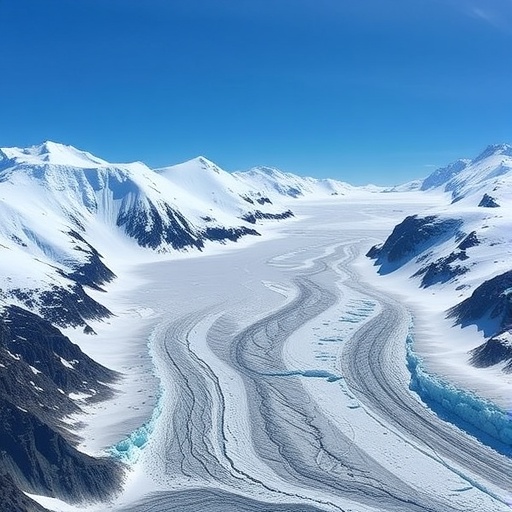
In a groundbreaking study that sheds unprecedented light on the fragile balance sustaining marine-terminating glaciers, researchers have documented an extraordinary retreat event at Eastern Antarctica’s Hektoria Glacier. Between January 2022 and March 2023, this glacier experienced a retreat of approximately 25 kilometers—an event that not only challenges our current understanding of glacier dynamics but also provides a stark warning about the vulnerabilities of marine ice masses in a warming climate.
The Hektoria Glacier’s rapid recession epitomizes an extreme class of glacier instability. Such retreat events are critical in shaping projections of future sea level rise, yet the mechanisms controlling these processes remain enigmatic. Prior to this study, prevailing hypotheses emphasized atmospheric warming and oceanographic changes as the dominant drivers of marine-terminating glacier retreat. However, the latest evidence points instead to a dynamic calving process occurring on a distinctive ice plain exposure, upending conventional thinking about what controls massive glacier loss.
Initial observations revealed that the retreat was triggered almost immediately following the loss of decade-old fast ice within the Larsen B embayment. Fast ice, a layer of sea ice that remains attached to the coastline or glacier fronts, plays an essential role in stabilizing glaciers by buttressing their termini and impeding iceberg calving. Its sudden disappearance set the stage for dramatic downstream effects: the glacier’s flow speed surged nearly sixfold, and its thinning accelerated by a factor of forty, relative to the pre-fast ice baseline. This response underscores the critical dependency of glacier stability on the presence of fast ice and confirms its role as an effective natural dam.
The evolution of the retreat observed during late 2022 was particularly startling. Over just two months—November to December—the glacier lost an additional 8.2 ± 0.2 kilometers of ice extent. This retreat rate is nearly an order of magnitude faster than what is recorded in existing literature for similar polar glacier systems, suggesting an unprecedented pace of change that few models currently anticipate.
Central to this rapid retreat event is the transition from conventional tabular iceberg calving—where large, flat icebergs break off at the glacier front—to a more destructive ice plain calving process. Unlike the typically grounded glacier fronts that restrict calving to discrete detachment of ice blocks, ice plains consist of relatively flat ice zones where the glacier is only lightly anchored to the seabed. This subtle bed topography dramatically alters stress regimes within the ice and facilitates buoyancy-driven calving events that can amplify ice loss exponentially.
The study’s authors emphasize that this ice plain calving process was the primary driver of the Hektoria Glacier’s unprecedented retreat, rather than atmospheric warming or oceanic forcing alone. This insight is a significant departure from many established paradigms that attribute glacier dynamics primarily to climatic variables, drawing attention to the critical importance of local basal geometry and mechanical ice behavior.
Detailed analysis of satellite remote sensing data and geophysical surveys permitted researchers to detect this calving transition and link it explicitly to the observed retreat. The ice plain geometry, characterized by shallower grounding depths and a flattened basal interface, encourages fracture propagation and ice detachment that can rapidly destabilize marine glacier fronts. These results suggest that glaciers with similar bed conditions elsewhere in polar regions are at heightened risk of abrupt retreat events.
Moreover, the surge in glacier flow speed following fast ice loss points to a potent feedback mechanism. Increased flow velocity thins the glacier significantly, driving the grounding line—where the glacier rests on the bed—to retreat further inland, amplifying vulnerability to calving processes. This positive feedback loop demonstrates how small initial perturbations can swiftly cascade into extensive glacier destabilization.
The unique interplay of ice plain calving dynamics and fast ice removal could help explain unexpected glacier retreats observed in other sectors of the Antarctic Peninsula and Arctic marine-terminating glaciers. This broadens the relevance of the findings beyond Hektoria Glacier and calls for a reevaluation of marine glacier vulnerability assessments globally.
Understanding these mechanisms is critical for improving predictive glacier models that inform sea level rise forecasts. Current models often oversimplify calving physics or ignore detailed basal topography, potentially underestimating the speed and extent of ice mass loss under changing climate conditions.
The Hektoria Glacier case study also demonstrates the value of integrating multi-disciplinary geophysical data types. Combining satellite imagery, ice velocity measurements, and bedmap reconstructions allowed researchers to dissect the complex sequence of destabilizing events at an unprecedented resolution, paving the way for more nuanced investigations of polar ice dynamics.
Importantly, this research underscores that not all glacier retreats will follow the slow, steady patterns that historical observations might suggest. Sudden transitions in basal conditions or sea ice configurations can precipitate abrupt, large-scale glacier disintegration, posing acute challenges for coastal communities dependent on accurate sea level projections.
Efforts to monitor polar glacier systems must, therefore, prioritize high-frequency observations capable of capturing fast-evolving ice front changes, including ice plain calving phases. These data are essential for validating models that can be used to develop early warning systems for abrupt glacier collapse and associated rapid sea level rise.
This study’s revelations around the Hektoria Glacier’s retreat will likely influence climate policy discussions by highlighting an underappreciated vulnerability in the Antarctic ice sheet. The possibility that large sections of marine-terminating glaciers are susceptible to mechanically driven instabilities independent of immediate climatic forcing introduces new dimensions to ice sheet risk assessments.
In conclusion, the extraordinary retreat of the Hektoria Glacier driven chiefly by an ice plain calving process reveals critical gaps in our understanding of marine glacier dynamics. The findings emphasize that certain bed geometries predispose glaciers to rapid disintegration events, triggered by changes in sea ice conditions and internal ice stress regimes. Incorporating these processes into glacier models is essential for robust predictions of Antarctica’s contribution to future sea level rise—a matter of pressing global concern.
This pioneering research opens new pathways for future investigations focused on the mechanical and geometric factors controlling glacier stability. Scientists must now grapple with the complexity of marine glacier retreat behavior, blending climatic, mechanical, and oceanographic factors to anticipate the fate of the polar ice sheets in a warming world.
Cite Scienmag News
Violet Maxwell. (November 3, 2025). Record Glacier Retreat Driven by Ice Plain Calving. Scienmag. https://scienmag.com/record-glacier-retreat-driven-by-ice-plain-calving/
Violet Maxwell. "Record Glacier Retreat Driven by Ice Plain Calving." Scienmag, 3 November 2025, https://scienmag.com/record-glacier-retreat-driven-by-ice-plain-calving/. Accessed 3 September 2026.
Violet Maxwell. "Record Glacier Retreat Driven by Ice Plain Calving." Scienmag. November 3, 2025. https://scienmag.com/record-glacier-retreat-driven-by-ice-plain-calving/


