


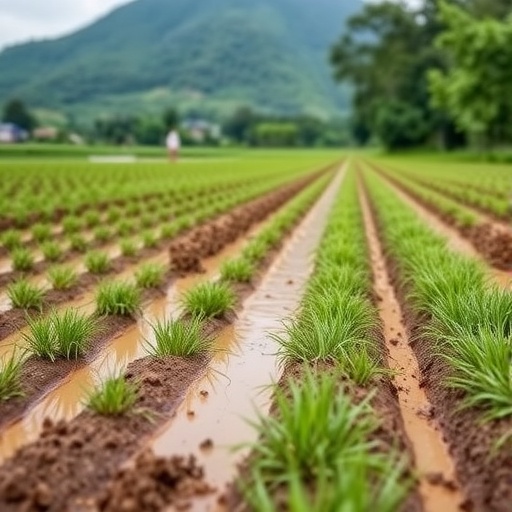
As the looming crisis of climate change threatens global food security, an innovative approach is emerging that offers new hope for sustaining agricultural productivity in the face of increasing environmental uncertainty. Researchers have now demonstrated that a strategic global reallocation of rainfed crop production could simultaneously boost food outputs by over 10% and slash the risk associated with climate variability by a third, all without expanding cropland or water use. This breakthrough analysis, grounded in the principles of modern portfolio theory, heralds a transformative framework for managing the world’s food systems amidst unprecedented climatic stress.
For decades, scientists and policymakers have grappled with the challenge of feeding a growing global population under erratic weather patterns made more extreme by climate change. Rainfed agriculture, which supplies a major portion of the world’s staple crops like maize, wheat, and soybeans, is particularly vulnerable to fluctuations in rainfall and temperature, contributing to volatile crop yields year-to-year. Addressing this volatility is critical, not only to ensure adequate global production but also to stabilize food markets and support livelihoods in vulnerable regions.
In this groundbreaking study, researchers leveraged modern portfolio theory—a tool originally developed to optimize financial investment portfolios by balancing returns against risk—to examine how redistributing rainfed crop production across different geographic regions could optimize the trade-off between overall crop output and interannual production variability. By doing so, they sought to identify Pareto-optimal spatial arrangements that maximize production returns while minimizing climatic risk, offering a robust roadmap for resilient crop allocation at a global scale.
The analysis integrated comprehensive datasets on crop yields and climate records from 2010 and projected forward to 2050 scenarios based on two representative concentration pathways (RCPs): a business-as-usual trajectory, RCP 6.0, and an ambitious mitigation pathway, RCP 2.6. These scenarios encapsulate the range of likely future greenhouse gas trajectories and their impacts on temperature and precipitation patterns, providing a rigorous test bed for exploring how spatial distribution of crops might buffer against climate-induced yield losses.
A striking conclusion emerged from this modeling effort: by optimizing the spatial layout of rainfed cropping areas, global food production can be increased by 10.1% with no additional risk beyond what was observed in 2010. Conversely, it is possible to reduce the interannual variability in production by 33.1% while maintaining the same average production levels. This implies that not only can the world grow more food using the same amount of land and water, but it can also do so more reliably amid the growing uncertainty of climate extremes.
These findings underscore the immense potential locked in strategic reallocation of crop production guided by climate risk profiles. Certain regions with relatively stable climate patterns could compensate for areas with higher variability, smoothing out global production volatility. This is analogous to diversifying an investment portfolio: spreading agricultural production across diverse climatic zones reduces the overall risk of concurrent crop failures due to adverse weather, while enhancing total output.
However, realizing this vision will require a coordinated, global effort transcending national boundaries and individual agricultural practices. Localized yield gaps must be closed through targeted interventions in agronomy, technology transfer, and sustainable intensification to fully harness the productivity potential indicated by the models. Enhanced international trade cooperation is equally critical, ensuring that surpluses generated in low-risk regions can be efficiently distributed to areas prone to yield fluctuations.
Furthermore, the study highlights that such global coordination must be embedded within climate adaptation policies that encourage resilience through diversified crop portfolios. This aligns with the broader goals of environmental sustainability and food system equity by optimizing resource use without further stressing freshwater availability or land conversion. The approach could also build adaptive capacity against future climate shocks by dynamically adjusting crop allocations based on evolving climatic conditions and yield data.
In addition to addressing food security, this research offers a template for integrating risk management principles into agronomic planning at an unprecedented scale. The application of modern portfolio theory to agricultural landscapes serves as a paradigm shift in how experts conceptualize and optimize the spatial dynamics of crop production globally. It transcends traditional yield-centric approaches by explicitly incorporating the dimension of risk reduction, which is paramount in a climate-changed world.
Importantly, the study’s methodology accounts not only for mean yield improvements but also for the critical variability underpinning food supply stability. By quantifying the full risk-return profile of crop distributions, decision-makers can evaluate trade-offs transparently and strategize agricultural investments and policies accordingly. This methodological advancement bridges the gap between climate science, agronomy, and economics, enhancing the robustness of future food system planning.
As climate patterns continue to evolve, the ability to adapt crop spatial arrangements proactively could become a vital component of global food security strategies. It offers a scalable, scientifically grounded mechanism to “climate-proof” food production by leveraging geographic diversity and climate risk heterogeneity. Integrating this with technological innovations such as remote sensing, precision agriculture, and climate forecasting would further enhance its practical viability.
Nevertheless, challenges remain in translating the model’s theoretical insights into actionable policies and practices. Political, infrastructural, and socioeconomic barriers could impede the shifts in cropping patterns necessary to achieve these optimizations. Equitable sharing of benefits and addressing potential disruptions to local farming communities are essential considerations to ensure the sustainability and inclusivity of such systems.
Despite these hurdles, the compelling evidence presented in this work provides a clarion call for the global community to rethink conventional agriculture paradigms. It illustrates that food security in an era of climate uncertainty does not rely solely on expanding inputs but on smarter spatial strategies that harness diversity and reduce vulnerability. It beckons a future where global food systems are managed as dynamic, adaptive networks optimized for resilience and productivity.
In summary, this pioneering research paves the way for a paradigm shift in global food security policy and practice. By harnessing the power of spatial optimization aligned with climate risk profiles, humanity can enhance both the quantity and reliability of critical staple crops without exerting additional pressure on finite natural resources. This offers a beacon of hope amid the escalating challenges climate change poses to feeding the world’s billions.
The findings reinforce the urgent need for integrated approaches combining agronomic innovation, international collaboration, and adaptive governance. Only by embracing coordinated production strategies and open global trade can the world unlock the resilience and abundance needed to sustain future generations amid an uncertain climatic future.
As the science of food systems evolves, this fusion of cutting-edge theoretical frameworks with real-world agricultural imperatives demonstrates the transformative potential of interdisciplinary solutions. It calls upon researchers, policymakers, and practitioners alike to reimagine and reshape global food production in ways that are productive, equitable, and climate-resilient. The future of feeding the world hinges not just on how much we grow but where and how strategically we grow it.
Cite Scienmag News
Alan Morgan. (June 15, 2026). Reallocating Rainfed Crops Boosts Yield, Cuts Climate Risk. Scienmag. https://scienmag.com/reallocating-rainfed-crops-boosts-yield-cuts-climate-risk/
Alan Morgan. "Reallocating Rainfed Crops Boosts Yield, Cuts Climate Risk." Scienmag, 15 June 2026, https://scienmag.com/reallocating-rainfed-crops-boosts-yield-cuts-climate-risk/. Accessed 5 September 2026.
Alan Morgan. "Reallocating Rainfed Crops Boosts Yield, Cuts Climate Risk." Scienmag. June 15, 2026. https://scienmag.com/reallocating-rainfed-crops-boosts-yield-cuts-climate-risk/


