

Tuesday, October 20, 2026
Science
No Result
View All Result
  • Login
  • HOME
  • SCIENCE NEWS
  • CONTACT US
  • HOME
  • SCIENCE NEWS
  • CONTACT US
No Result
View All Result
Scienmag
No Result
View All Result
Home Science News Medicine

Rat study finds exercise-dependent BDNF and cognitive responses

October 20, 2026
in Medicine
Cassandra Pierce
By Cassandra Pierce Scienmag Editorial Profile - Systems Neuroscience
Reading Time: 3 mins read
0
Rat study finds exercise-dependent BDNF and cognitive responses

Rat study finds exercise-dependent BDNF and cognitive responses

65
SHARES
587
VIEWS
Share on FacebookShare on Twitter
ADVERTISEMENT

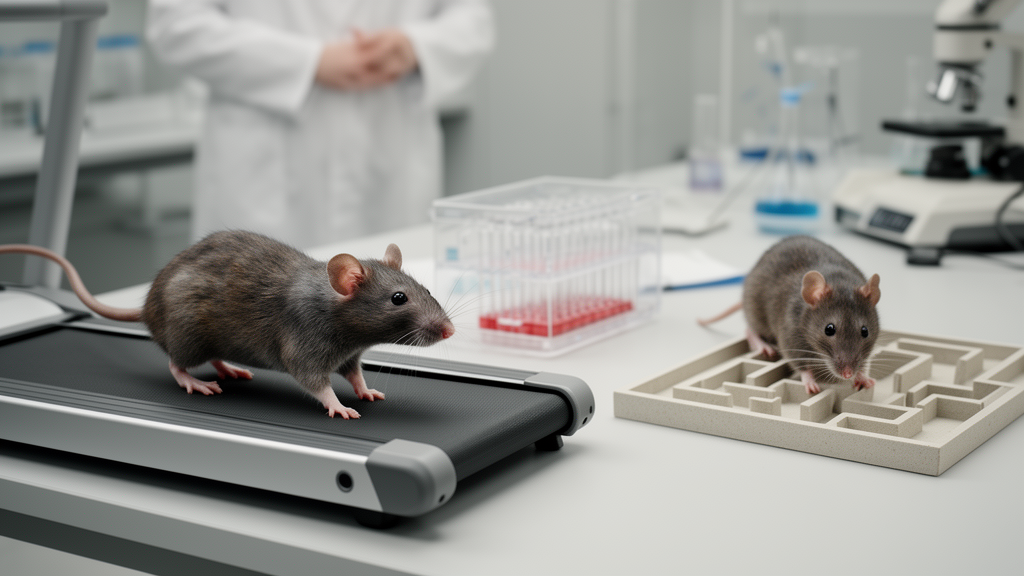
In an eight-week experiment with 40 male Wistar rats, endurance training was associated with significantly higher hippocampal brain-derived neurotrophic factor (BDNF) concentrations than a control group, rotarod training, and a program combining endurance followed by rotarod training. The biochemical results did not consistently correspond to better performance across the cognitive tests. Rats assigned to rotarod followed by endurance training showed lower escape latency during acquisition in the Morris Water Maze than the control and rotarod-only groups, but the groups did not differ significantly in Novel Object Recognition or passive avoidance performance.

The researchers randomly divided the animals into five groups of eight: endurance training, rotarod training, endurance followed by rotarod training, rotarod followed by endurance training, and control. After eight weeks, the investigators evaluated spatial learning and memory with the Morris Water Maze, recognition memory with a Novel Object Recognition test, and aversive memory with a passive avoidance test. They measured BDNF concentrations in the hippocampus using an enzyme-linked immunosorbent assay. The study was designed to compare the effects of different training programs rather than test a training program in people.

Endurance-trained rats had higher hippocampal BDNF concentrations than control animals, animals in the rotarod-only group, and animals in the endurance-plus-rotarod group, with the reported differences reaching p < 0.05. The rotarod-plus-endurance group also had higher BDNF concentrations than the rotarod-only group. The supplied results do not report a significant difference between the endurance-only and rotarod-plus-endurance groups, so the findings do not establish that one program produced the highest BDNF concentration across all five groups. Nor do the measurements show that a larger BDNF response was consistently accompanied by stronger behavioral performance.

Spatial learning improved across acquisition trials in the Morris Water Maze. During that phase, the rotarod-plus-endurance group had a lower overall escape latency than the rotarod-only and control groups, with differences reported at p < 0.05. Post hoc comparisons in the probe trial did not reveal significant differences among the groups. The study found no significant between-group differences in Novel Object Recognition or passive avoidance performance. These outcomes show that the clearest group-level behavioral difference was confined to acquisition performance in one spatial-learning task, rather than extending across all three measures of cognition.

Taken together, the findings indicate that different exercise programs were associated with distinct patterns of hippocampal BDNF and cognitive performance in this rat experiment. They do not demonstrate that training sequence caused the observed differences, that BDNF changes mediated the behavioral results, or that either training program offers a cognitive advantage in humans. The scope was limited by the use of 40 male Wistar rats, five experimental groups, three cognitive assessments, and an eight-week training period; effects in females, other animal populations, and people therefore were not established. The article was published as an early-access, peer-reviewed research article in BMC Neuroscience and was identified as still subject to further editing before replacement by the final Version of Record.

Subject of Research: Experimental comparison of training programs, hippocampal BDNF, and cognition in male Wistar rats

Article Title: Differential effects of endurance and motor skill training on hippocampal BDNF levels and cognitive performance in male Wistar rats

Article References: Sadeghi, M., Komaki, A., & Nazem, F. (2026). Differential effects of endurance and motor skill training on hippocampal BDNF levels and cognitive performance in male Wistar rats. BMC Neuroscience. https://doi.org/10.1186/s12868-026-01060-z

Image Credits: AI Generated

DOI: 10.1186/s12868-026-01060-z

Keywords: BDNF, hippocampus, endurance training, rotarod training, rat cognition, spatial learning, Morris Water Maze, recognition memory, passive avoidance, exercise, Differential, effects

Cite Scienmag News

Cassandra Pierce. (October 20, 2026). Rat study finds exercise-dependent BDNF and cognitive responses. Scienmag. https://scienmag.com/rat-study-finds-exercise-dependent-bdnf-and-cognitive-responses/

Cassandra Pierce. "Rat study finds exercise-dependent BDNF and cognitive responses." Scienmag, 20 October 2026, https://scienmag.com/rat-study-finds-exercise-dependent-bdnf-and-cognitive-responses/. Accessed 20 October 2026.

Cassandra Pierce. "Rat study finds exercise-dependent BDNF and cognitive responses." Scienmag. October 20, 2026. https://scienmag.com/rat-study-finds-exercise-dependent-bdnf-and-cognitive-responses/


Tags: animal models of exercise and cognitionBDNFBDNF concentration measurement in hippocampusbiochemical markers of neuroplasticitycombined training protocols in neuroscienceDifferentialEffectseffects of endurance training on cognitive functionendurance trainingExerciseexercise-dependent BDNF in ratshippocampal neuroplasticityhippocampusimpact of physical activity on brain healthimplications for human exercise and cognitive enhancementMorris water mazeMorris Water Maze spatial learningpassive avoidancerat cognitionrecognition and aversive memory testsrecognition memoryrotarod trainingrotarod training and motor learningspatial learning
Share26Tweet16
Previous Post

Single-center Bogotá study finds 24.9% STI prevalence among PrEP users

Next Post

Wheat remembers the cold: Molecular changes prepare plants for the next chill

Related Posts

Single-center Bogotá study finds 24.9% STI prevalence among PrEP users
Medicine

Single-center Bogotá study finds 24.9% STI prevalence among PrEP users

October 20, 2026
Legal Anonymity Raised Personal Injury Settlements by 12–17%
Medicine

Legal Anonymity Raised Personal Injury Settlements by 12–17%

October 20, 2026
Blood pressure and heart risk emerge as multiple myeloma clues
Medicine

Blood pressure and heart risk emerge as multiple myeloma clues

October 20, 2026
Dementia Care Showed Selective Analgesic Shifts After CDC Opioid Guideline
Medicine

Dementia Care Showed Selective Analgesic Shifts After CDC Opioid Guideline

October 20, 2026
Blood inflammation-albumin ratio linked to early decline after ischemic stroke
Medicine

Blood inflammation-albumin ratio linked to early decline after ischemic stroke

October 20, 2026
Ivermectin blunts cisplatin effects in oral cancer cells
Medicine

Ivermectin blunts cisplatin effects in oral cancer cells

October 20, 2026
Next Post
Wheat remembers the cold: Molecular changes prepare plants for the next chill

Wheat remembers the cold: Molecular changes prepare plants for the next chill

  • Mothers who receive childcare support from maternal grandparents show more optimized

    Mothers who receive childcare support from maternal grandparents show more parental warmth, finds NTU Singapore study

    27656 shares
    Share 11059 Tweet 6912
  • University of Seville Breaks 120-Year-Old Mystery, Revises a Key Einstein Concept

    1061 shares
    Share 424 Tweet 265
  • Bee body mass, pathogens and local climate influence heat tolerance

    682 shares
    Share 273 Tweet 171
  • Researchers record first-ever images and data of a shark experiencing a boat strike

    546 shares
    Share 218 Tweet 137
  • Groundbreaking Clinical Trial Reveals Lubiprostone Enhances Kidney Function

    531 shares
    Share 212 Tweet 133
Science

Embark on a thrilling journey of discovery with Scienmag.com—your ultimate source for cutting-edge breakthroughs. Immerse yourself in a world where curiosity knows no limits and tomorrow’s possibilities become today’s reality!

RECENT NEWS

  • Wheat remembers the cold: Molecular changes prepare plants for the next chill
  • Rat study finds exercise-dependent BDNF and cognitive responses
  • Single-center Bogotá study finds 24.9% STI prevalence among PrEP users
  • Working-memory signal changes sides as remembered objects cross the midline

Categories

  • Agriculture
  • Anthropology
  • Archaeology
  • Athmospheric
  • Biology
  • Biotechnology
  • Blog
  • Bussines
  • Cancer
  • Chemistry
  • Climate
  • Earth Science
  • Editorial Policy
  • Marine
  • Mathematics
  • Medicine
  • Pediatry
  • Policy
  • Psychology & Psychiatry
  • Science Education
  • Science News
  • Social Science
  • Space
  • Technology and Engineering

Subscribe to Blog via Email

Enter your email address to subscribe to this blog and receive notifications of new posts by email.

Join 5,150 other subscribers

© 2025 Scienmag - Science Magazine

Welcome Back!

Login to your account below

Forgotten Password?

Retrieve your password

Please enter your username or email address to reset your password.

Log In
No Result
View All Result
  • HOME
  • SCIENCE NEWS
  • CONTACT US

© 2025 Scienmag - Science Magazine

Discover more from Science

Subscribe now to keep reading and get access to the full archive.

Continue reading