A 27-year-old woman in India developed double vision, facial weakness, and difficulty swallowing within a single day, then deteriorated so rapidly that she needed a breathing tube within 24 hours. Over the following days she lost the ability to move her eyes in any direction, her pupils stopped responding normally to light, and her facial, bulbar, neck-flexor, and respiratory muscles failed progressively. Yet every laboratory test that might have explained her collapse came back negative or inconclusive, and the one treatment that could have targeted the suspected cause, botulinum antitoxin, could not be obtained because it was unavailable. Her case, published as a case report in Discover Neuroscience, describes how clinicians arrived at a diagnosis of clinically suspected botulism purely through pattern recognition and the systematic exclusion of every major neurological mimic.
Botulism is a rare but potentially life-threatening neuroparalytic illness caused by botulinum neurotoxins produced by Clostridium botulinum, an anaerobic gram-positive spore-forming bacterium. The toxin irreversibly blocks acetylcholine release at the presynaptic neuromuscular junction by cleaving SNARE proteins, producing flaccid paralysis that typically begins with cranial nerve dysfunction and descends toward the respiratory muscles. Human botulism occurs in foodborne, wound-associated, iatrogenic, and intestinal colonization forms, with foodborne exposure among the most recognized worldwide. Because toxin assays are often unavailable and early electrophysiological findings can be non-specific, diagnosis rests primarily on clinical assessment, a fact that makes the illness both dangerous to miss and difficult to confirm.
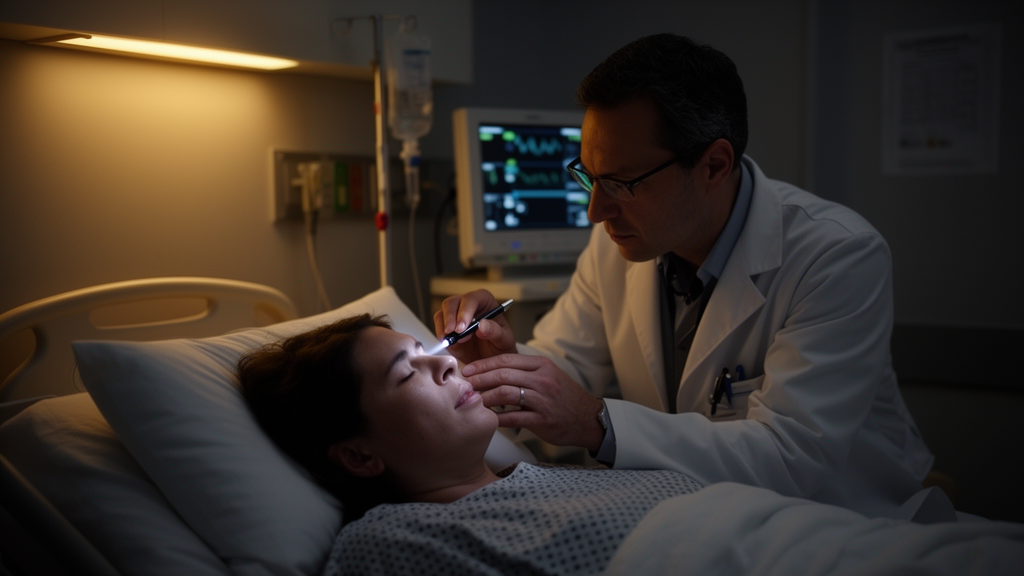
In this case, the neurological symptoms were preceded by a three-day febrile illness with vomiting and diarrhea that resolved on its own, followed two days later by buccal mucosal pain, headache, vertigo, and dysarthria. The gastrointestinal episode raised the possibility of foodborne exposure, but no contaminated food source could be identified and no family members or co-diners fell ill. There was no wound contamination, animal bite, or exposure to therapeutic or cosmetic botulinum toxin. On admission the patient was conscious, oriented, and hemodynamically stable, with a right sixth nerve palsy causing double vision, right facial weakness, nasal regurgitation, and dysarthria. Limb power was 5/5 in all four extremities, sensation was preserved, and deep tendon reflexes were intact. She was admitted to the intensive care unit for close neurological and respiratory monitoring.
The deterioration was swift. Initial blood tests showed only mild hypokalemia and transaminitis, and contrast-enhanced MRI of the brain revealed no structural abnormality. Within 24 hours her bulbar weakness worsened and she developed respiratory distress, requiring elective intubation and mechanical ventilation. Over the next 48 hours she developed bilateral ptosis, mid-dilated non-reactive pupils, progressive bulbar weakness, and respiratory muscle involvement. A neostigmine trial produced no improvement, arguing against myasthenia gravis. Cerebrospinal fluid showed normal protein and glucose without pleocytosis, and electroencephalography displayed frontocentral beta activity without epileptiform discharges. By 72 to 96 hours she had complete ophthalmoplegia, bilateral facial weakness, neck-flexor weakness, and severe bulbar dysfunction, yet remained fully conscious and communicated by writing.
The exclusion process was exhaustive. Intravenous immunoglobulin was tried without clinical benefit. Antibodies against the acetylcholine receptor, MuSK, and striated skeletal muscle were negative, as were paraneoplastic neuronal antibodies and an autoimmune encephalitis panel. Vasculitic workup, complement levels, and echocardiography were unrevealing. On Hospital Day 11, nerve conduction studies of the limbs were normal, but facial motor studies showed absent compound muscle action potentials from the bilateral orbicularis oculi and orbicularis oris muscles. Repetitive nerve stimulation at 3 and 10 hertz over three limb muscles, including post-exercise facilitation testing, showed no significant decrement or increment. The authors emphasize these electrophysiological findings were non-diagnostic for botulism and were not regarded as confirmatory evidence; needle and single-fiber electromyography were never performed.
Guillain–Barré syndrome and its variants remained the leading competing diagnoses. The authors note that normal cerebrospinal fluid and limb nerve conduction studies alone cannot exclude early GBS, because both may be non-diagnostic early in the disease. Nevertheless, preserved sensation and reflexes, prominent ophthalmoplegia with pupillary abnormalities, the absence of documented limb weakness, and the descending cranial–bulbar–respiratory progression made classical GBS, Miller Fisher syndrome, the pharyngeal-cervical-brachial variant, and overlap syndromes less likely. Brainstem encephalitis was also considered but argued against by normal neuroimaging, non-inflammatory cerebrospinal fluid, and a preserved sensorium. Pilocarpine testing demonstrated delayed pupillary constriction, interpreted as an ancillary sign of impaired parasympathetic cholinergic transmission rather than a diagnostic test.
By Hospital Day 10, clinically suspected botulism had become the leading diagnosis, based on the temporal sequence from gastrointestinal illness through ocular motor weakness, complete ophthalmoplegia with mydriasis, facial and bulbar weakness, neck-flexor weakness, and respiratory muscle involvement. Notably, the authors caution that objective generalized limb weakness was never documented, so the course is more accurately described as a descending cranial–bulbar–respiratory pattern rather than generalized descending paralysis. Interestingly, classic autonomic features such as dry mouth, constipation, urinary retention, ileus, and orthostatic hypotension were not recorded during the illness; increased salivation and lacrimation appeared only during recovery, possibly reflecting restoration of cholinergic function.
Confirmatory botulinum toxin testing was unavailable, and serum, stool, and suspected food samples were never collected for analysis, so the diagnosis remained clinically suspected rather than laboratory confirmed. No formal epidemiological or public health investigation identified an exposure source. Botulinum antitoxin, the principal disease-specific therapy that guidelines recommend giving promptly when suspicion is high rather than waiting for laboratory confirmation, was actively sought but could not be obtained. Management was therefore entirely supportive: mechanical ventilation, a tracheostomy, enteral nutrition, chest physiotherapy, limb physiotherapy, and rehabilitation.
Recovery unfolded slowly over weeks, a timeline compatible with the regeneration of neuromuscular junctions after toxin-mediated injury. Tongue movements returned on Day 18, jaw movement by Day 22, pupillary reactivity on Day 27, and extraocular movements between Days 31 and 33. Swallowing improved enough for oral intake by Day 38, she began ambulating with assistance on Day 44 and independently by Day 50, and the tracheostomy was removed on Day 61. She was discharged on Day 64, independently ambulant with recovered tongue movements, partial facial recovery, mild residual dysarthria, and swallowing that had not fully returned to baseline. At follow-up she had only minimal residual facial weakness with complete recovery of eye movements.
The authors are explicit about the limitations of their report. Without toxin assays, available samples, needle electromyography, single-fiber electromyography, anti-ganglioside antibody testing including anti-GQ1b and anti-GT1a, repeat electrodiagnostic studies, or complete documentation of handgrip strength, spirometry, and cerebellar signs, definitive confirmation was impossible. What the case demonstrates instead is a method: when confirmatory testing is unavailable, as is common in resource-limited settings, careful bedside history taking, recognition of the characteristic temporal sequence of neurological progression, and rigorous exclusion of mimics remain essential, provided clinicians explicitly acknowledge the degree of diagnostic uncertainty. It is also a reminder that delayed diagnosis of botulism can lead to respiratory failure requiring prolonged ventilatory support, and that early supportive care and respiratory monitoring can substantially reduce morbidity even when the definitive drug cannot be reached.
Subject of Research: A case report of clinically suspected, laboratory-unconfirmed botulism diagnosed through clinical pattern recognition and systematic exclusion of neurological mimics.
Article Title: Clinically suspected botulism without laboratory confirmation diagnosed through clinical pattern recognition and systematic exclusion
Article References: Mann, G. S., Rajeev, M., Nandwani, S., & Jain, N. (2026). Clinically suspected botulism without laboratory confirmation diagnosed through clinical pattern recognition and systematic exclusion. Discover Neuroscience, 21(1), Article 103. https://doi.org/10.1186/s13064-026-00333-x
Image Credits: AI Generated
DOI: 10.1186/s13064-026-00333-x
Keywords: botulism, Clostridium botulinum, clinical diagnosis, descending paralysis, Guillain-Barré syndrome, myasthenia gravis, neuromuscular junction, case report, ventilatory support, resource-limited settings, ophthalmoplegia, electrophysiology
Cite Scienmag News
Ophelia Keating. (October 29, 2026). Rare Suspected Botulism Case Diagnosed by Clinical Pattern Recognition Alone. Scienmag. https://scienmag.com/rare-suspected-botulism-case-diagnosed-by-clinical-pattern-recognition-alone/
Ophelia Keating. "Rare Suspected Botulism Case Diagnosed by Clinical Pattern Recognition Alone." Scienmag, 29 October 2026, https://scienmag.com/rare-suspected-botulism-case-diagnosed-by-clinical-pattern-recognition-alone/. Accessed 29 October 2026.
Ophelia Keating. "Rare Suspected Botulism Case Diagnosed by Clinical Pattern Recognition Alone." Scienmag. October 29, 2026. https://scienmag.com/rare-suspected-botulism-case-diagnosed-by-clinical-pattern-recognition-alone/