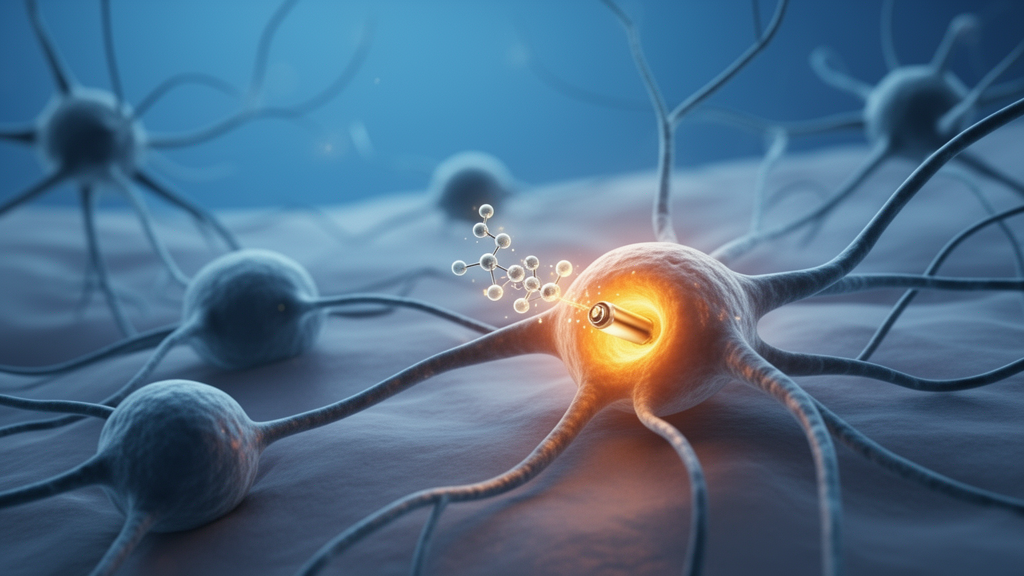
Scientists have developed and validated a new radioactive tracer, called [3H]5-MOP, that binds the colony stimulating factor-1 receptor (CSF1R) with high affinity and unprecedented selectivity. The receptor, a tyrosine kinase found on microglia — the resident immune cells of the central nervous system — has become a major focus of neuroscience research because it acts as a key mediator of communication between neurons and glia, and because its activation is considered a marker of neuroinflammation.
The work, published as original research in EJNMMI Research, addresses a long-standing technical problem in molecular imaging. Selective radioligands for CSF1R are of great interest both for visualizing neuroinflammation and for determining how much of a therapeutic drug occupies the receptor. Until now, the tracer most widely used for this purpose, CPPC, has shown weaknesses that the new compound appears to overcome.
The tracer is built around 5-MOP, a CSF1R inhibitor whose full chemical name is 4-((5-methoxy-6-((5-methoxypyridin-2-yl)methoxy)pyridin-3-yl)methyl)-2-(1-methyl-1H-pyrazol-4-yl)pyrimidine. By labeling this molecule with tritium, the team created a radioligand suitable for in vitro binding studies. The researchers validated its binding characteristics through saturation binding experiments conducted in both human and murine tissues.
The selectivity profile emerged from screening against a broad panel of kinases, in which 5-MOP proved selective for CSF1R. This matters because the brain expresses many other kinases, and a tracer that binds several of them cannot reliably report on the target of interest. Cross-reactivity distorts both basic research measurements and the interpretation of drug-occupancy studies.
Autoradiography experiments showed that [3H]5-MOP binds with high affinity, with a dissociation constant (KD) of 9.8 nanomolar, to a single saturable binding site in human meningioma tissues. A single saturable site is the signature expected when a ligand binds one specific receptor rather than a mixture of targets, and the nanomolar affinity falls in a range useful for quantitative binding assays.
The specificity of this binding was confirmed in displacement experiments. Known CSF1R inhibitors — including CPPC, sCSF1inh and GW-2580 — displaced the tracer from its binding sites, indicating that the binding indeed occurs at CSF1R rather than at an unrelated protein.
The contrast with the established tracer CPPC was striking. CPPC, which has been extensively used as a CSF1R radioligand, showed substantial cross-reactivity to other brain kinases, including the tropomyosin receptor kinase family Trk A, Trk B and Trk C. Moreover, in the displacement tests, [3H]CPPC could only be displaced by CPPC itself, not by other CSF1R ligands, including 5-MOP — behavior that complicates the interpretation of experiments relying on that older tracer.
Based on these findings, the authors conclude that [3H]5-MOP is the most selective radioligand currently available for CSF1R, enabling accurate detection of the receptor in vitro. The study’s significance statement notes that because CSF1R is selectively expressed in activated microglia, the radioligand could be useful for detecting neuroinflammatory activity.
It is worth emphasizing the scope of the validation. The reported experiments are in vitro studies performed in tissue samples, including human meningioma tissue and murine tissue, not imaging studies in living patients. The tritium label makes the compound suitable for laboratory autoradiography and binding assays rather than clinical positron emission tomography. The findings therefore establish a validated research tool for measuring CSF1R in tissue, with potential relevance to studying neuroinflammation, rather than a new diagnostic test ready for clinical use.
Even so, the advance is likely to be welcomed across several research communities. CSF1R has attracted attention as both a potential drug target and a biomarker of neuroinflammation, and its endogenous ligands, colony stimulating factor-1 and interleukin-34, are released from neurons, placing the receptor at a central position in neuron-glia communication. A tracer that reliably isolates CSF1R from the crowd of related kinases gives researchers a cleaner instrument for asking when and where microglia are activated — and for testing how candidate drugs engage their target.
Subject of Research: Development and in vitro validation of the selective CSF1R radioligand [3H]5-MOP
Article Title: [3H]5-MOP: a novel and selective colony stimulating factor-1 receptor (CSF1R) radiotracer
Article References: Iavazzo, C., Pazarlar, B. A., Bang-Andersen, B., Jensen, T., Hentzer, M., Bastlund, J. F., Haslund-Vinding, J. L., Mathiesen, T. I., Lambertsen, K. L., Finsen, B., Landau, A. M., & Mikkelsen, J. D. (2026). [3H]5-MOP: a novel and selective colony stimulating factor-1 receptor (CSF1R) radiotracer. EJNMMI Research. https://doi.org/10.1186/s13550-026-01520-x
Image Credits: AI Generated
DOI: 10.1186/s13550-026-01520-x
Keywords: CSF1R, radiotracer, 5-MOP, microglia, neuroinflammation, autoradiography, CPPC, kinase selectivity, tritium labeling, drug occupancy, EJNMMI Research, novel
Cite Scienmag News
Cassandra Pierce. (October 29, 2026). New Radiotracer Targets Brain Immune Cells With Unmatched Selectivity. Scienmag. https://scienmag.com/new-radiotracer-targets-brain-immune-cells-with-unmatched-selectivity/
Cassandra Pierce. "New Radiotracer Targets Brain Immune Cells With Unmatched Selectivity." Scienmag, 29 October 2026, https://scienmag.com/new-radiotracer-targets-brain-immune-cells-with-unmatched-selectivity/. Accessed 29 October 2026.
Cassandra Pierce. "New Radiotracer Targets Brain Immune Cells With Unmatched Selectivity." Scienmag. October 29, 2026. https://scienmag.com/new-radiotracer-targets-brain-immune-cells-with-unmatched-selectivity/