A single deleted gene has produced a morning glory plant with no blue or purple pigment anywhere on its body, from the tips of its petals to the furthest reaches of its stems, and researchers have now traced the striking transformation to a precise slice of missing DNA. The plant is an Ivy-leaf morning glory, Ipomoea hederacea, and the deletion sits in IhUF3GT1, a gene that performs the final step in the assembly of anthocyanins, the pigments that paint the species’ flowers a vivid blue-purple and tint its shoots. Because the missing step is the last one in the pathway, the mutation wipes out anthocyanins without disturbing the production of related flavonoid compounds built earlier in the network, a feature the researchers say makes the plant a potentially valuable model for isolating the fitness effects of anthocyanin loss itself.
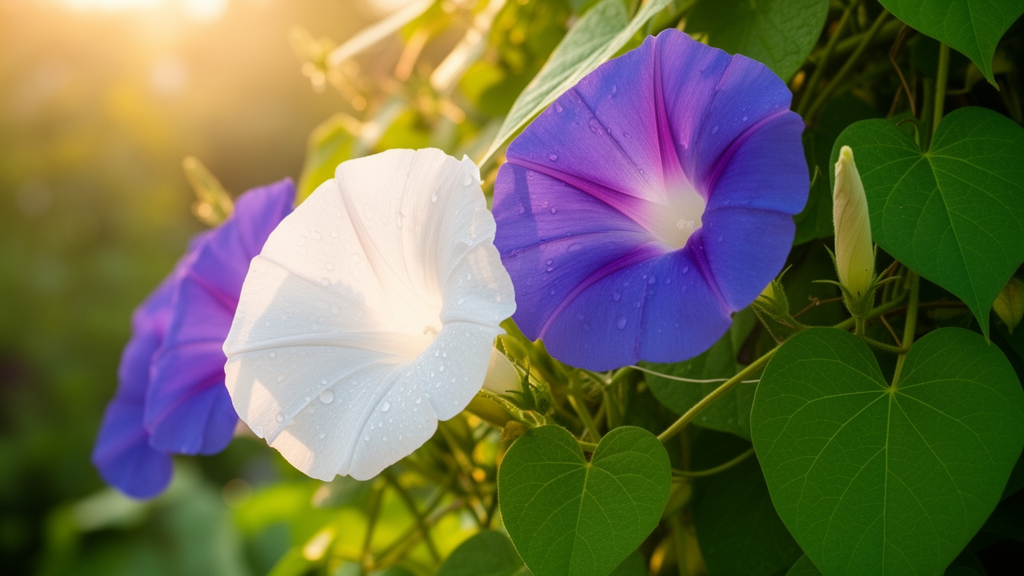
The discovery began when a maternal family of I. hederacea, previously collected in North Carolina, turned up with white flowers and entirely green, unpigmented stems. In canonical plants of this species, the flowers are a saturated blue-purple and the shoots carry visible pigmentation, both derived from anthocyanins of the cyanidin branch. The mutant departs from that pattern dramatically: photographs of the line show flowers that are completely white in both petals and sepals, and vegetative tissue that lacks any trace of the purple coloring typical of the species. The researchers note that the delphinidin branch of anthocyanin production is absent in Ipomoea, and red or orange pigments of the pelargonidin branch have not evolved in the lineage to which I. hederacea belongs, so the cyanidin branch is the only source of pigment in this plant, and the mutation silenced it entirely.
To work out how the trait is inherited, the team crossed the unpigmented line with a pigmented line collected in Easton, Maryland, and grew out the resulting generations in the greenhouse. Among 494 second-generation plants, 141, or 28.5 percent, were unpigmented, a proportion that does not deviate significantly from the 25 percent expected if the trait is controlled by a single recessive gene (chi-squared = 3.3063, p = 0.07). The slight excess of white-flowered offspring was not large enough to reject a one-locus model, and the researchers conclude that the unpigmented phenotype is a homozygous, recessive trait determined by a single locus. White flowers also traveled with unpigmented stems: in a haphazard sample of 44 white-flowered plants, every one also lacked pigmentation in its stems, suggesting the mutation eliminates the ability to synthesize anthocyanins altogether rather than merely switching off pigment production in one tissue type.
The next question was which gene had failed. The researchers extracted RNA from the petals of four white-flowered and four purple-flowered plants drawn from the second-generation population and compared their transcriptomes. One gene stood out above all others: g2417, which matches the anthocyanidin 3-O-glucosyltransferase gene IhUF3GT1 in tomato, was completely silent in white flowers and expressed in purple ones, and its absence was the single most striking transcriptomic difference between the two flower colors. No other gene in the anthocyanin biosynthesis pathway showed differential expression between white and purple flowers, meaning the block in the pathway sits precisely at the conversion of anthocyanidins such as cyanidin into their stable anthocyanin derivatives. That terminal position matters, because mutations earlier in the network would also disrupt flavonols, isoflavonoids, and proanthocyanidins, entangling the consequences of anthocyanin loss with those of other compounds.
Genome sequencing explained why the gene had gone quiet. The unpigmented parent carries a deletion of up to seven kilobases in the region within and upstream of IhUF3GT1, and the deletion removes 50.3 percent of the gene’s coding sequence, including the start codon. Without its beginning, the gene cannot produce a functional protein, and without the protein, anthocyanidins are never converted into the pigments that color the plant. The researchers then checked whether any other plant in the species carried the same defect: among 123 naturally pigmented I. hederacea lines whose genomes were screened, all 123 contained the IhUF3GT1 coding sequence, including the start codon, indicating that the deletion is unique to the unpigmented line.
Co-segregation analysis sealed the case. The team grew third-generation progeny from pigmented and unpigmented second-generation individuals and used a polymerase chain reaction assay to test for the presence or absence of the IhUF3GT1 locus. Every one of 36 pigmented plants carried the IhUF3GT1 sequence, and none of 17 unpigmented plants did, a perfect association between the deletion and the loss of pigment. Taken together with the inheritance pattern and the expression data, the results demonstrate that the deletion of IhUF3GT1 underlies the absence of pigmentation in these white-flowered plants, and they describe a genetic basis for anthocyanin loss that has not previously been reported in the genus Ipomoea.
The rarity of the finding is itself part of the story. The researchers report that this is the first unpigmented I. hederacea sample they have observed in more than 25 years of field work on the species and among roughly 750 naturally collected lines in their laboratory. Other researchers report similar scarcity: one colleague encountered a single unpigmented individual across four years of field surveys of about 50 populations each throughout the southeastern and midwestern portion of the species’ range, comprising thousands of individuals. Whole-plant anthocyanin loss is also known to occur at very low frequency in other species, at less than 1 percent in Silene littorea and less than 0.1 percent in Delphinium nelsonii, where albino individuals showed reduced pollinator visitation and seed set. Loss-of-function mutations in the enzymatic genes of the anthocyanin pathway, such as those affecting DFR in Mimulus lewisii and Iochroma calycinum, are likewise reported to be rare in populations.
The contrast with a close relative is instructive. In the common morning glory, Ipomoea purpurea, white-flowered alleles are better documented: the a allele, caused by a transposable element insertion in the CHS-D gene, appears at low frequency in natural populations and is associated with lower survival to flowering in the field and lower fecundity at high temperatures, while the w allele, which inactivates the transcription factor IpMyb1, has not shown strong fitness costs in multiple investigations. The researchers suggest that the w and a alleles in I. purpurea may be protected from loss by a transmission advantage associated with increased selfing when homozygous, but because selfing rates in I. hederacea are already very high, often above 90 percent, such an advantage seems unlikely to explain the persistence of the IhUF3GT1 deletion. Instead, they hypothesize that selection acts against anthocyanin loss itself, keeping the deletion’s frequency governed by mutation-selection balance, though they frame this as a hypothesis rather than a demonstrated result.
Because the deletion affects the terminal step of anthocyanin biosynthesis, the researchers do not expect it to have pleiotropic consequences on traits derived from other branches of the flavonoid pathway, which is what makes the mutant potentially useful for disentangling the ecological consequences of anthocyanin loss from the loss of related compounds. Anthocyanins are implicated in floral color, tolerance to high levels of ultraviolet radiation, and drought resilience in plants, and the species is tractable for field experiments, so the second- and third-generation populations developed in this study could be deployed in experimental plots with much of the genetic background randomized by recombination. The researchers propose that the mutant could help identify and quantify the mechanisms by which anthocyanins determine fitness in I. hederacea and perhaps other Ipomoea species, including economically significant crops such as sweet potato, crop-destroying weeds such as I. hederacea itself, and ornamental plants such as I. purpurea. For now, the finding stands as a description of a novel, monogenic, recessive unpigmented mutant whose rarity, in both phenotype and genotype, hints at the selective forces that keep the morning glory’s flowers blue.
Subject of Research: A rare deletion of the anthocyanin biosynthesis gene IhUF3GT1 causing complete loss of pigmentation in Ipomoea hederacea
Article Title: A rare deletion of IhUF3GT1 in the Ivy-leaf morning glory eliminates anthocyanin-based pigmentation
Article References: Hernandez, D. J., Glasgow, E., Li, M. C., Henry, M. R., Peake, A. L., & Stinchcombe, J. R. (2026). A rare deletion of IhUF3GT1 in the Ivy-leaf morning glory eliminates anthocyanin-based pigmentation. Heredity. https://doi.org/10.1038/s41437-026-00898-7
Image Credits: AI Generated
DOI: 10.1038/s41437-026-00898-7
Keywords: IhUF3GT1, Ipomoea hederacea, anthocyanins, gene deletion, flower color, pigmentation, Mendelian inheritance, recessive trait, transcriptomics, co-segregation, flavonoid biosynthesis, plant genetics
Cite Scienmag News
Juliet Wilcox. (October 28, 2026). Rare Gene Deletion Turns Morning Glory Flowers Completely White. Scienmag. https://scienmag.com/rare-gene-deletion-turns-morning-glory-flowers-completely-white/
Juliet Wilcox. "Rare Gene Deletion Turns Morning Glory Flowers Completely White." Scienmag, 28 October 2026, https://scienmag.com/rare-gene-deletion-turns-morning-glory-flowers-completely-white/. Accessed 28 October 2026.
Juliet Wilcox. "Rare Gene Deletion Turns Morning Glory Flowers Completely White." Scienmag. October 28, 2026. https://scienmag.com/rare-gene-deletion-turns-morning-glory-flowers-completely-white/