


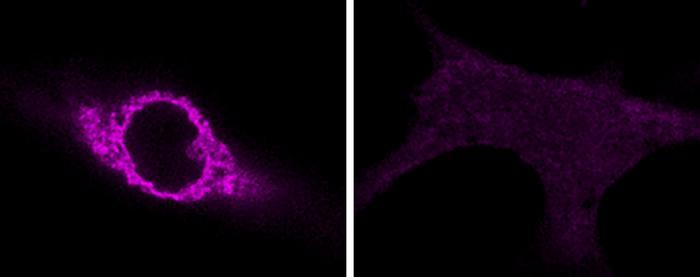
TREX1 is a gene that is supposed to direct the maintenance of the entire body’s DNA, but new research shows that when people are born with mutated TREX1, it causes catastrophic damage to the DNA over time, resulting in a deadly rare disease called retinal vasculopathy with cerebral leukoencephalopathy (RVCL). Published in Nature Communications, the research was led by teams at the Perelman School of Medicine at the University of Pennsylvania and the Brain Research Institute at Niigata University in Japan.

Credit: Courtesy of Penn Medicine/Jonathan Miner’s Lab
TREX1 is a gene that is supposed to direct the maintenance of the entire body’s DNA, but new research shows that when people are born with mutated TREX1, it causes catastrophic damage to the DNA over time, resulting in a deadly rare disease called retinal vasculopathy with cerebral leukoencephalopathy (RVCL). Published in Nature Communications, the research was led by teams at the Perelman School of Medicine at the University of Pennsylvania and the Brain Research Institute at Niigata University in Japan.
While it was already known that a mutation in TREX1 was behind RVCL, the mechanism by which it did its damage was not known. In discovering that TREX1 speeds up the typical process of DNA damage—a process some theorize is tied to every animal’s aging process—the researchers may not have only discovered the weapon TREX1 uses on RVCL patients, but also offered insight beyond this rare disease population.
“It seems that accelerated DNA damage in RVCL causes the premature aging of certain cells, including the cells in the blood vessel wall,” said the study’s lead author Jonathan Miner, MD, PhD, an associate professor of Rheumatology at the Perelman School of Medicine. “If this is the case, then targeting TREX1 could have very broad implications for the treatment of many human diseases linked to aging, including cardiovascular diseases, autoimmune disorders, and cancer.”
RVCL impacts about 200 people worldwide and is often misdiagnosed as lupus, multiple sclerosis, or cancer. The disease causes the breakdown of small blood vessels in the body, which can affect many organs, including the brain, eyes, kidneys, liver, and bones. Patients with the condition typically do not begin to have symptoms—such as memory loss, partial loss of vision, and small strokes—until their 40s or 50s. Eventually, the breakdowns can cause organ damage and failure, including brain atrophy and blindness. There is no cure or treatment, and many patients die within five to ten years of symptoms beginning.
“We’re hopeful that our work will put us on the path toward improving the lives of patients with RVCL,” said the other lead author of this study Taisuke Kato, PhD, an associate professor of Molecular Neuroscience at Niigata University. “With our discoveries, we feel we will be much better equipped to address what is happening within their bodies.”
Studying RVCL models in animal and human cells, Miner and his colleagues explored their hypothesis that the TREX1 mutation, which shortens the gene, was causing instability within cells and damage that appears similar to breakdowns seen in radiation injuries.
They found that the mutation was interfering with a DNA repair process , which occurs when there is a break in both strands of DNA. This interruption of the process allowed DNA to be deleted, and cells prematurely aged and stopped dividing, which leads to overall premature aging and organ damage.
In addition to uncovering RVCL’s primary mechanism of damage, the researchers also found that the TREX1 mutation also displayed a cell-level vulnerability that mirrors those seen in people with mutations to the BRCA1 and BRCA2 genes, which cause breast cancer. Sure enough, the authors found similar elevated rates of risk of breast cancer in patients with TREX1 mutations as in patients with mutations in the BRCA1 and BRCA2 genes.
But on top of that, the TREX1 mutation’s effect on DNA damage also makes people with it more susceptible to damage from chemotherapy, the team found.
“I do worry that certain treatments may have accelerated the progression of disease in some patients,” Miner said. “In many cases, chemotherapy was prescribed as a way of treating suspected ‘autoimmunity’ since certain chemotherapeutic agents can also be used to treat patients with systemic lupus. This was frequently employed in the treatment of RVCL in the past, and even recently by some, and we are concerned that this would actually make the disease worse.”
The study’s findings provide a clearer picture for the types of treatments and medicines that could be pursued for people with RVCL. They could involve lowering levels of TREX1 in the body, correcting the mutation, or just blocking the gene’s DNA-damaging effects.
“Until those therapies are developed, we are working to figure out whether certain mediations already FDA-approved for the treatment of other diseases might be repurposed for RVCL or potentially impact TREX1 levels in the body overall,” Miner said. “TREX1 levels increase with age in multiple tissues in all humans—even in healthy individuals without RVCL—and we need to understand the processes linked to this.”
To that end, the study’s findings extend well beyond the population of patients with RVCL because of what it may add to the DNA damage theory of aging.
“One hope is that understanding the role of TREX1 in RVCL might help us uncover mechanisms that could link the TREX1 gene to a wide variety of human conditions that could also include normal aging,” Miner said.
This study was funded by the National Institutes of Health (K08AR070918, R01AI143982, R01NS131480, T32 GM007170), the Rheumatology Research Foundation, the Colton Center for Autoimmunity, the Clayco Foundation, the Penn RVCL Sisters Fund, the Japan Agency for Medical Research and Development (22ek0109424h0003), the Japan Society for the Promotion of Science (22H00466), and the Japan MHLW for Research on Intractable Disease (JP21FC1007).
Journal
Nature Communications
Method of Research
Experimental study
Subject of Research
Animals
Article Title
Inherited C-terminal TREX1 variants disrupt homology-directed repair to cause senescence and DNA damage phenotypes in Drosophila, mice, and humans
Cite Scienmag News
Nathaniel Bowman. (June 4, 2024). Rare disease’s DNA-damaging mutation could have consequences for more common conditions. Scienmag. https://scienmag.com/rare-diseases-dna-damaging-mutation-could-have-consequences-for-more-common-conditions/
Nathaniel Bowman. "Rare disease’s DNA-damaging mutation could have consequences for more common conditions." Scienmag, 4 June 2024, https://scienmag.com/rare-diseases-dna-damaging-mutation-could-have-consequences-for-more-common-conditions/. Accessed 3 September 2026.
Nathaniel Bowman. "Rare disease’s DNA-damaging mutation could have consequences for more common conditions." Scienmag. June 4, 2024. https://scienmag.com/rare-diseases-dna-damaging-mutation-could-have-consequences-for-more-common-conditions/

