


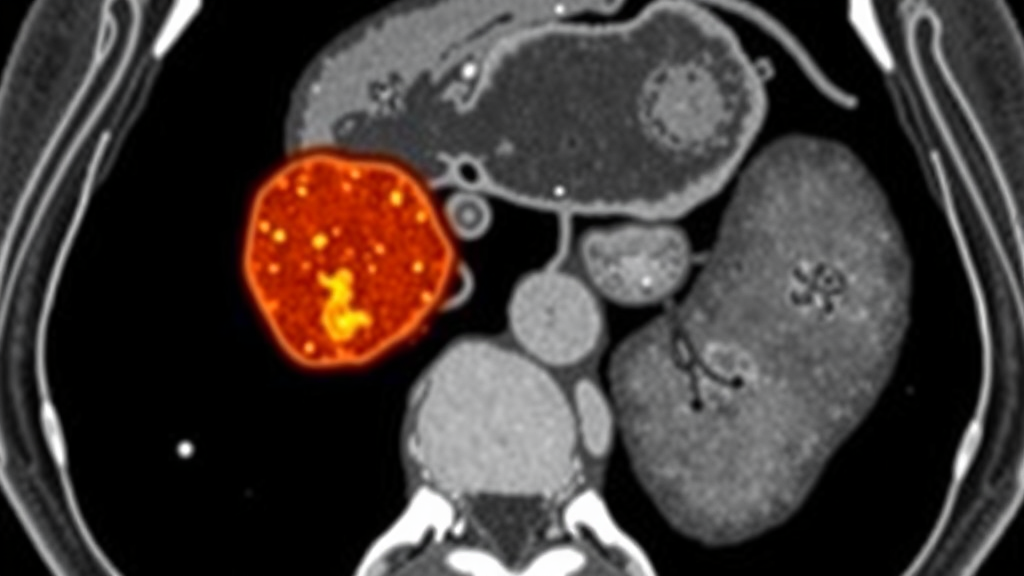
Anaplastic thyroid carcinoma is one of the most lethal malignancies in human medicine, and a newly published case report in the European Journal of Nuclear Medicine and Molecular Imaging has added a striking entry to its already formidable catalogue of behaviors. Clinicians at Bellvitge University Hospital in Barcelona describe a patient whose anaplastic thyroid carcinoma, after a disease-free interval of 17 months, reappeared in a place almost nobody expected: the splenic flexure of the colon. The lesion was confirmed histologically as a metastasis from the patient’s original thyroid cancer, and the imaging modality that flagged it was fluorine-18 fluorodeoxyglucose positron emission tomography combined with computed tomography, universally abbreviated as [18F]FDG PET/CT.
The case matters because anaplastic thyroid carcinoma, often abbreviated ATC, does not usually announce its return in the large intestine. According to the report’s authors, the metastatic pattern of ATC typically involves the lungs, and autopsy series have documented a wide but characteristic distribution of secondary deposits. Autopsy findings from 45 cases at a single institution, cited in the report, have helped map where this cancer tends to spread. The gastrointestinal tract, and the colon in particular, sits far outside the usual territory. Earlier literature reviewed by the Spanish team includes reports of well-differentiated thyroid cancer metastasizing to the gastrointestinal system, and a 2025 case report describing an isolated bowel metastasis from undifferentiated thyroid carcinoma, but such events remain vanishingly rare.
The patient’s clinical story, as summarized in the published abstract, began with a diagnosis of ATC that harbored a papillary component, a detail that carries real biological weight. Anaplastic thyroid carcinoma is thought in many cases to arise through dedifferentiation of a pre-existing, better-behaved papillary thyroid cancer, and the coexistence of both components in one tumor is a recognized phenomenon. Molecular testing revealed a BRAF V600E mutation, one of the most frequently encountered genetic alterations in this disease and a target of growing therapeutic interest. At the time of initial treatment, the disease had invaded locally beyond the thyroid, a feature that already placed the patient in a high-risk category.
Management followed the standard aggressive playbook for localized ATC. The patient underwent surgery and, after residual disease was detected, radiotherapy. This multimodal approach reflects the reality that anaplastic thyroid carcinoma rarely surrenders to any single treatment. Surgery aims to remove the bulk of disease, radiotherapy suppresses local regrowth, and in suitable cases targeted drugs directed against mutations such as BRAF V600E may be added. Despite these efforts, ATC carries a dismal prognosis, with median survival measured in months for many patients, which makes a disease-free interval of 17 months in this case notably long.
It was during surveillance after that interval that the colonic lesion appeared. The report emphasizes the role of [18F]FDG PET/CT in making the detection possible. The technique works by exploiting the altered metabolism of cancer cells. Fluorodeoxyglucose is a radioactive analog of glucose that is taken up by metabolically active tissue, and most malignant tumors, being hungry for glucose, accumulate the tracer avidly. The positron emission tomography component maps where the tracer concentrates throughout the body, while the computed tomography component provides detailed anatomical context, allowing physicians to pinpoint exactly which organ or structure is lighting up.
For thyroid cancer specifically, this imaging strategy has a particular logic. Well-differentiated thyroid cancers are traditionally followed with radioactive iodine imaging, because they retain the iodine-handling machinery of normal thyroid tissue. But as tumors dedifferentiate, they lose that machinery and simultaneously tend to become more glycolytically active, meaning they take up more glucose. Anaplastic thyroid carcinoma represents the extreme end of this spectrum: it is typically iodine-avid not at all and glucose-avid to a striking degree. That metabolic profile makes [18F]FDG PET/CT one of the most informative tools available for detecting ATC recurrence and spread, especially in atypical locations where conventional surveillance might not think to look.
The histological confirmation of the colonic lesion as an ATC metastasis is the linchpin of the report. Distinguishing a metastasis from thyroid carcinoma in the bowel from a primary colorectal cancer is not trivial, and it requires careful pathological analysis, often aided by immunohistochemical markers and knowledge of the patient’s molecular profile, including the BRAF V600E mutation found in the original tumor. The confirmation transforms what might have been dismissed as an unrelated second cancer into evidence of disseminated disease, with immediate consequences for staging, prognosis, and treatment planning.
The clinical lesson the authors draw is straightforward but consequential: unusual presentations demand imaging capable of surveying the whole body. A patient treated for anaplastic thyroid carcinoma who develops gastrointestinal symptoms, or an incidental finding on any scan, should prompt clinicians to consider metastatic disease even in organs far from the typical metastatic map. Because ATC is so aggressive and its treatment options narrow once disease spreads, early detection of an atypical recurrence can change the trajectory of care, opening doors to localized therapies, systemic targeted treatment, or enrollment in clinical trials that would be inappropriate if the recurrence went unrecognized.
The broader context underscores why vigilance matters. Thyroid cancer as a whole is common and, in its differentiated forms, highly curable, with long-term survival exceeding the vast majority of solid tumors. Reviews published in JAMA and The Lancet in 2023 and 2024, cited in the report, frame the disease as a spectrum ranging from indolent nodules to one of medicine’s fastest killers. Anaplastic carcinoma accounts for only a small fraction of thyroid malignancies but a disproportionate share of thyroid cancer deaths. Its tendency for rapid local invasion and distant spread means that surveillance strategies, molecular profiling, and whole-body functional imaging all play interlocking roles in managing the disease.
For the nuclear medicine community, the case is a compact demonstration of the value of [18F]FDG PET/CT beyond routine indications. Published as an Image of the Month, it joins a small but growing literature on gastrointestinal metastases from thyroid carcinoma, including a documented case in which small bowel perforation and death were caused by an ATC metastasis in a patient with concurrent colonic and bilateral breast cancers. Each such report expands the collective awareness of where this relentless cancer can hide. The Barcelona team, led by Marta Argelés Colet and colleagues, received no external funding for the work and declared no conflicts of interest, and the case was managed in accordance with the principles of the Declaration of Helsinki. As targeted therapies against BRAF-mutant disease mature and imaging technology sharpens, the hope is that unusual recurrences like this one will be caught earlier, when something can still be done about them.
Subject of Research: Detection of an unusual colonic metastasis from anaplastic thyroid carcinoma using FDG PET/CT
Article Title: Colonic metastasis from anaplastic thyroid carcinoma: The value of [18F]FDG PET/CT in an unusual presentation
Article References: Colonic metastasis from anaplastic thyroid carcinoma: The value of [18F]FDG PET/CT in an unusual presentation. (n.d.). https://doi.org/10.1007/s00259-026-08193-7
Image Credits: AI Generated
DOI: 10.1007/s00259-026-08193-7
Keywords: anaplastic thyroid carcinoma, FDG PET/CT, colonic metastasis, BRAF V600E, thyroid cancer, nuclear medicine, cancer imaging, metastasis, molecular imaging, radiotherapy, case report, gastrointestinal metastasis
Cite Scienmag News
Nathaniel Bowman. (September 24, 2026). Rare Colon Metastasis From Aggressive Thyroid Cancer Spotted by FDG PET/CT. Scienmag. https://scienmag.com/rare-colon-metastasis-from-aggressive-thyroid-cancer-spotted-by-fdg-pet-ct/
Nathaniel Bowman. "Rare Colon Metastasis From Aggressive Thyroid Cancer Spotted by FDG PET/CT." Scienmag, 24 September 2026, https://scienmag.com/rare-colon-metastasis-from-aggressive-thyroid-cancer-spotted-by-fdg-pet-ct/. Accessed 4 October 2026.
Nathaniel Bowman. "Rare Colon Metastasis From Aggressive Thyroid Cancer Spotted by FDG PET/CT." Scienmag. September 24, 2026. https://scienmag.com/rare-colon-metastasis-from-aggressive-thyroid-cancer-spotted-by-fdg-pet-ct/


