


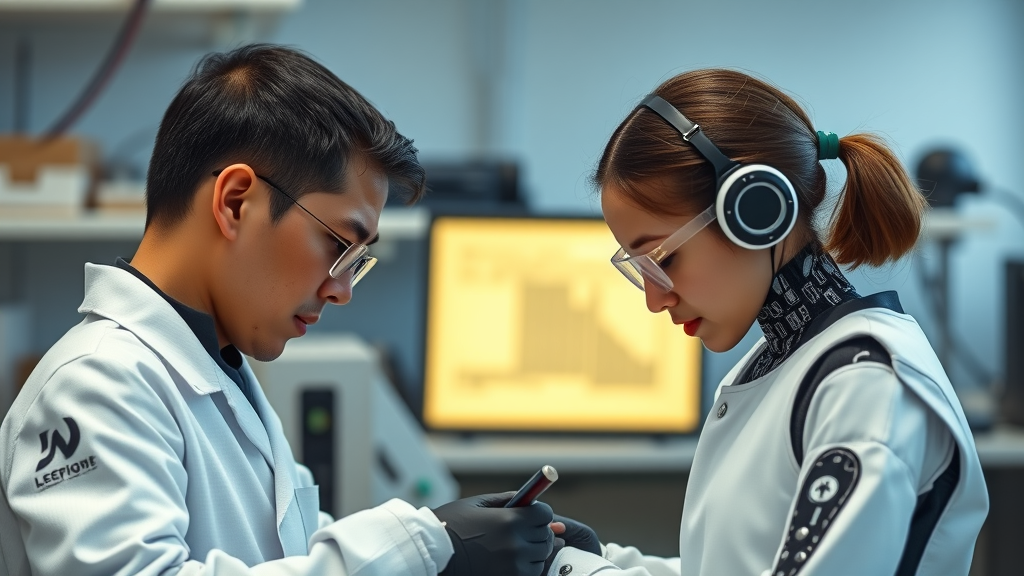
Analog circuit laboratories have long been a rite of passage for electrical engineering students, a place where abstract schematics collide with the stubborn realities of oscilloscopes, breadboards, and op-amps that refuse to behave as the textbook promised. In these sessions, one instructor typically circulates among dozens of students, answering a queue of questions that range from basic wiring errors to subtle questions about transistor biasing. A new controlled experiment from researchers at Beijing University of Posts and Telecommunications suggests that a large language model-based assistant, embedded directly into this workflow, can meaningfully change what students get out of the lab, even if it cannot replace the human teacher at the front of the room.
The study, published in the journal Frontiers of Digital Education by Xinyi Tian, Jianwei Li, and Yanli Ji, examined what happens when an intelligent learning companion system, or ILCS, is woven into a human–AI collaborative teaching model for analog circuit laboratory instruction. The system was built on retrieval-augmented generation, an architecture that combines a large language model with a curated knowledge base so that responses are grounded in course-specific material rather than drawn purely from the model’s general training. In practice, this means the companion can answer questions about amplifiers, filters, and measurement techniques with reference to the actual lab content, offering personalized support and instant feedback at a scale no single instructor could match.
To test the system’s impact, the team ran a controlled experiment comparing traditional teacher-led guidance with system-supported instruction. Rather than measuring a single outcome, the researchers assessed three core dimensions. The first was knowledge acquisition, the raw learning of concepts and facts. The second was learning effect, which they decomposed into cognition, skill, and emotion. The third was flow experience, a construct borrowed from psychologist Mihaly Csikszentmihalyi’s theory of optimal experience, capturing cognitive control, immersion and time transformation, loss of self-consciousness, and autotelic experience, the sense that an activity is rewarding in itself.
The results, published on 5 January 2026, present a nuanced picture that resists both hype and dismissal. The intelligent companion showed only a limited impact on knowledge acquisition and on students’ emotional responses. In other words, having an AI assistant at the bench did not dramatically change how much conceptual material students absorbed, nor did it substantially shift how they felt about the subject in affective terms. For anyone who has followed the often breathless coverage of AI in education, this finding is a useful corrective: a retrieval-augmented chatbot is not automatically a better lecturer.
Where the system did shine was in the practical and experiential dimensions of learning. Students working with the companion showed significantly enhanced skills, along with marked improvements in immersion and time transformation, the hallmark of flow in which learners become so absorbed that hours feel like minutes, and in autotelic experience, the intrinsic enjoyment of the task itself. For a laboratory course, where the entire point is to move from theory to competent hands-on practice, these are precisely the outcomes that matter most. The authors interpret this as evidence that intelligent learning companions serve as effective complements in practice-oriented engineering education, particularly by strengthening hands-on learning and student engagement through personalized support and instant feedback.
The technical logic behind this pattern is worth unpacking. Laboratory work generates a high frequency of small, immediate questions: Why is my output waveform clipped? Is this grounding correct? What does this reading on the multimeter mean? When such questions go unanswered because the instructor is occupied elsewhere, students stall, lose momentum, and drift out of the focused state that educators prize. An always-available companion that responds instantly keeps the feedback loop tight, sustaining the balance between challenge and skill that flow theory identifies as the precondition for deep engagement. Conceptual understanding, by contrast, often requires scaffolding, dialogue, and the kind of structured explanation that a teacher is better positioned to provide.
That distinction leads to the study’s most consequential conclusion: such companions cannot fully substitute for teacher-led conceptual scaffolding or emotional guidance. The researchers are explicit that the AI system’s strengths lie in operational, in-the-moment support, while the deeper work of building mental models and nurturing motivation remains a fundamentally human task. This framing moves the conversation away from the tired question of whether AI will replace teachers and toward a more productive one: how should the labor of teaching be divided between humans and machines? The authors argue that role allocation is the central design problem of human–AI collaborative education, and their findings give that argument empirical weight.
The study sits within a rapidly growing body of research on pedagogical agents and AI tutors, a literature the authors engage extensively. Earlier work on pedagogical agents, dating back decades, produced mixed evidence on whether virtual learning companions improve motivation and outcomes, and more recent studies of large language model tutors in physics and language classrooms have reported both enthusiasm and concern. One recurring worry in the field is metacognitive laziness, the risk that students offload thinking to a generative AI rather than exercising it themselves. The present study’s finding that knowledge acquisition was largely unaffected, while skills and engagement improved, offers a suggestive counterpoint: when the AI’s role is confined to supporting hands-on practice rather than answering for the student, the division of labor may naturally protect the cognitive work that matters.
For engineering educators, the practical implications are concrete. Analog electronics is notoriously difficult to teach at scale, and laboratory sessions are expensive in instructor time. A retrieval-augmented companion that handles the torrent of routine technical questions frees the human instructor to concentrate on conceptual explanation, troubleshooting strategies that require judgment, and the mentorship that keeps struggling students afloat. The study also offers design guidance for the systems themselves: grounding the model in course-specific material through retrieval, rather than relying on a general-purpose chatbot, appears to be a workable way to make AI assistance contextually accurate enough for a technical lab environment.
The research, supported in part by the Chinese Academy of Engineering Science and Technology Strategy Consulting Project and related institutional programs at Beijing University of Posts and Telecommunications, arrives at a moment when universities worldwide are scrambling to define their AI policies. Its message is neither utopian nor alarmist. An intelligent learning companion, deployed within a thoughtfully structured human–AI collaborative model, can deepen the flow and skill-building that make laboratory education transformative, while leaving the irreplaceable human elements of teaching exactly where they belong. As institutions redesign courses for the AI era, the Beijing experiment offers a template worth copying: measure what actually changes, respect the boundaries of the technology, and treat the AI as a complement to teachers, never a stand-in for them.
Subject of Research: Effect of a retrieval-augmented intelligent learning companion system on learning outcomes and flow experience in analog circuit laboratory instruction
Article Title: Investigating the Impact of an Intelligent Learning Companion on Learning Effect and Experience in Analog Circuit Laboratory Instruction
Article References: Tian, X., Li, J., & Ji, Y. (2026). Investigating the Impact of an Intelligent Learning Companion on Learning Effect and Experience in Analog Circuit Laboratory Instruction. Frontiers of Digital Education, 3(1), Article 5. https://doi.org/10.1007/s44366-026-0079-x
Image Credits: AI Generated
DOI: 10.1007/s44366-026-0079-x
Keywords: intelligent learning companion system, human-AI collaborative education, analog circuit laboratory, retrieval-augmented generation, engineering education, flow experience, learning effect, pedagogical agents, large language models, instant feedback, student engagement, instructional design
Cite Scienmag News
Denise Maddox. (September 24, 2026). AI Learning Companion Boosts Hands-On Skills in Electronics Labs. Scienmag. https://scienmag.com/ai-learning-companion-boosts-hands-on-skills-in-electronics-labs/
Denise Maddox. "AI Learning Companion Boosts Hands-On Skills in Electronics Labs." Scienmag, 24 September 2026, https://scienmag.com/ai-learning-companion-boosts-hands-on-skills-in-electronics-labs/. Accessed 4 October 2026.
Denise Maddox. "AI Learning Companion Boosts Hands-On Skills in Electronics Labs." Scienmag. September 24, 2026. https://scienmag.com/ai-learning-companion-boosts-hands-on-skills-in-electronics-labs/


