


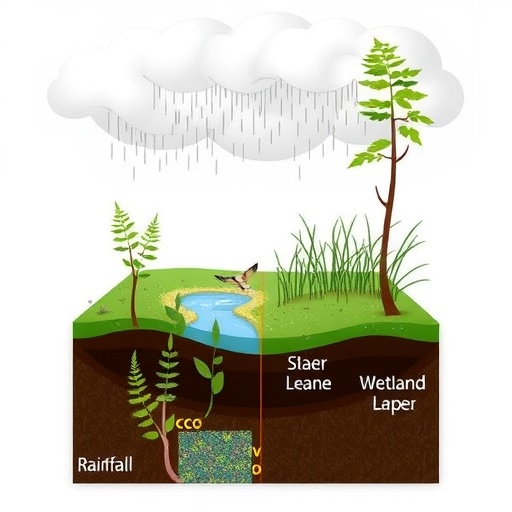
Rainfall is doing more than replenishing water in alpine wetlands: it may be steering the microscopic communities that live around plant roots, according to a new perspective on how carbon and water interact belowground. The proposed framework, centered on “carbon–water coupling,” explains why two visually similar wetland systems at high elevation can host sharply different rhizosphere microbiomes after the same rainfall event. The rhizosphere—the narrow zone of soil directly influenced by roots—is a biological hotspot where plants, bacteria, fungi and dissolved organic compounds continuously exchange resources. In alpine wetlands, where low temperatures, intense ultraviolet radiation, short growing seasons and rapidly shifting moisture conditions already impose severe ecological stress, rainfall can act as a powerful environmental switch. By altering the movement of water and the availability of plant-derived carbon, precipitation may reorganize microbial networks within days, with consequences that extend from nutrient cycling to greenhouse-gas emissions.
The central idea is that rainfall does not affect microbes simply by making soil wetter. Water changes the physical pathways through which carbon travels, the chemical conditions that determine whether microbes can use it, and the amount of oxygen available in soil pores. Plants respond at the same time, adjusting photosynthesis, root growth and the release of soluble compounds known as root exudates. These exudates include sugars, amino acids, organic acids and other low-molecular-weight molecules that serve as energy sources or signaling compounds for microorganisms. When rain reaches a dry alpine wetland, it can rapidly dissolve and transport these substances into the surrounding soil. Microbes capable of quickly exploiting easily available carbon may multiply, while organisms adapted to oxygen-poor, nutrient-limited or chemically complex conditions may lose their competitive advantage. The result is not a uniform microbial response, but a selective reshuffling of the community around plant roots.
The perspective distinguishes this rhizosphere response from changes in the broader soil microbiome. Bulk soil, located outside the immediate influence of roots, is governed primarily by mineral composition, long-term moisture patterns and accumulated organic matter. The rhizosphere is more dynamic. Root activity creates steep gradients in carbon, oxygen, acidity and nutrient concentration over distances of only millimeters. Rainfall can intensify these gradients by pushing dissolved compounds through the soil profile or by temporarily flooding the pores surrounding roots. In one part of a wetland, a pulse of water may stimulate aerobic bacteria that rapidly consume fresh plant carbon. In another, the same rainfall may produce prolonged saturation, driving oxygen depletion and favoring anaerobic microorganisms involved in fermentation, sulfate reduction or methane production. These contrasting responses help explain why rainfall can increase microbial diversity in some microsites while narrowing it in others.
The two alpine wetland types examined through the framework are expected to differ in their hydrological architecture and carbon reservoirs. One may retain water close to the soil surface for long periods, creating chemically reduced conditions, while the other may drain more rapidly and expose roots and microbes to alternating wet and dry phases. Such differences determine how quickly rainfall infiltrates, where carbon accumulates and how long oxygen remains available. Wetlands with persistent saturation often store large amounts of partially decomposed organic matter because cold, oxygen-limited soils slow microbial breakdown. A sudden rain event can nevertheless mobilize a fraction of this stored carbon, releasing dissolved organic carbon into porewater. Better-drained wetlands may contain less standing water but experience stronger pulses of root-derived carbon after rewetting. Their microbial communities may therefore be shaped less by chronic anoxia and more by repeated cycles of desiccation, rehydration and rapid resource competition.
Plants are active participants in this process rather than passive indicators of wetland conditions. Rainfall can improve plant water status, reopen stomata and restore photosynthetic carbon supply after a dry interval. Within the roots, that newly acquired carbon can be transported downward and released into the rhizosphere, where it becomes available to microbes. At the same time, saturated soils may restrict root respiration and limit nutrient uptake, forcing plants to alter the quantity and composition of their exudates. Some species may increase the release of organic acids that help mobilize phosphorus or iron; others may reduce exudation when oxygen stress becomes severe. These changes create feedback loops. Microorganisms that consume root exudates can mineralize nitrogen and phosphorus, making nutrients more accessible to plants, while plant carbon supports microbial growth and the production of extracellular enzymes. The balance between these exchanges may determine whether rainfall ultimately strengthens plant–microbe cooperation or intensifies competition for limited resources.
The carbon–water framework also offers a mechanism for understanding greenhouse-gas dynamics in alpine wetlands. Microbial decomposition of organic matter produces carbon dioxide under oxygen-rich conditions and can generate methane when oxygen is scarce. Rainfall-driven changes in water table depth, pore connectivity and carbon availability influence which pathway dominates. A short, moderate rainfall event may stimulate carbon dioxide release by activating aerobic decomposers. A longer period of saturation can suppress oxygen-dependent respiration and create conditions favorable to methanogenic archaea, microorganisms that produce methane as they convert simple carbon compounds into energy. Methane can then be consumed by methanotrophic bacteria near oxic–anoxic boundaries, meaning that the final atmospheric flux depends on the location and duration of these chemical interfaces. Because the two wetland types differ in their capacity to store water and carbon, they may respond to identical rainfall patterns with different emissions profiles.
The perspective is particularly relevant as climate change alters precipitation regimes in mountain ecosystems. Many alpine regions are experiencing shifts in the timing, intensity and form of precipitation, including more intense storms, longer dry intervals and changes in snowfall. These changes can disrupt the historical relationship between plant growth, soil moisture and microbial metabolism. A larger storm after an extended drought may produce a pronounced “rewetting pulse,” in which dormant or stressed microbes rapidly resume activity and consume accumulated carbon. If repeated more frequently, such pulses could accelerate the release of carbon that would otherwise remain stored in wetland soils. Conversely, reduced precipitation may shrink the saturated zone, increase oxygen penetration and transform microbial communities adapted to anaerobic conditions. Such transitions could alter nutrient availability, plant composition and the capacity of alpine wetlands to function as long-term carbon reservoirs.
Testing the framework will require more than measuring soil moisture or counting microbial taxa. Researchers must connect rainfall events to plant physiology, dissolved carbon movement, oxygen dynamics and microbial function at the same time. High-throughput sequencing can reveal which bacterial, archaeal and fungal groups are present, but DNA profiles alone cannot show whether those organisms are actively processing carbon. Stable-isotope tracing, in which carbon labeled with a nonradioactive isotope is followed from plants into soil and microbial biomass, can identify the organisms receiving recent photosynthate. Metagenomic and metatranscriptomic analyses can reveal the genes and pathways associated with decomposition, nitrogen transformation and methane cycling. Combining these tools with microsensors for oxygen, redox potential and pH would allow scientists to map the rapidly changing chemical environment around roots. Repeated sampling before and after natural rainfall, supplemented by controlled precipitation experiments, could then distinguish immediate microbial responses from longer-term ecological reorganization.
The broader message is that alpine wetlands should be understood as tightly coupled biological systems in which atmospheric water, plant carbon and microbial metabolism are inseparable. Rainfall is not merely an external climate variable; it is a trigger that can reshape the underground economy of carbon and nutrients. By comparing two wetland types, the carbon–water perspective highlights why ecosystem responses cannot be predicted from precipitation totals alone. The same amount of rain may promote carbon storage in one system, stimulate decomposition in another or shift methane production depending on soil structure, vegetation and hydrological history. Understanding these interactions will be essential for improving climate models and identifying which alpine wetlands are most vulnerable to future precipitation extremes. Beneath the plants, microbial communities are registering every change in water delivery—and their response may help determine whether these fragile landscapes continue to store carbon or begin returning more of it to the atmosphere.
Cite Scienmag News
Morgan Morrow. (August 25, 2026). Rainfall Shapes Rhizosphere Microbial Communities Across Two Alpine Wetland Types. Scienmag. https://scienmag.com/rainfall-shapes-rhizosphere-microbial-communities-across-two-alpine-wetland-types/
Morgan Morrow. "Rainfall Shapes Rhizosphere Microbial Communities Across Two Alpine Wetland Types." Scienmag, 25 August 2026, https://scienmag.com/rainfall-shapes-rhizosphere-microbial-communities-across-two-alpine-wetland-types/. Accessed 4 September 2026.
Morgan Morrow. "Rainfall Shapes Rhizosphere Microbial Communities Across Two Alpine Wetland Types." Scienmag. August 25, 2026. https://scienmag.com/rainfall-shapes-rhizosphere-microbial-communities-across-two-alpine-wetland-types/


