


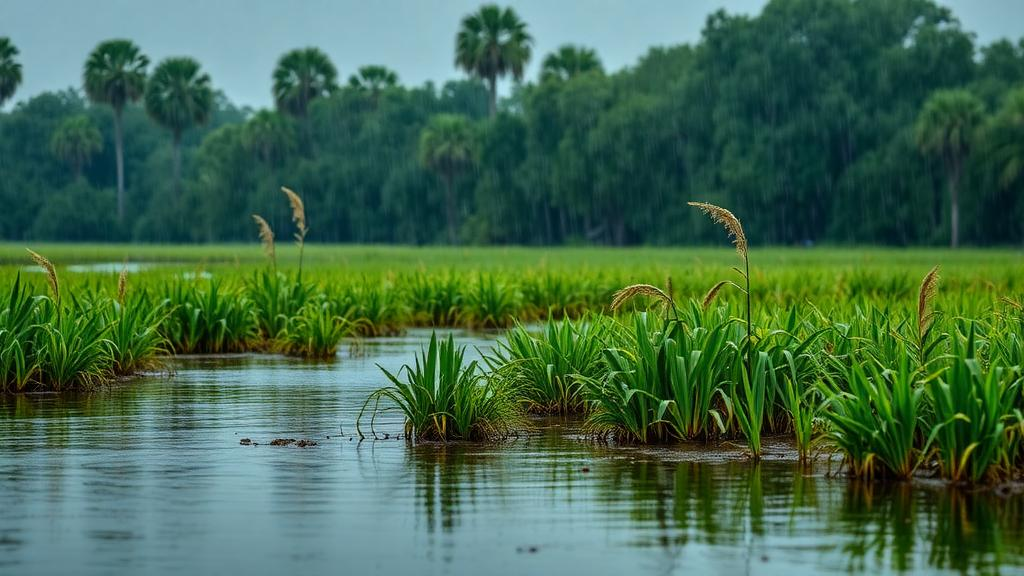
Coastal Louisiana is losing land at a pace that few places on Earth can match. Since 1932, roughly 5,180 square kilometers of coastal wetlands have vanished beneath the Gulf of Mexico, and without intervention, the state’s coastline is projected to shed another 2,848 square kilometers over the next fifty years. The causes are a tangle of natural and human forces: hurricanes, erosion, subsidence, and rising seas, all made worse by canals and levees that have cut the Mississippi River off from the delta it built. In response, engineers and ecologists have turned to a strikingly counterintuitive strategy—reconnecting the river to its estuary through diversions and siphons that once again deliver freshwater, nutrients, and sediment to marshes starved of them. But a new study reveals that these restoration projects may be quietly reshaping one of the most fundamental processes in wetland ecology: the decay of dead plants.
Researchers led by Aine O’Nuanain of Louisiana State University set out to measure how the decomposition of smooth cordgrass, Spartina alterniflora, varies across brackish marshes at different distances from the West Pointe à la Hache freshwater siphon in Plaquemines Parish. The siphon, built in 1991, consists of eight tubes each 183 centimeters in diameter and can push up to 76.5 cubic meters of Mississippi River water per second into wetlands that were historically disconnected from the river. Its stated goals are to raise the ratio of marsh to open water, reduce salinity, and improve growing conditions for saltmeadow cordgrass. Yet the freshwater and nutrients it delivers could also accelerate or slow the breakdown of plant litter—a process that recycles nutrients, builds soil, and ultimately determines whether a marsh can keep pace with rising seas.
Decomposition sits at the heart of marsh survival. In organic-rich marsh soils, the balance between plant production and plant decay controls whether the land surface gains or loses elevation. Fast decay can release carbon to the atmosphere and water, while slow decay allows organic matter to accumulate and support the soil. Prior research has linked decomposition rates to inundation, temperature, salinity, and precipitation, but the picture is messy: some studies find that more flooding speeds decay, others find it slows it, and salinity has been reported to have positive, negative, or negligible effects depending on the marsh. Disentangling these collinear drivers is notoriously difficult, and the effects of river diversions on litter decomposition in brackish and saltwater wetlands had never been well quantified.
The team deployed a classic litter bag experiment at three Spartina alterniflora-dominated sites—WPH1, WPH2, and PS7—located 1.2, 6.2, and 11.5 kilometers from the siphon. Live cordgrass collected near Cocodrie, Louisiana was dried at 60 degrees Celsius, and exactly 25.0 grams of leaves and stems were sealed into each mesh bag. Five bags were strung along a line and staked to the marsh surface at plots 1, 10, 25, 50, and 100 meters from the marsh edge along a transect at each site. The bags sat through two-month deployments in the summers of 2018 and 2019, when the siphon was closed, and 2021, when it was open, for durations of 63 to 65 days. Recovered bags were rinsed over a 125-micron sieve, dried to constant mass, and weighed to the nearest 0.1 milligram to calculate the percentage of litter lost per day and an exponential decay coefficient.
The results defied the researchers’ expectations. Decomposition was fastest in 2021—the year the siphon was running—when rates averaged 1.27 percent of mass lost per day, compared with 1.20 percent in 2018 and 1.15 percent in 2019. But 2021 was also the year with the lowest water temperature, the lowest air temperature, and the lowest salinity, contradicting the common finding that warmer, saltier conditions accelerate decay. Salinity in 2021 averaged just 3.42 practical salinity units, versus 10.93 in 2018 and 8.17 in 2019, a dramatic freshening driven by the combination of siphon discharge and heavy rainfall. When the team ran a formal model selection analysis using the Akaike Information Criterion corrected for small sample size, a single variable emerged as the best predictor of decomposition: precipitation, with a positive relationship and an AIC weight of 0.56.
The explanation lies in the dual role of rain. Precipitation directly wets plant litter on the marsh surface, and wetting is known to enhance microbial breakdown of the labile, easily decomposed fraction of organic matter. Indirectly, rainfall and river discharge both push salinity down, and lower salinity may favor different microbial communities and improve litter quality for decomposers. Because water temperature, salinity, and precipitation were cross-correlated across years, the authors caution that their relative contributions cannot be fully separated. Still, the coincidence of high rainfall, low salinity, and peak decomposition in 2021—when the siphon was open—suggests that freshwater inputs from both sky and river acted together to speed the decay of cordgrass litter.
Among sites, the pattern was equally surprising. The marsh farthest from the siphon, PS7, had the highest decomposition rate at 1.29 percent per day, while the two sites closer to the siphon, WPH1 and WPH2, averaged 1.16 and 1.17 percent per day and did not differ from each other. Elevation and inundation explained this gradient: PS7 sat highest above the water at 0.248 meters NAVD88 and was flooded only 8.90 hours per day on average, whereas WPH1, the lowest site at 0.109 meters, was inundated 15.83 hours per day. Contrary to the prediction that more flooding means faster decay, the driest site decayed fastest. The likely mechanism is oxygen: prolonged flooding starves the marsh surface of air, slowing the metabolism of detritivores and aerobic microbes. Previous work by White and Trapani likewise found that increased tidal inundation reduced Spartina litter decomposition, and the authors note that detritivore activity, which they did not measure directly, may underlie the pattern.
The study has honest limitations. The team could not measure nutrient conditions across sites or years, even though Mississippi River water carries elevated nitrate and ammonia that prior research suggests can accelerate microbial breakdown of organic matter. If nutrient enrichment mattered, its effect should have been strongest at WPH1, closest to the siphon—yet that site did not have the highest decomposition rates, even in 2021. Soil chemistry may also cap how much added nutrients can stimulate decay. Site-specific precipitation and air temperature data were unavailable, and a sonde failure at WPH1 in 2019 forced the researchers to interpolate water temperature and salinity from a nearby station using regression models with r-squared values of 0.98 and 0.51 respectively. These compromises are common in litter bag studies, but they add uncertainty to an already tangled web of correlated drivers.
The broader implications reach into the heart of Louisiana’s fifty-billion-dollar coastal master plan. River diversions and siphons hold genuine promise for rebuilding land, but this study shows they can also alter the ecological machinery that determines whether rebuilt land persists. Wet years will bring more freshwater runoff into brackish marshes, higher river stages, and more frequent opening of diversions—compounding freshwater conditions and, apparently, accelerating litter decay. Faster decay could undermine the carbon sequestration and soil-building services that make marshes resilient to sea-level rise, a concern other researchers have raised about nutrient influx from rivers. The authors recommend that future restoration monitoring quantify litter decomposition, soil and water nutrients, and—critically—the decay of belowground biomass, which contributes most of the organic matter in marsh soils. As the delta’s engineers reopen the pipes to the Mississippi, the invisible world of decomposers may prove just as important as the sediment they deliver.
Subject of Research: Effects of a Mississippi River freshwater siphon and environmental drivers on Spartina alterniflora litter decomposition in Louisiana brackish marshes
Article Title: Decomposition of Spartina alterniflora (smooth cordgrass) in coastal Louisiana brackish marshes influenced by a freshwater siphon
Article References: O’Nuanain, A., Benelli, A., Winston, J., Swenson, E. M., López-Duarte, P. C., Roberts, B. J., & Polito, M. J. (2025). Decomposition of Spartina alterniflora (smooth cordgrass) in coastal Louisiana brackish marshes influenced by a freshwater siphon. Discover Ecology, 1(1), Article 16. https://doi.org/10.1007/s44396-025-00019-4
Image Credits: AI Generated
DOI: 10.1007/s44396-025-00019-4
Keywords: Spartina alterniflora, litter decomposition, coastal Louisiana, Mississippi River, freshwater siphon, brackish marsh, wetland restoration, salinity, precipitation, inundation, carbon sequestration, land loss
Cite Scienmag News
Sloane Callahan. (September 30, 2026). Rain, Not the River, Drives How Fast Louisiana Marsh Grass Decays. Scienmag. https://scienmag.com/rain-not-the-river-drives-how-fast-louisiana-marsh-grass-decays/
Sloane Callahan. "Rain, Not the River, Drives How Fast Louisiana Marsh Grass Decays." Scienmag, 30 September 2026, https://scienmag.com/rain-not-the-river-drives-how-fast-louisiana-marsh-grass-decays/. Accessed 4 October 2026.
Sloane Callahan. "Rain, Not the River, Drives How Fast Louisiana Marsh Grass Decays." Scienmag. September 30, 2026. https://scienmag.com/rain-not-the-river-drives-how-fast-louisiana-marsh-grass-decays/


