


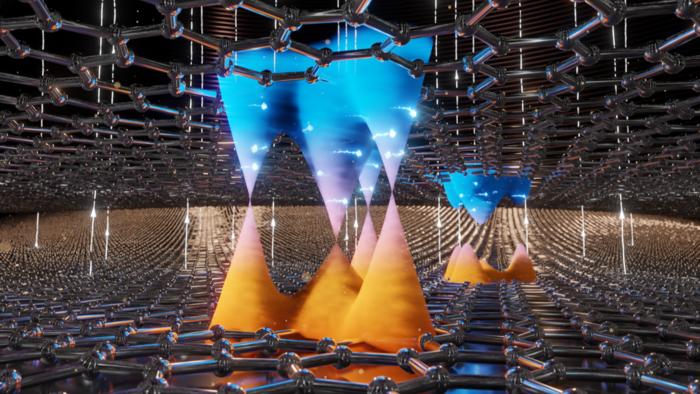
An international research team led by the University of Göttingen has demonstrated experimentally that electrons in naturally occurring double-layer graphene move like particles without any mass, in the same way that light travels. Furthermore, they have shown that the current can be “switched” on and off, which has potential for developing tiny, energy-efficient transistors – like the light switch in your house but at a nanoscale. The Massachusetts Institute of Technology (MIT), USA, and the National Institute for Materials Science (NIMS), Japan, were also involved in the research. The results were published in Nature Communications.

Credit: Lukas Kroll
An international research team led by the University of Göttingen has demonstrated experimentally that electrons in naturally occurring double-layer graphene move like particles without any mass, in the same way that light travels. Furthermore, they have shown that the current can be “switched” on and off, which has potential for developing tiny, energy-efficient transistors – like the light switch in your house but at a nanoscale. The Massachusetts Institute of Technology (MIT), USA, and the National Institute for Materials Science (NIMS), Japan, were also involved in the research. The results were published in Nature Communications.
Graphene was identified in 2004 and is a single layer of carbon atoms. Among its many unusual properties, graphene is known for its extraordinarily high electrical conductivity due to the high and constant velocity of electrons travelling through this material. This unique feature has made scientists dream of using graphene for much faster and more energy-efficient transistors. The challenge has been that to make a transistor, the material needs to be controlled to have a highly insulating state in addition to its highly conductive state. In graphene, however, such a “switch” in the speed of the carrier cannot be easily achieved. In fact, graphene usually has no insulating state, which has limited graphene’s potential a transistor.
The Göttingen University team have now found that two graphene layers, as found in the naturally occurring form of double-layer graphene, combine the best of both worlds: a structure that supports the amazingly fast motion of electrons moving like light as if they had no mass, in addition to an insulating state. The researchers showed that this condition can be changed by the application of an electric field applied perpendicularly to the material, making the double-layer graphene insulating. This property of fast-moving electrons had been theoretically predicted as early as 2009, but it took significantly enhanced sample quality as enabled my materials supplied by NIMS and close collaboration about theory with MIT, before it was possible to identify this experimentally. While these experiments were carried out at cryogenic temperatures – at around 273° below freezing – they show the potential of bilayer graphene to make highly efficient transistors.
“We were already aware of the theory. However, now we have carried out experiments which actually show the light-like dispersion of electrons in bilayer graphene. It was a very exciting moment for the entire team,” says Professor Thomas Weitz, at Göttingen University’s Faculty of Physics. Dr Anna Seiler, Postdoctoral researcher and first author also at Göttingen University, adds: “Our work is very much a first step but a crucial one. The next step for researchers will be to see if bilayer graphene really can improve transistors or to investigate the potential of this effect in other areas of technology.”
Original publication: Anna M. Seiler et al. “Probing the tunable multi-cone band structure in Bernal bilayer graphene”, Nature Communications 2024. Doi: 10.1038/s41467-024-47342-0 and https://rdcu.be/dErrl. Text also available via preprint:
Contact:
Professor Thomas Weitz
University of Göttingen
Faculty of Physics – 1st Institute of Physics
Friedrich Hund Weg 1, 37077 Göttingen, Germany
Tel: +49 (0)551 39-27607
thomas.weitz@uni-goettingen.de
Dr Anna Seiler
University of Göttingen
Faculty of Physics – 1st Institute of Physics
Friedrich-Hund-Weg 1, 37077 Göttingen, Germany
Tel: +49 (0)551 39-27622
anna.seiler@uni-goettingen.de
An international research team led by the University of Göttingen has demonstrated experimentally that electrons in naturally occurring double-layer graphene move like particles without any mass, in the same way that light travels. Furthermore, they have shown that the current can be “switched” on and off, which has potential for developing tiny, energy-efficient transistors – like the light switch in your house but at a nanoscale. The Massachusetts Institute of Technology (MIT), USA, and the National Institute for Materials Science (NIMS), Japan, were also involved in the research. The results were published in Nature Communications.
Graphene was identified in 2004 and is a single layer of carbon atoms. Among its many unusual properties, graphene is known for its extraordinarily high electrical conductivity due to the high and constant velocity of electrons travelling through this material. This unique feature has made scientists dream of using graphene for much faster and more energy-efficient transistors. The challenge has been that to make a transistor, the material needs to be controlled to have a highly insulating state in addition to its highly conductive state. In graphene, however, such a “switch” in the speed of the carrier cannot be easily achieved. In fact, graphene usually has no insulating state, which has limited graphene’s potential a transistor.
The Göttingen University team have now found that two graphene layers, as found in the naturally occurring form of double-layer graphene, combine the best of both worlds: a structure that supports the amazingly fast motion of electrons moving like light as if they had no mass, in addition to an insulating state. The researchers showed that this condition can be changed by the application of an electric field applied perpendicularly to the material, making the double-layer graphene insulating. This property of fast-moving electrons had been theoretically predicted as early as 2009, but it took significantly enhanced sample quality as enabled my materials supplied by NIMS and close collaboration about theory with MIT, before it was possible to identify this experimentally. While these experiments were carried out at cryogenic temperatures – at around 273° below freezing – they show the potential of bilayer graphene to make highly efficient transistors.
“We were already aware of the theory. However, now we have carried out experiments which actually show the light-like dispersion of electrons in bilayer graphene. It was a very exciting moment for the entire team,” says Professor Thomas Weitz, at Göttingen University’s Faculty of Physics. Dr Anna Seiler, Postdoctoral researcher and first author also at Göttingen University, adds: “Our work is very much a first step but a crucial one. The next step for researchers will be to see if bilayer graphene really can improve transistors or to investigate the potential of this effect in other areas of technology.”
Original publication: Anna M. Seiler et al. “Probing the tunable multi-cone band structure in Bernal bilayer graphene”, Nature Communications 2024. Doi: 10.1038/s41467-024-47342-0 and https://rdcu.be/dErrl. Text also available via preprint:
Contact:
Professor Thomas Weitz
University of Göttingen
Faculty of Physics – 1st Institute of Physics
Friedrich Hund Weg 1, 37077 Göttingen, Germany
Tel: +49 (0)551 39-27607
thomas.weitz@uni-goettingen.de
Dr Anna Seiler
University of Göttingen
Faculty of Physics – 1st Institute of Physics
Friedrich-Hund-Weg 1, 37077 Göttingen, Germany
Tel: +49 (0)551 39-27622
anna.seiler@uni-goettingen.de
Journal
Nature Communications
Method of Research
Experimental study
Subject of Research
Not applicable
Article Title
Probing the tunable multi-cone band structure in Bernal bilayer graphene
Article Publication Date
11-Apr-2024
Cite Scienmag News
Neil Sanderson. (April 16, 2024). Quantum electronics: Charge travels like light in bilayer graphene. Scienmag. https://scienmag.com/quantum-electronics-charge-travels-like-light-in-bilayer-graphene/
Neil Sanderson. "Quantum electronics: Charge travels like light in bilayer graphene." Scienmag, 16 April 2024, https://scienmag.com/quantum-electronics-charge-travels-like-light-in-bilayer-graphene/. Accessed 4 September 2026.
Neil Sanderson. "Quantum electronics: Charge travels like light in bilayer graphene." Scienmag. April 16, 2024. https://scienmag.com/quantum-electronics-charge-travels-like-light-in-bilayer-graphene/

