

Tuesday, October 20, 2026
Science
No Result
View All Result
  • Login
  • HOME
  • SCIENCE NEWS
  • CONTACT US
  • HOME
  • SCIENCE NEWS
  • CONTACT US
No Result
View All Result
Scienmag
No Result
View All Result
Home Science News Medicine

Protocol for five-year cluster-randomized trial of active lessons and breaks among Aracaju schoolchildren

October 20, 2026
in Medicine
Ophelia Keating
By Ophelia Keating Scienmag Editorial Profile - Health Services Research
Reading Time: 2 mins read
0
Five-Year Trial Puts Movement Inside Brazilian Classrooms to Test Cognitive Gains in Children

Five-Year Trial Puts Movement Inside Brazilian Classrooms to Test Cognitive Gains in Children

65
SHARES
587
VIEWS
Share on FacebookShare on Twitter
ADVERTISEMENT

The published abstract describes the ERGUER/Aracaju Project, a five-year cluster-randomized clinical trial planned for first-grade students in public schools in Aracaju, Sergipe, Brazil. The protocol sets out to evaluate two classroom-based physical activity strategies—physically active lessons and physically active breaks—and their potential effects on cognitive development, academic performance and selected secondary outcomes. It is a study protocol, so the abstract does not report intervention effects or establish whether either approach improves student outcomes.

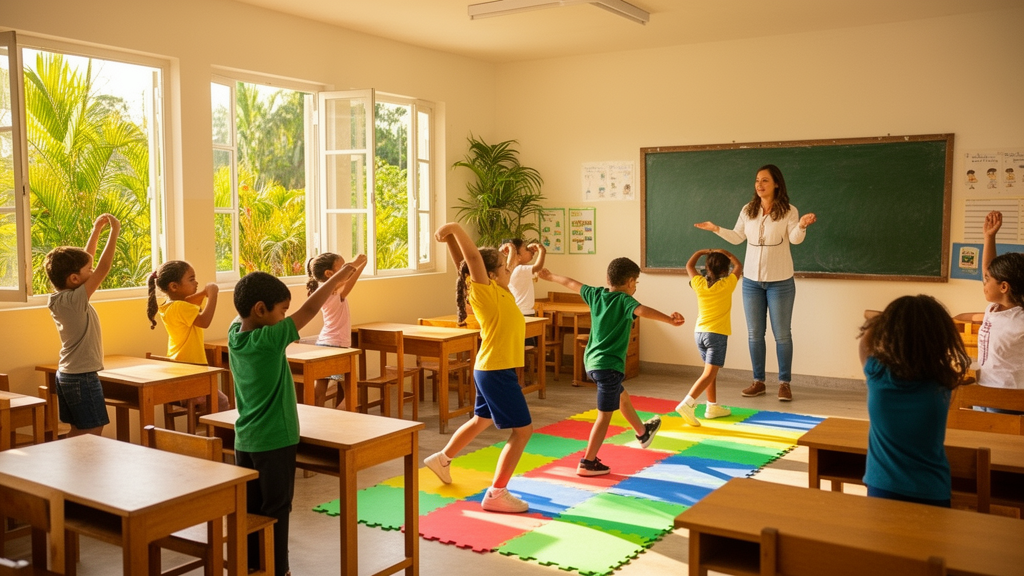
Six public schools are assigned to three conditions: two schools will use physically active lessons, two will use physically active breaks and two will serve as controls. First-grade students will be followed from 2022 through 2026. Classroom teachers will deliver the interventions twice each week. Physically active lessons will incorporate movement into school content through teaching methods that involve movement. Physically active breaks will not be tied to academic content and will consist of exercises averaging five minutes, with the stated aim of interrupting sedentary behavior and promoting moderate-to-vigorous movement.

The primary outcomes are cognitive development, measured through computerized tests assessing executive functions, and academic performance, assessed through teachers’ grades and national and state examinations. Secondary outcomes include anthropometry, physical activity level, sedentary behavior, eating habits, sleepiness, quality of life and students’ perception of school. The cluster-randomized design compares interventions delivered across schools rather than evaluating individual students in isolation. The trial was retrospectively registered in the Brazilian Clinical Trials Registry on January 9, 2025, under identifier RBR-10zxwdrh.

The protocol’s stated aim is to provide information about the potential longer-term effects of classroom physical activity strategies, particularly in a setting outside high-income countries. However, the available abstract presents planned methods and expected information rather than completed efficacy results. It does not provide the number of participating students, numerical estimates of intervention effects, or outcome data for any study group. The evidence therefore supports describing the trial’s population, assignments, interventions, follow-up period and measurement plans, but not claiming cognitive, academic, health or educational benefits from physically active lessons or breaks.

Subject of Research: Protocol for a cluster-randomized trial of classroom physical activity interventions in first-grade students in Aracaju, Brazil

Article Title: Effects of physically active lessons and physically active breaks on cognitive development and academic performance of schoolchildren: protocol for a cluster randomized clinical trial

Article References: Gandarela, L., Melo, J. C. N., Oliveira, D. N., Ywgne, J., Tejada, J., & Silva, D. R. (2026). Effects of physically active lessons and physically active breaks on cognitive development and academic performance of schoolchildren: protocol for a cluster randomized clinical trial. BMC Pediatrics. https://doi.org/10.1186/s12887-026-07638-0

Image Credits: AI Generated

DOI: 10.1186/s12887-026-07638-0

Keywords: cluster-randomized trial, study protocol, schoolchildren, physically active lessons, active breaks, cognitive development, academic performance, Aracaju, Brazil, public schools, Effects, physically

Cite Scienmag News

Ophelia Keating. (October 20, 2026). Protocol for five-year cluster-randomized trial of active lessons and breaks among Aracaju schoolchildren. Scienmag. https://scienmag.com/protocol-for-five-year-cluster-randomized-trial-of-active-lessons-and-breaks-among-aracaju-schoolchildren/


Ophelia Keating. "Protocol for five-year cluster-randomized trial of active lessons and breaks among Aracaju schoolchildren." Scienmag, 20 October 2026, https://scienmag.com/protocol-for-five-year-cluster-randomized-trial-of-active-lessons-and-breaks-among-aracaju-schoolchildren/. Accessed 20 October 2026.

Ophelia Keating. "Protocol for five-year cluster-randomized trial of active lessons and breaks among Aracaju schoolchildren." Scienmag. October 20, 2026. https://scienmag.com/protocol-for-five-year-cluster-randomized-trial-of-active-lessons-and-breaks-among-aracaju-schoolchildren/

Tags: academic performanceactive breaksactive lessons and breaks for cognitive developmentAracajuBrazilcluster randomized trialcluster-randomized trial in Brazilian schoolscognitive developmentEffectsevaluation of active breaks versus active lessonsfive-year school-based physical activity studyimpact of classroom movement strategies on academic performancelong-term effects of active classroom strategiesmeasurement of executive functions in childrenphysical activity promotion in primary educationphysicallyphysically active lessonsprotocol for school-based physical activity researchpublic schoolsschool-based physical activity interventionsschoolchildrensecondary health outcomes in schoolchildrensedentary behavior reduction in schoolchildrenstudy protocol
Share26Tweet16
Previous Post

Cross-sectional survey finds lower learning-environment scores among Ugandan medical interns in surgery

Next Post

Düzce soil study of 30 samples finds predominantly geogenic composition with localized elemental enrichments

Related Posts

AI Challenges May Drive Integrity Awareness and Innovation in Postgraduate Nursing Students, Survey Finds
Medicine

AI challenges, academic integrity awareness and innovative behaviour linked in postgraduate nursing survey

October 20, 2026
Why Legal Aid Struggles to Reach Veterans Facing Abuse Inside America’s Largest Health System
Medicine

Barriers to Implementing Medical-Legal Partnerships for Survivors of Intimate Partner Violence: Qualitative Perspectives from the Veterans Health Administration

October 20, 2026
Novel FRRS1L Gene Variant Linked to Fatal Childhood Epilepsy in First Chinese Case
Medicine

Novel homozygous FRRS1L variant reported in Chinese girl with DEE37-related symptoms

October 20, 2026
Why Some People Say Yes to Tuberculosis Preventive Treatment and Others Refuse
Medicine

Cross-sectional study identifies seven predictors of stated willingness to accept TB preventive treatment among Xinjiang close contacts

October 20, 2026
Trauma-informed care pathway for unaccompanied asylum-seeking children wins broad staff support
Medicine

Qualitative evaluation identifies support and implementation challenges for integrated care for asylum-seeking youth

October 20, 2026
Interleukin-6 and lactate outperform routine inflammatory markers for predicting 28-day mortality in ICU sepsis
Medicine

IL-6 and lactate better discriminated 28-day mortality than CRP, procalcitonin and NLR in retrospective ICU sepsis cohort

October 20, 2026
Next Post
Soil chemistry in Düzce reveals geology rules, but human fingerprints are starting to show

Düzce soil study of 30 samples finds predominantly geogenic composition with localized elemental enrichments

  • Mothers who receive childcare support from maternal grandparents show more optimized

    Mothers who receive childcare support from maternal grandparents show more parental warmth, finds NTU Singapore study

    27656 shares
    Share 11059 Tweet 6912
  • University of Seville Breaks 120-Year-Old Mystery, Revises a Key Einstein Concept

    1061 shares
    Share 424 Tweet 265
  • Bee body mass, pathogens and local climate influence heat tolerance

    682 shares
    Share 273 Tweet 171
  • Researchers record first-ever images and data of a shark experiencing a boat strike

    546 shares
    Share 218 Tweet 137
  • Groundbreaking Clinical Trial Reveals Lubiprostone Enhances Kidney Function

    531 shares
    Share 212 Tweet 133
Science

Embark on a thrilling journey of discovery with Scienmag.com—your ultimate source for cutting-edge breakthroughs. Immerse yourself in a world where curiosity knows no limits and tomorrow’s possibilities become today’s reality!

RECENT NEWS

  • Machine learning-assisted hydrothermal process optimization yields carbon quantum dots from tea waste
  • Abstract of Ghana soil study reports risk-element exceedances and three seasonal differences
  • AI challenges, academic integrity awareness and innovative behaviour linked in postgraduate nursing survey
  • Düzce soil study of 30 samples finds predominantly geogenic composition with localized elemental enrichments

Categories

  • Agriculture
  • Anthropology
  • Archaeology
  • Athmospheric
  • Biology
  • Biotechnology
  • Blog
  • Bussines
  • Cancer
  • Chemistry
  • Climate
  • Earth Science
  • Editorial Policy
  • Marine
  • Mathematics
  • Medicine
  • Pediatry
  • Policy
  • Psychology & Psychiatry
  • Science Education
  • Science News
  • Social Science
  • Space
  • Technology and Engineering

Subscribe to Blog via Email

Enter your email address to subscribe to this blog and receive notifications of new posts by email.

Join 5,150 other subscribers

© 2025 Scienmag - Science Magazine

Welcome Back!

Login to your account below

Forgotten Password?

Retrieve your password

Please enter your username or email address to reset your password.

Log In
No Result
View All Result
  • HOME
  • SCIENCE NEWS
  • CONTACT US

© 2025 Scienmag - Science Magazine

Discover more from Science

Subscribe now to keep reading and get access to the full archive.

Continue reading