


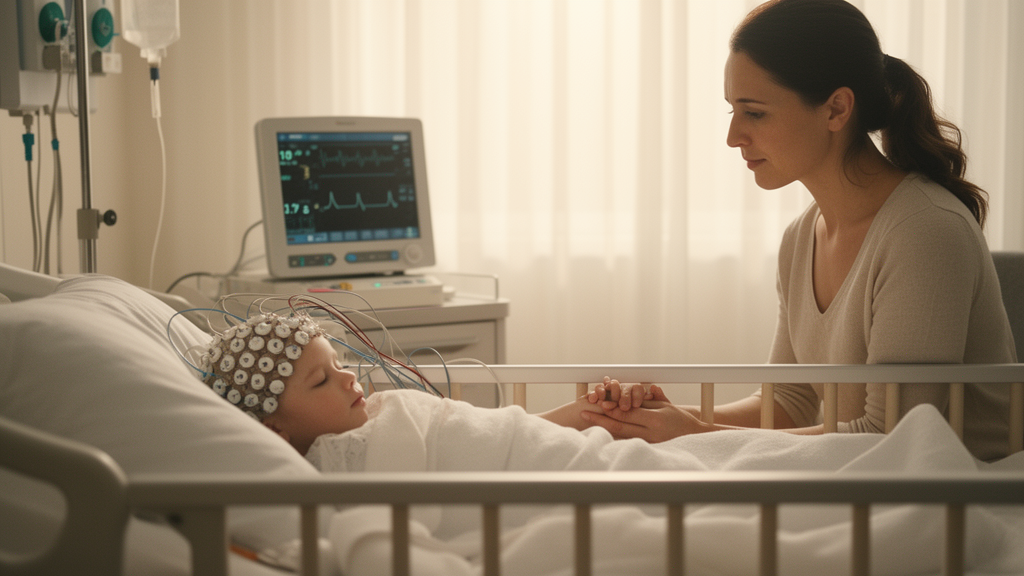
A case report describes a Chinese girl with epilepsy, global developmental delay, choreiform movement disorder, thyroid dysfunction, and elevated blood ammonia and lactic acid. According to the article abstract, whole-exome sequencing identified a novel homozygous FRRS1L variant, NM_014334.4: exon5: c.725A>G (p.His242Arg), and Sanger sequencing confirmed inheritance from her parents. The investigators described the case as the first reported Chinese case involving a girl carrying an FRRS1L variant.
The abstract reports that treatment with adrenocorticotropic hormone, valproic acid, and oral prednisone was followed by seizure control and improvement in electroencephalography. The girl later died from an unclear cause. These are treatment-associated observations in one patient; the abstract does not report medication doses, duration of response, specific electroencephalographic findings, or evidence establishing which treatment produced the observed improvements. It also does not specify the cause of death.
Pathogenic variants in FRRS1L have been associated with developmental and epileptic encephalopathy 37 (DEE37; OMIM 616981). The abstract states that affected patients typically exhibit global developmental delay, epileptic encephalopathy, hyperkinetic movement disorder with choreoathetosis, spasticity, and rigidity, while noting that rare variants have been reported. The investigators also summarized previously reported FRRS1L variants and compared phenotypes among affected patients.
Within the scope of this single-patient case report, the findings document the girl’s variant, associated clinical features, treatment-associated seizure and electroencephalographic improvement, and unclear cause of death. The authors state that the case expands the genetic and phenotypic spectra reported in DEE37. However, the available evidence comes from one patient and cannot establish the variant’s effects across a wider population, separate the contributions of the three therapies, or determine the cause of death. The article was published as an open-access case report in BMC Pediatrics on 9 September 2026.
Subject of Research: A case report of a novel homozygous FRRS1L variant in a Chinese girl with developmental delay and epilepsy
Article Title: Identification of a novel homozygous FRRS1L variant in a Chinese girl with development delay and epilepsy: a case report
Article References: Liu, L., Song, X., Li, B., Jia, S., Wang, D., Qian, X., & Wang, Z. (2026). Identification of a novel homozygous FRRS1L variant in a Chinese girl with development delay and epilepsy: a case report. BMC Pediatrics. https://doi.org/10.1186/s12887-026-07671-z
Image Credits: AI Generated
DOI: 10.1186/s12887-026-07671-z
Keywords: FRRS1L, developmental delay, epilepsy, DEE37, whole-exome sequencing, genetic variant, case report, movement disorder, choreoathetosis, Identification, novel, homozygous
Cite Scienmag News
Ophelia Keating. (October 20, 2026). Novel homozygous FRRS1L variant reported in Chinese girl with DEE37-related symptoms. Scienmag. https://scienmag.com/novel-homozygous-frrs1l-variant-reported-in-chinese-girl-with-dee37-related-symptoms/
Ophelia Keating. "Novel homozygous FRRS1L variant reported in Chinese girl with DEE37-related symptoms." Scienmag, 20 October 2026, https://scienmag.com/novel-homozygous-frrs1l-variant-reported-in-chinese-girl-with-dee37-related-symptoms/. Accessed 20 October 2026.
Ophelia Keating. "Novel homozygous FRRS1L variant reported in Chinese girl with DEE37-related symptoms." Scienmag. October 20, 2026. https://scienmag.com/novel-homozygous-frrs1l-variant-reported-in-chinese-girl-with-dee37-related-symptoms/


