


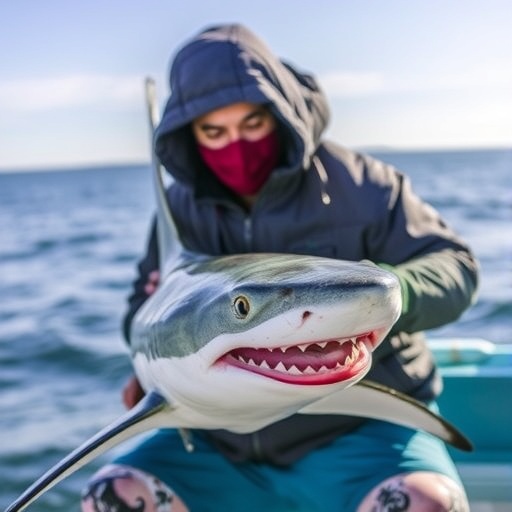
A groundbreaking study led by researchers at the University of Exeter has revealed promising insights into the survival rates and post-release recovery behaviors of sharks caught in recreational fisheries around the British Isles. By equipping nearly 70 sharks from three species—blue, porbeagle, and tope—with sophisticated tracking devices, the team has provided unprecedented empirical evidence underscoring the resilience of sharks when catch-and-release fishing follows established best-practice guidelines.
The meticulous tagging operation, involving collaborative efforts with Edinburgh Napier University, the Government of Jersey, and other marine conservation bodies, focused on tracking the sharks’ movement after release. Over a tracking window of up to 45 days, these electronic tags transmitted location data to confirm the sharks’ survival status. Remarkably, fewer than 5% of the tracked individuals—specifically one shark from each species—did not survive following capture and release, a finding that represents a hopeful narrative for conservation-oriented anglers.
Francesco Garzon, leading the research team, highlighted that the general absence of external injuries and the sharks’ vigorous physical state at release imply that mortality was not directly linked to apparent physical trauma. Instead, two mortalities involved deep hooking, a critical condition where the fishing hook embeds far inside the shark’s throat or digestive tract, complicating extraction efforts and often resulting in the hooked shark being released with the hook still embedded to avoid adding trauma.
Data retrieved from sixteen recovered tags allowed for detailed behavioral analysis concerning depth and movement patterns immediately following release. The sharks exhibited an immediate and rapid descent to deeper waters, which researchers posit serves dual purposes: evasion from the immediate stressor (the fishing interaction) and facilitation of gill reoxygenation after the exertion of capture. Such behavior confirms evolutionary strategies sharks employ to mitigate stress following capture events.
Variations in post-release recovery were apparent among the species. While most sharks resumed typical activity within 24 hours, some, particularly porbeagle sharks, demonstrated prolonged recovery periods, indicating species-specific physiological responses to capture stress. This insight adds nuance to the understanding of species-level vulnerability and adaptive capacities under angling pressures, informing management and conservation strategies.
This pioneering investigation fills a crucial gap in the European marine fisheries literature. Despite the widespread embrace of catch-and-release fishing as a conservation-friendly approach, empirical data on shark mortality in European waters have been sparse. Prior research underscored that survival after catch and release is intricately linked to species taxonomy and geographical contexts, emphasizing the importance of localized studies such as this.
The conservation status of the species under scrutiny adds gravity to these findings. The International Union for Conservation of Nature (IUCN) has classified porbeagle sharks as critically endangered, tope sharks as vulnerable, and blue sharks as near threatened. Given these designations, the observed high survival rates post-catch-and-release in this study underscore the potential of responsible angling practices to act as a mitigating factor against further population declines.
Fishing trips spanning ports in England, Scotland, and the Channel Islands contributed to the capture and tagging process, highlighting a broad and representative sample across the British Isles. The research benefited from a synergistic partnership network, including fishers, skippers, Shark Hub UK, the Centre for Environment, Fisheries and Aquaculture Science, and strategic oversight by the Shark Trust, underscoring the importance of cooperative stakeholder engagement in marine conservation research.
Funding from multiple sources, including the European Maritime and Fisheries Fund and Marine Fund Scotland, alongside doctoral support for Francesco Garzon via the NERC GW4+ Doctoral Training Partnership, underpinned this extensive study. The multi-institutional and interdisciplinary approach illustrates how resources and expertise can coalesce to deepen understanding of marine ecosystem dynamics.
The results from this study bear significant implications for fisheries management and policy frameworks across Europe. By validating the efficacy of current best-practice handling techniques and recognizing species-specific recovery profiles, regulatory bodies are better equipped to refine guidelines that minimize post-release mortality and support sustainable recreational shark fisheries.
One of the study’s technological highlights is the use of data-transmitting tags capable of detaching autonomously after several weeks. This innovation not only provides continuous post-release fate assessments but also allows data retrieval without the need to recapture the animal, minimizing additional stress. Such advancements push the frontier of animal telemetry and post-capture mortality studies, offering a replicable model for global marine conservation research.
In conclusion, the University of Exeter-led research presents powerful evidence that, under rigorous catch-and-release protocols, sharks within the North-East Atlantic’s recreational fisheries demonstrate strong survival capability. This fosters optimism for ongoing conservation efforts and highlights the importance of sustained education and collaboration among anglers to ensure continued protection of vulnerable shark populations.
News Publication Date: 3-Nov-2025
Web References:
- Study publication: https://academic.oup.com/icesjms/article/82/10/fsaf191/8306672
- NERC GW4+ Doctoral Training Partnership: https://www.nercgw4plus.ac.uk/
References:
Garzon, F., et al. (2025). Survival and recovery of three shark species in North-East Atlantic recreational fisheries. ICES Journal of Marine Science, 82(10).
Cite Scienmag News
Violet Maxwell. (November 3, 2025). Promoting Shark Survival Through Best Angling Practices. Scienmag. https://scienmag.com/promoting-shark-survival-through-best-angling-practices/
Violet Maxwell. "Promoting Shark Survival Through Best Angling Practices." Scienmag, 3 November 2025, https://scienmag.com/promoting-shark-survival-through-best-angling-practices/. Accessed 4 September 2026.
Violet Maxwell. "Promoting Shark Survival Through Best Angling Practices." Scienmag. November 3, 2025. https://scienmag.com/promoting-shark-survival-through-best-angling-practices/


