
Monday, October 26, 2026
Science
No Result
View All Result
  • Login
  • HOME
  • SCIENCE NEWS
  • CONTACT US
  • HOME
  • SCIENCE NEWS
  • CONTACT US
No Result
View All Result
Scienmag
No Result
View All Result
Home Science News Psychology & Psychiatry

Problem-Posing Self-Efficacy Linked to Later Geometry Confidence in Teacher Candidates

October 26, 2026
in Psychology & Psychiatry
Glenn Wilkins
By Glenn Wilkins Scienmag Editorial Profile - Clinical Psychology
Reading Time: 2 mins read
0
Problem-Posing Self-Efficacy Linked to Later Geometry Confidence in Teacher Candidates

Problem-Posing Self-Efficacy Linked to Later Geometry Confidence in Teacher Candidates

65
SHARES
587
VIEWS
Share on FacebookShare on Twitter
ADVERTISEMENT

Problem-posing self-efficacy measured at the start of a mathematics teacher-education program was positively associated with geometry self-efficacy nearly four years later, according to a two-wave longitudinal study of pre-service mathematics teachers. The analysis included a matched sample of 251 participants and found that the relationship remained after accounting for the stability of both constructs and their baseline relationship. The result shows a prospective association, not proof that stronger problem-posing confidence causes stronger geometry confidence.

Researchers collected data in October 2021 and May 2025, using a two-wave cross-lagged panel design to examine the longitudinal interplay between geometry self-efficacy and problem-posing self-efficacy. Both constructs were assessed at each wave. The analysis tested whether variation in one measure at the first measurement was associated with variation in the other at the second measurement, while accounting for each construct’s stability over time and the initial relationship between them.

Both geometry self-efficacy and problem-posing self-efficacy were significantly stable across the study period. Within that pattern, the cross-lagged result pointed in one temporal direction: problem-posing self-efficacy at Time 1 was positively associated with geometry self-efficacy at Time 2 after the researchers accounted for geometry self-efficacy at Time 1, problem-posing self-efficacy at Time 2, and the baseline association between the two measures. The findings address a gap identified by the researchers, who noted that cross-sectional studies have generally examined these self-efficacy beliefs at a single point in time.

Because the new analysis placed both measures in temporal order across two waves, it could test a directional association rather than only a relationship between concurrent scores. The study nevertheless concerns longitudinal association, not a direct developmental mechanism: the data do not demonstrate that one type of self-efficacy produces or causes changes in the other. Several limitations constrain interpretation.

The interval between October 2021 and May 2025 was long, and many educational experiences could have occurred during it, but the supplied study abstract does not identify those experiences or their influence. The analysis also does not establish the effect of an intervention, including a problem-posing or geometry program. In addition, the final results are based on 251 matched participants, so they characterize the analyzed group rather than demonstrating that the same relationship applies to every pre-service teacher.

The evidence supports further investigation of how the two forms of self-efficacy may be connected during teacher education, but it does not establish a causal pathway or a basis for claiming that a particular training strategy will improve either outcome.

Subject of Research: Longitudinal associations between geometry and problem-posing self-efficacy in pre-service mathematics teachers

Article Title: A two-wave longitudinal study of geometry self-efficacy and problem-posing in pre-service mathematics teachers

Article References: Ergene, O., Caylan-Ergene, B., & Türk Kurtça, T. (2026). A two-wave longitudinal study of geometry self-efficacy and problem-posing in pre-service mathematics teachers. BMC Psychology, 14(1), Article 1523. https://doi.org/10.1186/s40359-026-05569-0

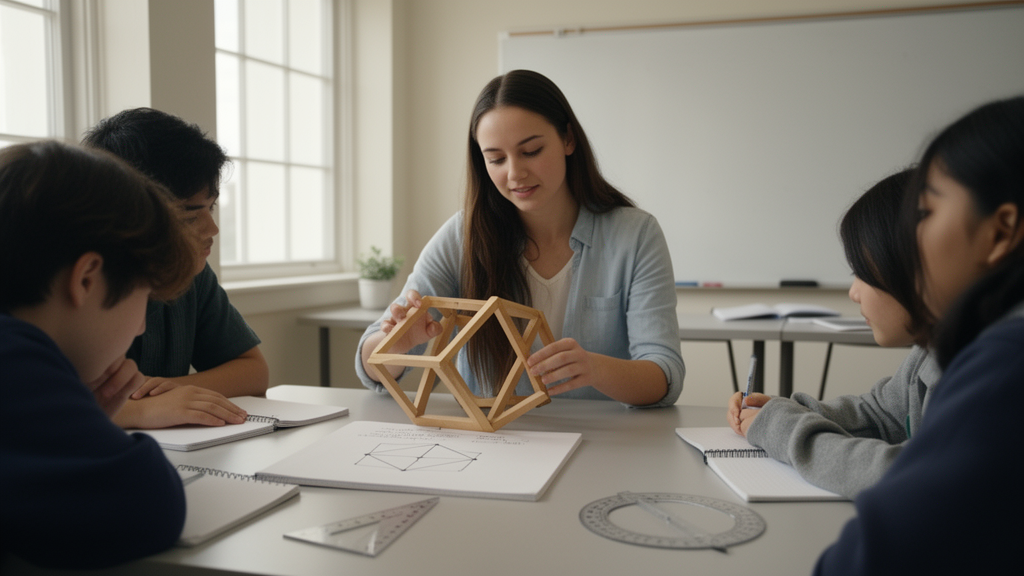
Image Credits: AI Generated

DOI: 10.1186/s40359-026-05569-0

Keywords: geometry self-efficacy, problem-posing self-efficacy, pre-service teachers, mathematics education, teacher education, longitudinal study, cross-lagged panel, self-efficacy beliefs, two-wave, longitudinal, geometry, self-efficacy

Cite Scienmag News

Glenn Wilkins. (October 26, 2026). Problem-Posing Self-Efficacy Linked to Later Geometry Confidence in Teacher Candidates. Scienmag. https://scienmag.com/problem-posing-self-efficacy-linked-to-later-geometry-confidence-in-teacher-candidates/

Glenn Wilkins. "Problem-Posing Self-Efficacy Linked to Later Geometry Confidence in Teacher Candidates." Scienmag, 26 October 2026, https://scienmag.com/problem-posing-self-efficacy-linked-to-later-geometry-confidence-in-teacher-candidates/. Accessed 26 October 2026.

Glenn Wilkins. "Problem-Posing Self-Efficacy Linked to Later Geometry Confidence in Teacher Candidates." Scienmag. October 26, 2026. https://scienmag.com/problem-posing-self-efficacy-linked-to-later-geometry-confidence-in-teacher-candidates/

Tags: cross-lagged panelcross-lagged panel analysis in education researchgeometrygeometry confidence in teacher candidatesgeometry self-efficacyimpact of problem-posing confidence on geometry self-efficacylong-term effects of teacher training on self-efficacyLongitudinallongitudinal studylongitudinal study of mathematics teacher educationmathematics educationpre-service teacherspredictors of geometry confidence in pre-serviceproblem-posing self-efficacyrelationship between problem-posing skills and geometry confidenceself-efficacyself-efficacy beliefsself-efficacy development in mathematics teachersstability of self-efficacy constructs over timeteacher candidate self-efficacy measurementteacher educationtwo-wave
Share26Tweet16
Previous Post

Pyramid vision transformer cuts attention cost and boosts image classification

Next Post

Cross-sectional study finds partial rural–urban linkage progress in Robe, Ethiopia

Related Posts

Performance-linked rewards shape cognitive effort in 30-person study
Psychology & Psychiatry

Performance-linked rewards shape cognitive effort in 30-person study

October 26, 2026
Survey links AI dependence to a peak in employee innovation
Psychology & Psychiatry

Survey links AI dependence to a peak in employee innovation

October 26, 2026
Exploring Institutional factors of resilience in undergraduate medical training: a thematic inquiry into experiences of medical students
Psychology & Psychiatry

Exploring Institutional factors of resilience in undergraduate medical training: a thematic inquiry into experiences of medical students

October 26, 2026
Autonomous motivation linked with heart failure self-care over three months
Psychology & Psychiatry

Autonomous motivation linked with heart failure self-care over three months

October 26, 2026
About one in four caregivers of children with cancer show anxiety or depression
Psychology & Psychiatry

About one in four caregivers of children with cancer show anxiety or depression

October 26, 2026
Qualitative Study Finds Parent-Reported Sensory Integration Benefits and Access Barriers
Psychology & Psychiatry

Qualitative Study Finds Parent-Reported Sensory Integration Benefits and Access Barriers

October 26, 2026
Next Post
Cross-sectional study finds partial rural–urban linkage progress in Robe, Ethiopia

Cross-sectional study finds partial rural–urban linkage progress in Robe, Ethiopia

  • Mothers who receive childcare support from maternal grandparents show more optimized

    Mothers who receive childcare support from maternal grandparents show more parental warmth, finds NTU Singapore study

    27656 shares
    Share 11059 Tweet 6912
  • University of Seville Breaks 120-Year-Old Mystery, Revises a Key Einstein Concept

    1061 shares
    Share 424 Tweet 265
  • Bee body mass, pathogens and local climate influence heat tolerance

    682 shares
    Share 273 Tweet 171
  • Researchers record first-ever images and data of a shark experiencing a boat strike

    546 shares
    Share 218 Tweet 137
  • Groundbreaking Clinical Trial Reveals Lubiprostone Enhances Kidney Function

    531 shares
    Share 212 Tweet 133
Science

Embark on a thrilling journey of discovery with Scienmag.com—your ultimate source for cutting-edge breakthroughs. Immerse yourself in a world where curiosity knows no limits and tomorrow’s possibilities become today’s reality!

RECENT NEWS

  • Single-cell study reveals how interferon redirects mutant blood stem cells
  • Cardiovascular disease tops cancer as leading cause of death among Hispanic adults in U.S.
  • Systematic review maps PCR accuracy for newborn cytomegalovirus screening
  • Arginine extends quantum material behavior above room temperature

Categories

  • Agriculture
  • Anthropology
  • Archaeology
  • Athmospheric
  • Biology
  • Biotechnology
  • Blog
  • Bussines
  • Cancer
  • Chemistry
  • Climate
  • Earth Science
  • Editorial Policy
  • Marine
  • Mathematics
  • Medicine
  • Pediatry
  • Policy
  • Psychology & Psychiatry
  • Science Education
  • Science News
  • Social Science
  • Space
  • Technology and Engineering

Subscribe to Blog via Email

Enter your email address to subscribe to this blog and receive notifications of new posts by email.

Join 5,151 other subscribers

© 2025 Scienmag - Science Magazine

Welcome Back!

Login to your account below

Forgotten Password?

Retrieve your password

Please enter your username or email address to reset your password.

Log In
No Result
View All Result
  • HOME
  • SCIENCE NEWS
  • CONTACT US

© 2025 Scienmag - Science Magazine

Discover more from Science

Subscribe now to keep reading and get access to the full archive.

Continue reading