


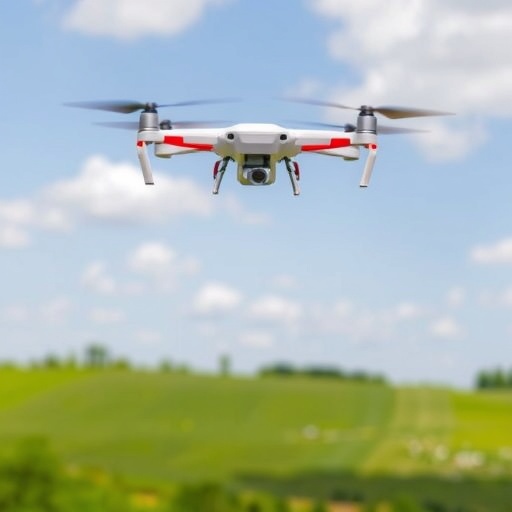
In the rapidly evolving landscape of telecommunications and network infrastructure, Unmanned Aerial Vehicles (UAVs) have emerged as pivotal players. Selim, M.M. delves into this frontier in his groundbreaking study published in Scientific Reports, exploring the intricate dynamics of UAV-assisted networks through the lens of stochastic geometry. This research presents a comprehensive analysis of how probabilistic activation patterns of UAVs can significantly influence network performance and connectivity.
One of the central themes of Selim’s work is the integration of UAVs into traditional network topologies. Traditionally static and bound by geographical constraints, modern communication networks are beginning to rely on the flexibility and mobility offered by aerial drones. The study meticulously examines how UAVs can be deployed to overcome physical barriers that often hinder signal propagation in dense urban environments. The implications of this technology pave the way for enhanced communication strategies that can dynamically adapt to changing environmental conditions.
At the heart of the research lies the mathematical framework of stochastic geometry. This approach enables the modeling of random spatial processes that dictate the behavior of UAV-assisted networks. By employing probabilistic models, the study allows for a nuanced understanding of how individual UAVs activate within a network. This activation can be influenced by several factors, including the UAV’s operational mandates, battery life, and environmental constraints, leading to varying connectivity and performance levels across the network.
The findings reveal that the probabilistic activation of UAVs can either bolster or hinder network efficiency. In scenarios where UAVs are selectively activated based on real-time data analytics, there is a marked improvement in the network’s overall performance. The paper emphasizes the importance of strategic deployment and activation of UAVs to maximize their utility. The interplay between UAVs and ground-based infrastructure is further emphasized, showing that coordinated efforts can lead to a significant enhancement in data transmission rates and reliability.
One of the intriguing aspects of this research is how it challenges traditional notions of network staticity. The adaptability of UAVs offers a dynamism previously unseen in conventional networks. Selim’s work highlights how networks can be designed to leverage this mobility, with UAVs dynamically adjusting their positions and operational statuses in response to fluctuating demand. This adaptability is crucial, especially in emergency situations where ground networks may be compromised.
Selim’s analysis also investigates the potential trade-offs associated with UAV deployment. While the advantages are significant—improved coverage, enhanced data rates, and flexibility—there are inherent challenges such as the management of UAV traffic and the coordination of multiple units to prevent overlaps or signal interference. The study meticulously calculates the optimal number of UAVs required for efficient operations, factoring in geographical data and user density, thus providing a blueprint for future implementations.
The implications of this research extend beyond theoretical models; practical applications can revolutionize industries ranging from disaster response to commercial delivery services. By deploying UAVs to deliver goods or services in remote areas where traditional vehicles cannot efficiently operate, we are not only enhancing accessibility but also potentially transforming logistics and supply chains. This vision aligns with global trends towards smarter cities and advanced technology integration into everyday life.
Selim also brings attention to the regulatory aspects surrounding UAV deployment. As these technologies become more ingrained in urban infrastructures, policymakers must grapple with the implications of their use. The work advocates for a proactive framework that balances innovation with safety and privacy concerns. Ensuring compliance with aviation laws while promoting technological advancement is essential for the sustainable growth of UAV services in urban landscapes.
Furthermore, the study opens avenues for future research directions. The increasing sophistication of UAV technology, including enhancements in artificial intelligence and machine learning, presents opportunities to refine network models further. By incorporating these advanced technologies, future studies could delve deeper into autonomous UAV operations, where machines make real-time decisions based on user behavior, environmental conditions, and network health.
The pioneering work by Selim is not merely an academic exercise; it is a clarion call for industries and researchers alike to embrace the potential of UAV-assisted networks. With the exponential growth of data consumption and the need for robust telecommunications, this research underlines the urgency of innovation in this domain. As cities grow and evolve, so too must our approaches to connectivity, and UAVs offer a promising solution.
In conclusion, Selim’s stochastic geometry analysis of UAV-assisted networks provides critical insights that could shape the future of telecommunications. By embracing this new paradigm of network design, there is immense potential for improved connectivity, efficiency, and resilience in the face of emerging challenges. As UAV technology continues to advance, fostering an environment of collaboration between researchers, urban planners, and policymakers will be vital for turning these theoretical findings into concrete realities that benefit society as a whole.
Selim, M.M. Stochastic geometry analysis of UAV-assisted networks with probabilistic UAV activation.
Sci Rep 15, 37356 (2025). https://doi.org/10.1038/s41598-025-21343-5
Cite Scienmag News
Denise Maddox. (October 28, 2025). Probabilistic UAV Activation in Stochastic Geometry Networks. Scienmag. https://scienmag.com/probabilistic-uav-activation-in-stochastic-geometry-networks/
Denise Maddox. "Probabilistic UAV Activation in Stochastic Geometry Networks." Scienmag, 28 October 2025, https://scienmag.com/probabilistic-uav-activation-in-stochastic-geometry-networks/. Accessed 4 September 2026.
Denise Maddox. "Probabilistic UAV Activation in Stochastic Geometry Networks." Scienmag. October 28, 2025. https://scienmag.com/probabilistic-uav-activation-in-stochastic-geometry-networks/


