


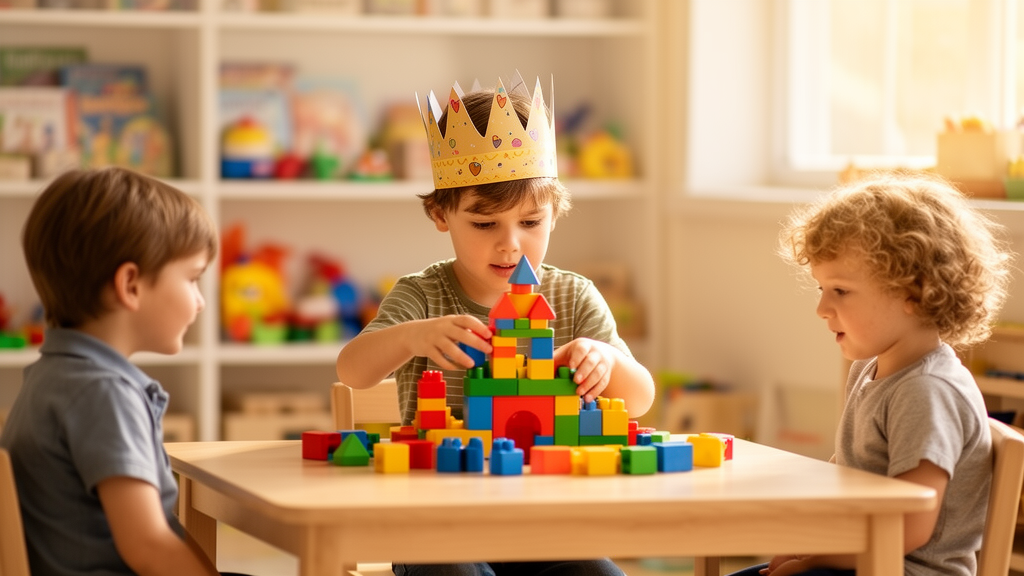
Thematic social role-play — the kind of pretend play in which preschool children take on roles such as doctor, chef, or firefighter within a shared imaginary situation — is not simply recreation, according to a new theoretical analysis published in Frontiers in Psychology. The article, a conceptual analysis grounded in Lev Vygotsky’s cultural-historical paradigm, argues that this form of play is the leading activity of the preschool years: the activity that drives psychological development and generates the creative imagination and symbolic thinking on which later school learning depends. The authors, Claudia Ximena González-Moreno of Pontificia Javeriana University in Bogotá and Yulia Solovieva of the Meritorious Autonomous University of Puebla and collaborating institutions, present their case as a theoretical synthesis rather than a new experimental study, and their central claims should be read in that light.
The analysis builds on Vygotsky’s famous dictum that play is the source of development and creates the zone of proximal development — the space in which a child can perform, with support, actions not yet possible alone. Within this framework, the authors position role-play as the activity that restructures the preschool child’s personality. When a child steps into a role, they argue, the child is compelled to follow the implicit rules of that role: the doctor must wait for patients, the cashier must collect payment, the waiter must take orders in sequence. In submitting to these rules voluntarily, the child’s behavior loses its spontaneous and immediate character, and impulsive action is transformed into self-regulated conduct.
A key mechanism in this transformation is symbolic substitution. When a child uses a wooden block as a telephone, a stick as a magic sword, or a pencil as a syringe, the child breaks the literal link to the object’s physical properties and acts instead on what the object represents in mind. The authors describe this as the seed of the symbolic function — the capacity to identify one thing through another — which they consider the cornerstone of creative imagination and the groundwork for abstract thought. According to their analysis, this function does not emerge automatically with age; it must be fostered through progressive stages, from material substitutes such as concrete objects, through perceptual means such as drawings and diagrams, to purely verbal means.
The article proposes that mature thematic role-play has a definable structure. It begins with a need and a motive — the enactment of a social role, which intrinsically requires a co-participant as a social anchor. It includes roles bound to cultural norms, a co-constructed plot or theme guiding sequences of verbal and non-verbal actions, and a symbolic component in which real objects are replaced by semiotic substitutes. Crucially, the authors argue that this kind of play cannot be a purely individual or free activity. Free play, they contend, lacks a stable motive, shifting constantly from object to object, whereas role-play acquires meaning only through interaction with another participant within a shared imaginary situation.
Adult guidance occupies a central place in the proposal. The authors describe a trajectory in which adult-guided orientation transforms initial, fragmented play behaviors into advanced, mature role-play characterized by reflective initiative, internal rules, and symbolic verbal actions. At first the child continues a dialogue proposed by the adult; later the child initiates dialogue, introduces new content, and sustains the play with peers. The adult’s role is distinguished sharply from direct control: rigid control, the authors argue, extinguishes a child’s autonomy, while guidance enriches play, validates emotions, and opens new avenues of exploration. Feedback should be precise, action-oriented, and delivered within an emotionally safe environment — for example, praising how a child checked a stuffed dog’s ears with a toy flashlight rather than offering vague praise or personal criticism.
To illustrate the model, the authors offer worked examples. In one, a teacher introduces a plush dog that is lost in an imaginary forest; children choose flexible roles such as search party, animal helpers, or comfort team, and the adult narrates while letting children make choices. In another, a Farm Rescue narrative begins with a letter describing animals trapped by a flood; children propose building a cardboard boat, assign themselves roles as captain, doctor, nurse, and rescuers, and use a cardboard circle as binoculars. The authors present these as illustrative anecdotes of how children bridge physical actions and verbal communication, not as controlled demonstrations of efficacy.
The analysis also traces developmental stages of play, from role-play with real objects, through play with object substitutes, to play marked by increased initiative and finally narrative role-play in which children jointly construct stories to solve problems. At the most mature stage, the authors propose, children coordinate actions through social negotiation, immerse themselves in roles, navigate implicit rules, and even experience conflicting emotions simultaneously — such as a child crying in the role of a patient while remaining happy as a participant — and consciously reflect on that state. Indicators of creative imagination include developing and detailing an idea within play and considering multiple perspectives to solve a play problem; indicators of symbolic thought include sequences of actions with substitute objects and creating imaginary situations through words alone.
From this synthesis, the authors advance a hypothesis with clear educational stakes: that a child’s readiness for formal school learning is a direct function of the semiotic and structural complexity of their thematic social role-play. The more intentional, collaborative, and creative the play, the stronger, they propose, the cognitive, volitional, and social foundations for subsequent academic success. They argue that preschool education should prioritize psychological development — voluntary behavior, reflective communication, imagination, empathy, and cognitive motivation — over early mastery of formal knowledge, and that play at this stage should take precedence over early academic instruction. Within Vygotsky’s framework, the principle of timeliness matters: children maximize their potential at each developmental stage, securing the groundwork for the next, rather than accelerating through it.
The authors contrast their cultural-historical account with views of play as biological instinct or purely individual activity. On their reading, children do not invent play dynamics from nothing; they recreate the activities and relationships of the adults in their culture. They also challenge the assumption that adults should never intervene in play for fear of corrupting creativity, arguing instead that mature, complex play is not achieved in isolation and that the adult expands the zone of proximal development by introducing manageable challenges a child could not navigate alone. They recommend that teachers receive continuous theoretical and methodological training, that families join children’s imaginary play at home without turning it into disguised lessons, and that educators treat structured, high-level role-play as a core developmental necessity rather than a leisure choice.
Because the article is a conceptual analysis, its claims rest on theoretical argument and the interpretation of prior research rather than on new empirical data, and the authors themselves frame the school-readiness relationship as a hypothesis. They acknowledge that implementing thematic role-play requires time, collaborative teamwork, and supportive environments involving parents, and they note that adults also appear to experience professional and personal growth when playing with children — a dimension they flag as a promising avenue for future research. For educators and parents, the article’s practical message is that the value of a toy lies not in its finished form but in the collaborative ability to assign it a new function — and that the imaginary worlds children build together may be doing quiet, structural work on the minds that build them.
Subject of Research: Theoretical analysis of thematic social role-play as the driver of creative imagination, symbolic thinking, and school readiness in preschool children
Article Title: The development of creative imagination and symbolic thinking through thematic social role-play activity
Article References: González-Moreno, C. X., & Solovieva, Y. (2026). The development of creative imagination and symbolic thinking through thematic social role-play activity. Frontiers in Psychology, 17, Article 1916508. https://doi.org/10.3389/fpsyg.2026.1916508
Image Credits: AI Generated
DOI: 10.3389/fpsyg.2026.1916508
Keywords: pretend play, preschool development, Vygotsky, symbolic thinking, creative imagination, school readiness, self-regulation, zone of proximal development, cultural-historical theory, role-play, early childhood education, child psychology
Cite Scienmag News
Glenn Wilkins. (October 26, 2026). Pretend Play With Rules May Build the Imagination Children Need for School. Scienmag. https://scienmag.com/pretend-play-with-rules-may-build-the-imagination-children-need-for-school/
Glenn Wilkins. "Pretend Play With Rules May Build the Imagination Children Need for School." Scienmag, 26 October 2026, https://scienmag.com/pretend-play-with-rules-may-build-the-imagination-children-need-for-school/. Accessed 26 October 2026.
Glenn Wilkins. "Pretend Play With Rules May Build the Imagination Children Need for School." Scienmag. October 26, 2026. https://scienmag.com/pretend-play-with-rules-may-build-the-imagination-children-need-for-school/


